

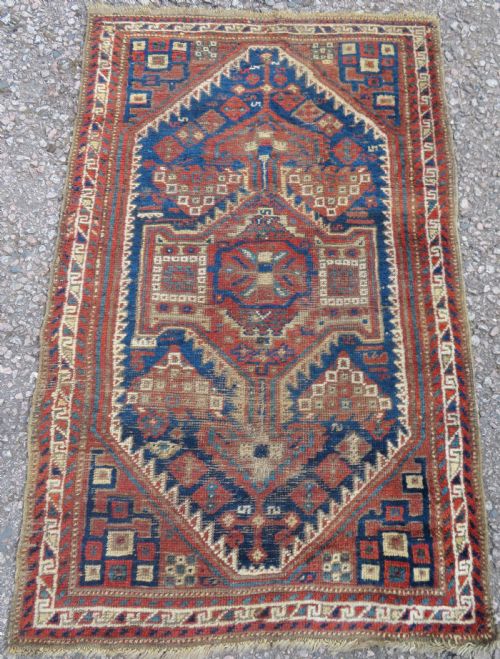
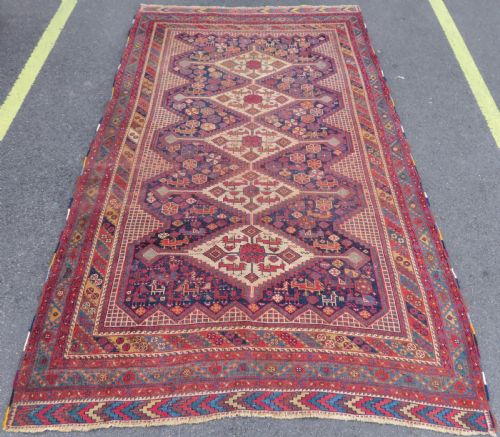


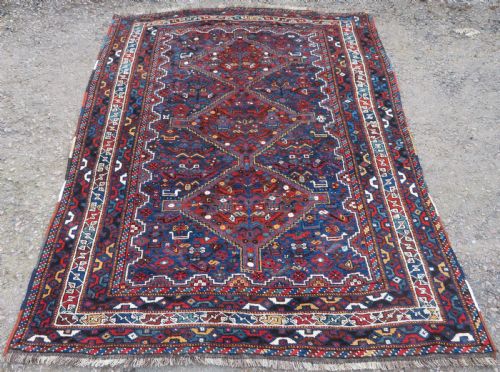


Persian Khamseh Rug
A persian khamseh rug brings the bold geometric motifs and rich natural palettes of southwestern nomadic confederacies directly into a room.
Persian Khamseh Rug
A persian khamseh rug originates from the confederation of nomadic and settled tribes in the Fars province of southwestern Persia. Weavers from groups such as the Baharlu, Arab, Basseri, and Shekarlu produced these floor coverings, often sharing stylistic traits with neighbouring Qashqai and Luri makers.
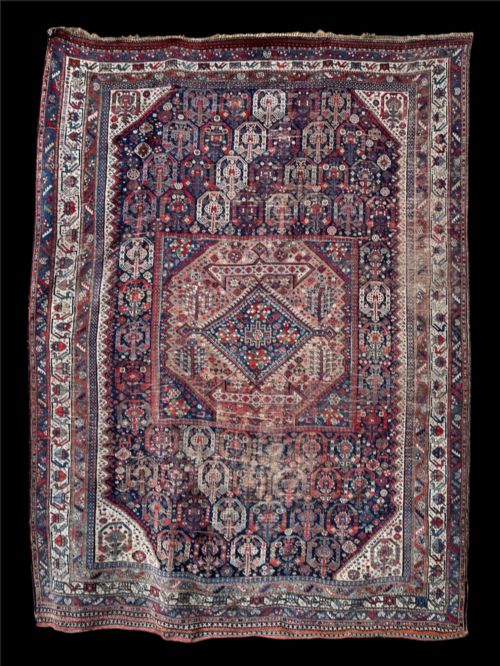
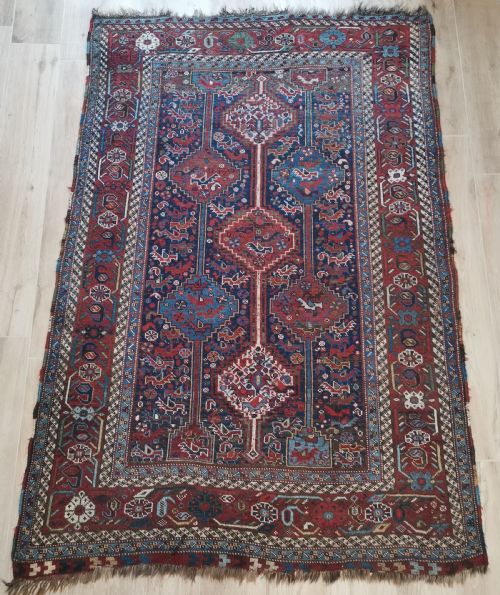
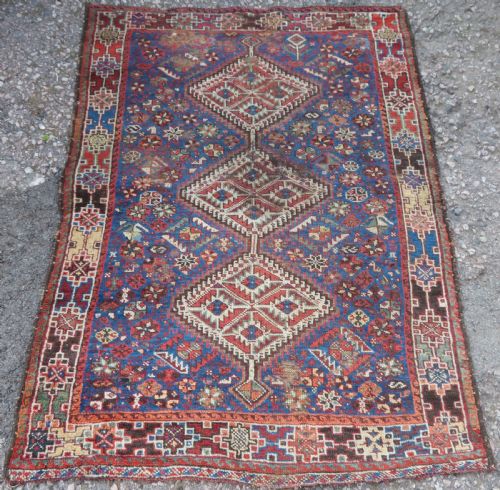
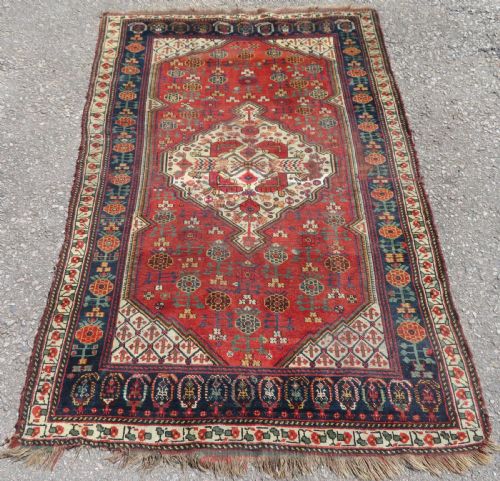
The format varies from full room-size carpets down to smaller area formats, scatter rugs, and utilitarian saddlebags known as khorjin. Field designs frequently incorporate repeating rows of boteh, tree of life motifs, stylised birds, and distinctive chicken or morghi patterns.
Dating primarily from the late nineteenth century and early twentieth century, these textiles reflect a distinct tribal identity shaped by pastoral life. The weave structure relies on a wool foundation, yielding pliable structures that sit well on modern floors.
Materials and Construction
The primary material used for both warp and weft is wool, often hand-spun to create varied texture and irregular absorption of colour. Cotton also appears in the foundations of certain pieces from later periods.
Natural dyes provide the underlying palette, producing deep indigos, madder reds, and earthy yellows that mellow gracefully over decades of light and wear. Hand-knotting techniques secure the pile firmly to the wool foundation, creating durable surfaces designed for nomadic utility.
Certain early carpets feature stylised chickens woven right into the field, proving that tribal weavers enjoyed a sense of humour.
Assessing Quality and Execution
Knot density and structural tightness dictate the crispness of geometric medallions and tribal motifs within the field. Finer execution allows complex borders, such as the Shekarlu pattern, to maintain precise proportions along the outer edges.
The depth and saturation of natural dye lots establish visual impact, while the integrity of the original selvedges and end finishes marks the survival level of an antique survivor. Uniform pile height and supple handle indicate balanced tension during the weaving process.
The Persian Khamseh Rug Glossary
- Khamseh
- A confederation of five distinct tribes in southwestern Persia whose weavers produced rugs known for bold tribal motifs and dark wool foundations. Their output frequently overlaps in style with neighbouring Qashqai groups.
- Boteh
- A stylised almond or paisley motif representing a floral spray or cypress tree, commonly repeated across the field of tribal carpets. This ancient symbol appears frequently in nineteenth-century southwestern Persian weaving.
- Khorjin
- A traditional double-sided saddlebag woven for transport on pack animals, often surviving today as a small face rug or complete bag. These smaller pieces demonstrate the same knotting and design vocabulary as large floor carpets.
- Warp
- The vertical threads stretched tightly on the loom that carry the structural weight of the rug. In these tribal pieces, wool is the predominant material for these foundational elements.
- Weft
- The horizontal threads passed between rows of knots to bind the structure together. Coloured wool or un-dyed yarns frequently make up these passes in nomadic production.
Persian Khamseh Rug: Frequently Asked Questions
What tribes made these rugs?
The Khamseh confederation brought together several distinct groups including the Baharlu, Arab, Basseri, and Shekarlu tribes living in the Fars province.
Weavers within these sub-tribes shared wool resources and designs, creating distinct regional aesthetics that also incorporated influences from neighbouring Qashqai and Luri populations.
How do I identify bird motifs?
Bird designs, often referred to locally as chicken or morghi patterns, appear as highly stylised avian figures arranged in vertical rows across the central field.
These depictions are typically geometric rather than naturalistic, integrated smoothly into the overall tribal geometry alongside floral sprays and hooked medallions.
Are these rugs suitable for high-traffic areas?
Hand-spun wool pile combined with sturdy wool foundations provides natural resilience against everyday foot traffic in domestic settings.
Placing a quality underlay beneath the textile prevents slipping and cushions the weave, helping to preserve the historic structure over time.
How do I care for an antique rug?
Regular gentle vacuuming without a rotating brush roll prevents dust and grit from settling deep into the wool pile of the carpet.
Professional specialist cleaning is recommended every few years to maintain the integrity of natural dyes and hand-spun fibres without introducing harsh chemicals.