
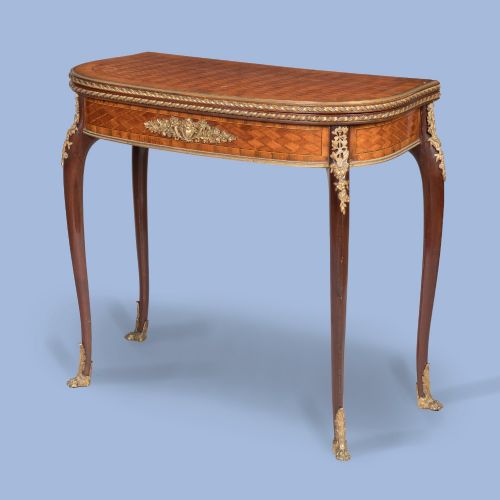


Parquetry Folding Table
A parquetry folding table brings geometric wood veneers and ingenious mechanisms together into a functional surface that stores away with ease.
Parquetry Folding Table
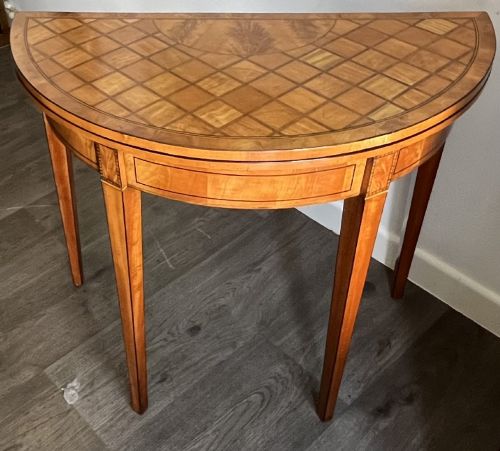
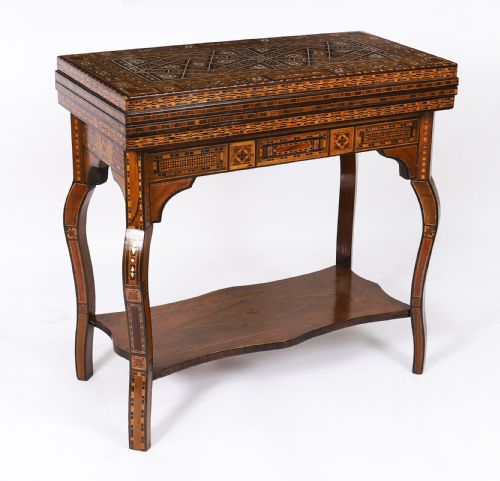
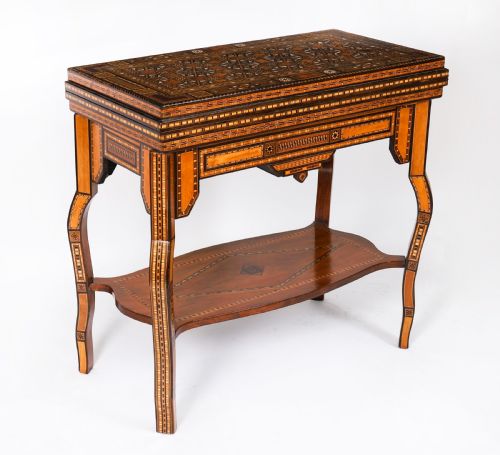
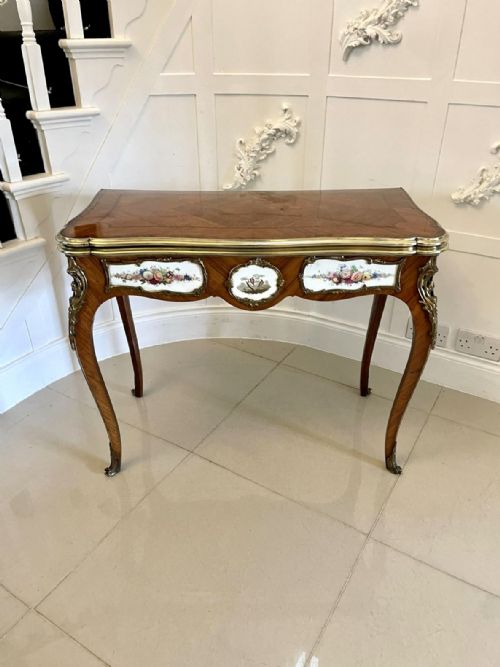
A parquetry folding table combines intricate geometric wood patterns with clever hinged or pivoting tops designed for cards, games, or tea. When you search for a parquetry folding table, you are looking at items primarily originating from the eighteenth, nineteenth, and early twentieth centuries. The versions most commonly encountered on this page take the form of card tables and games tables styled after French revivals like Louis XV and Louis XVI.
Many examples incorporate multi-functional surfaces, opening to reveal inlaid boards for chess and backgammon alongside standard card playing areas. The construction ranges from demilune consoles to rectangular silhouettes, frequently utilising rich timbers such as kingwood and walnut. These pieces served both decorative and social purposes in period drawing rooms, operating as centres for evening entertainment.
What separates the finest pieces
The standard of a parquetry folding table rests on the crispness of its wood geometry and the precision of the veneer cuts. Top-tier examples display flawless alignment in their parquetry across the fold, showing minimal gaps between the individual wooden tiles over time. The choice of timbers also dictates quality, with densely grained kingwood and richly figured walnut commanding greater regard.
The integration of metalwork marks another clear distinction between average and exceptional specimens. Finely chased ormolu mounts that fit snugly against the wooden contours indicate superior workshop production compared to generic cast brass fittings. Furthermore, the smoothness and stability of the folding or pivoting mechanism reveal the original joiner's skill.
Listings feature periods spanning from the eighteenth century through the 1930s, alongside materials including kingwood, ormolu, bone, and fruitwood.
G T Morant·François Linke·Maison Mottheau·Joseph-Emmanuel Zwiener·Morison of Edinburgh
The Parquetry Folding Table Glossary
- Parquetry
- A geometric mosaic of wood veneers arranged in decorative patterns such as cubes, lozenges, or herringbone. This technique decorates the folding tops and aprons of the tables.
- Ormolu
- Gilded bronze mounts applied to furniture edges and legs for decorative accent and protection. It appears frequently on French revival pieces.
- Kingwood
- A dense, richly figured tropical timber with dark violet-brown tones used extensively for high-end veneering. It forms the primary surface of many nineteenth-century examples.
- Demilune
- A half-moon shape characteristic of console and card tables designed to sit flat against a wall when folded. This silhouette was popular during the Louis XVI revival period.
- Sutherland table
- A narrow drop-leaf tea table with folding flaps supported by pivoting gatelegs. It represents a distinct form within the wider category of folding tables.
Parquetry Folding Table: Frequently Asked Questions
How do these tables open?
Most examples use a folding leaf top that hinges open to double the surface area, often supported by a swing leg or a pivoting mechanism built into the frame.
Some designs feature a top that rotates ninety degrees before opening, revealing a concealed compartment for cards and gaming pieces beneath the surface.
Were they used only for cards?
While the majority functioned as card tables for whist or hazard, many incorporated inlaid chess and backgammon boards beneath the primary folding lid.
Certain variations served dual purposes as tea tables or decorative console tables when left closed against the drawing room wall.
How do I spot a Louis XVI style table?
Louis XVI style pieces typically display straight tapered legs, often fluted, contrasting with the sweeping curves found on earlier Louis XV designs.
The ornamentation relies on classical symmetry, straight architectural lines, and restrained ormolu mounts rather than exuberant rococo asymmetry.
Why use kingwood for veneers?
Kingwood provided cabinetmakers with a heavy, durable timber featuring striking natural colour variations that lent themselves well to geometric parquetry.
Its dense grain allowed craftsmen to cut thin tiles that resisted warping and held a sharp edge when fitted into complex parquet designs.