


Parquetry Wood Card Table
These parquetry wood card table examples bring geometric timber work and folding surfaces together for formal entertaining.
Parquetry Wood Card Table
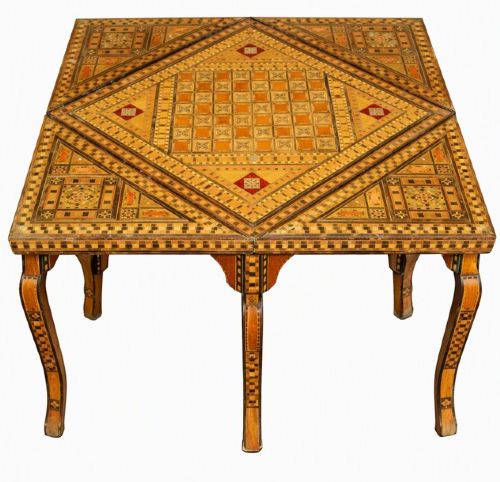
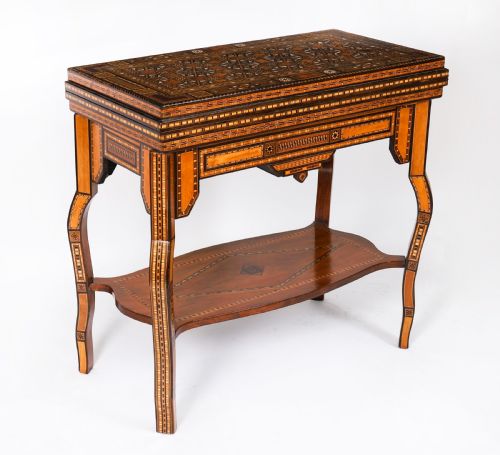
A parquetry wood card table serves as both a decorative centrepiece and a functional folding surface for games, drawing on traditions from the eighteenth century through to the twentieth century. These pieces appear in forms such as card tables, chess tables, backgammon boards, and general games tables.
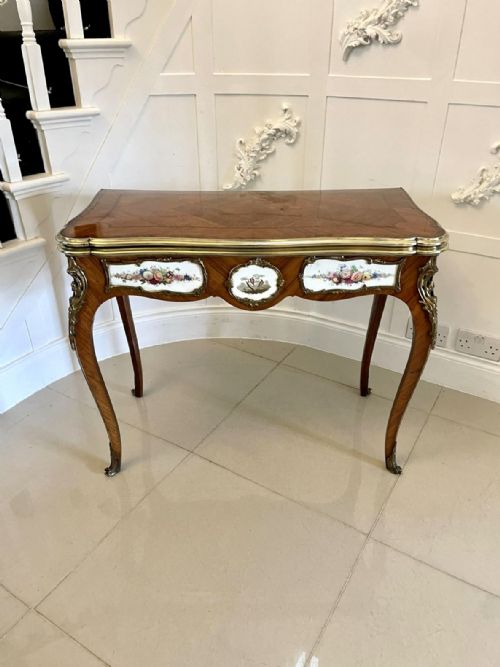
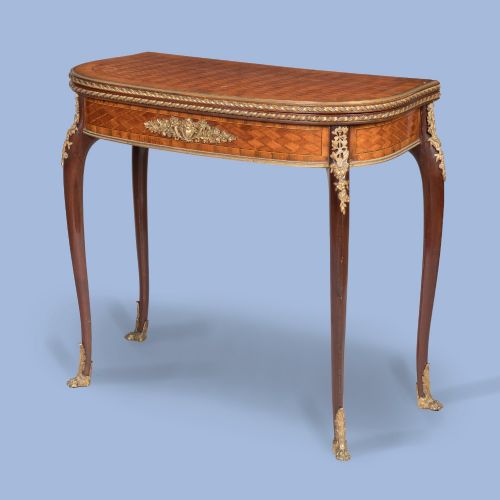
Most examples encountered on this page date from the nineteenth century, including Victorian pieces alongside French creations from the eighteen-eighties and eighteen-nineties. Revival aesthetics dominate the selection, with Louis XV Revival, Louis XVI Revival, and Louis XVI Style geometric surfaces predominating alongside Syrian Ottoman, Moorish Revival, and Georgian pieces.
The construction typically involves a timber framework that conceals a folding or rotating top designed to reveal a baize-lined interior or inlaid playing surface. Makers combined utility with display, ensuring the folded table sat flat against a wall when not in use during card evenings.
How they were made
Craftsmen applied precise geometric veneers of kingwood, walnut, mahogany, and satinwood onto structural carcases, arranging contrasting grains to create intricate optical patterns across the top. This timber work was frequently enhanced by the inclusion of bone and mother-of-pearl details embedded within the wooden design.
Mounts in ormolu and gilt bronze provide structural framing and decorative accents around the apron, legs, and corners, particularly on pieces influenced by French cabinet-making traditions. These metal elements were cast and chased before being fixed to the timber substrate to complement the parquetry patterns.
Materials recorded across the selection include kingwood, walnut, mahogany, satinwood, bone, mother-of-pearl, ormolu, and gilt bronze.
What varies in quality
The precision of the timber geometry and the choice of contrasting woods determine the visual impact of the surface, with tighter grain alignment separating finer examples from simpler work. The integration of bone and mother-of-pearl inlay adds another layer of execution that distinguishes workshop output.
The quality of the cast ormolu and gilt bronze mounts, alongside the robustness of the folding mechanism, dictates the overall standard of the piece. Tables bearing attribution to makers such as François Linke or G T Morant demonstrate superior bronze-chasing and structural joinery.
G T Morant·François Linke·Maison Mottheau·E Kahn
The Parquetry Wood Card Table Glossary
- Parquetry
- A geometric mosaic of wood veneers arranged in repeating patterns such as cubes, chequers, or diagonals to decorate furniture surfaces. It requires meticulous cutting and fitting of various timber species.
- Kingwood
- A dense, richly figured tropical timber with dark violet-brown and golden striping, frequently utilised in high-end cabinet-making. It provides strong visual contrast in geometric veneer layouts.
- Ormolu
- Gilded bronze applied as decorative mounts, feet, and edge trim on fine furniture. The technique involves coating cast bronze with a mercury-gold amalgam and firing.
- Louis XVI Style
- A neoclassical design aesthetic characterised by straight lines, symmetry, fluted legs, and classical motifs. It influences many nineteenth-century French games tables on this page.
- Console Table
- A wall table designed to be fixed or placed against a vertical surface, often sharing proportions with folding game furniture. These items functioned as display surfaces when closed.
Parquetry Wood Card Table: Frequently Asked Questions
What is a parquetry wood card table?
A parquetry wood card table is a folding or pivoting furniture piece featuring geometric wood veneer patterns on the top surface. These tables were designed for card games and social gatherings.
Over the centuries, cabinet-makers adapted the form through various revivals, incorporating timbers such as kingwood and walnut alongside gilt bronze mounts.
How were parquetry card tables used?
These tables stood against a drawing room wall as decorative side furniture when closed. When guests arrived, the top folded or swung open to reveal a baize-covered playing surface.
Many examples accommodated multiple pastimes, incorporating inlaid chess or backgammon boards alongside card playing areas.
How do I identify Louis XVI style pieces?
Louis XVI style parquetry wood card tables typically display straight lines, geometric symmetry, and tapering fluted legs rather than the curved cabriole lines of earlier periods. Ormolu mounts on these pieces often feature classical motifs.
Date markers for these revival pieces generally point towards the late nineteenth century.
What materials are used in these tables?
The primary structure relies on cabinet timbers such as mahogany, walnut, kingwood, and satinwood arranged in parquetry patterns. Details in bone and mother-of-pearl frequently accent the wooden designs.
Metal components typically consist of cast ormolu and gilt bronze framing the edges and legs.