
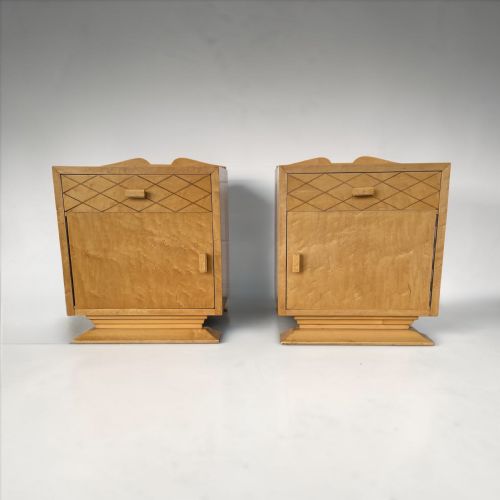


Pair Swedish Nightstands
Pair swedish nightstands bring painted charm and practical storage to a bedroom.
Pair Swedish Nightstands
These pair swedish nightstands encompass bedside tables, bedside cabinets, bedside cupboards, and commodes. You will frequently meet painted or white nineteenth-century chests of drawers alongside satin birch pieces.
The selections span the nineteenth century, nineteen twenty, nineteen thirty, and eighteen ninety. Styles include Gustavian, Scandinavian country, Scandinavian art deco, and Swedish Biedermeier.
Forms range from simple side tables and two-drawer commodes to marble-topped bedside cabinets. Each pair provides matched bedside storage rooted in Scandinavian tradition.
How they were made
Carpenters utilised solid pine, birch veneer, solid birch, and satin birch for the carcases. Ebonised wood and brass details appear alongside marble and faux marble tops.
Surfaces received hand-painted finishes, often in white or traditional tones. Construction relies on timber craftsmanship suited to nineteenth-century and early twentieth-century workshops.
Current listings span four distinct periods, incorporating materials from solid birch and satin birch to brass and marble.
What varies in quality
Quality rests in the precision of the timber work and the integrity of the painted or polished surfaces. Faux marble and genuine marble tops distinguish utility pieces from finer cabinets.
The refinement of period stylistic details, such as Gustavian influence or art deco lines, dictates the distinction between standard country pieces and high-end examples.
The Pair Swedish Nightstands Glossary
- Gustavian
- A Swedish neoclassical style originating in the late eighteenth century, characterised by restraint and symmetry. It heavily influences nineteenth-century pieces.
- Commode
- A decorative chest of drawers or cabinet with doors and drawers. These provide enclosed bedside storage.
- Satin Birch
- A pale hardwood with a lustrous, grain appearance used for fine cabinet-making. It appears on nineteenth-century tables.
- Ebonised Wood
- Timber treated to resemble ebony, creating dark contrasting details. This finish highlights structural lines.
Pair Swedish Nightstands: Frequently Asked Questions
What periods do these pieces span?
The listings include items from the nineteenth century, eighteen ninety, nineteen twenty, and nineteen thirty.
These dates cover transitional phases from traditional painted furniture to art deco design.
Which materials are most common?
Pine, paint, birch veneer, solid birch, and satin birch dominate the construction. Marble and faux marble also feature on top surfaces.
Brass accents and ebonised wood appear on specific design variants.
How were these nightstands used?
They served beside beds for private storage and lighting support in Scandinavian homes. Commodes and cupboards kept personal belongings concealed.
Side tables provided open surfaces for nighttime essentials.
What styles should I expect?
Styles range from Scandinavian country and Gustavian to Swedish Biedermeier and Scandinavian art deco. Nineteenth-century painted pieces offer a traditional aesthetic.
Art deco examples bring twentieth-century geometric forms to the bedroom.