
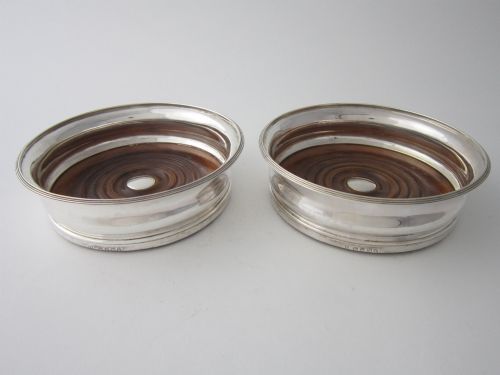
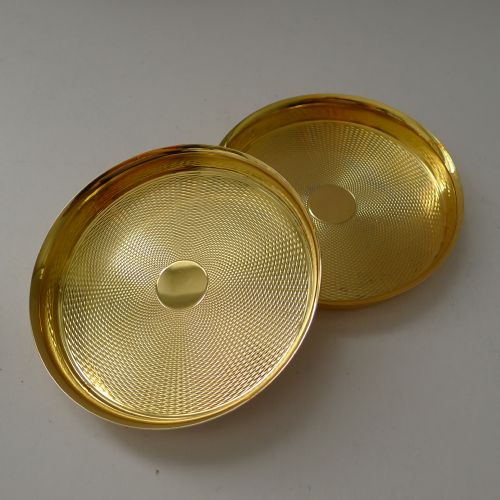
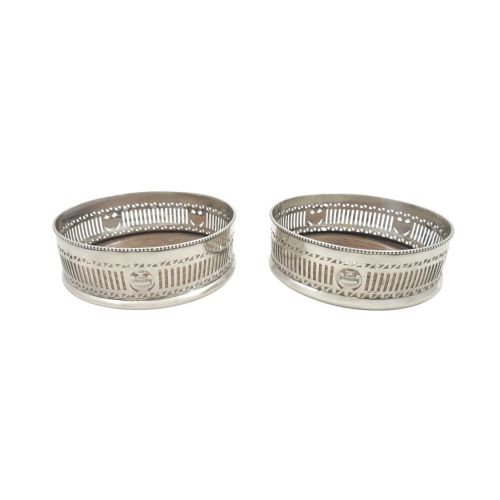
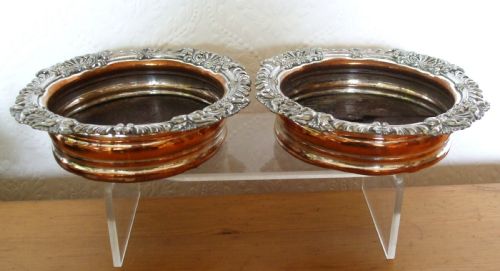


Pair Silver Bottle Coasters
These pair silver bottle coasters protect the dining table whilst passing wine with old English weight and polish.
Pair Silver Bottle Coasters
A pair silver bottle coasters provides a matching set of low circular stands designed to hold wine bottles or decanters safely on the dining table. Most examples seen across the listings span the Georgian, Victorian, and Edwardian eras, with later twentieth-century interpretations also appearing.
The dominant construction pairs precious metal walls with turned timber bases, often mahogany or oak, which protect the furniture and cushion the glass base. Collectors encounter both solid sterling silver and various grades of silver plate, including Old Sheffield Plate and mid-century plate.
Materials and Construction
Silversmiths formed the gallery walls by piercing, embossing, or casting sheet metal into repeating classical or floral motifs, then soldered the decorative borders to heavy turned wooden bases. Old Sheffield Plate examples utilised a sandwich of silver fused to a copper core, often revealing a thin copper line along the cut edges.
Makers integrated green baize or felt beneath the timber base to ensure smooth gliding across polished mahogany dining tables during after-dinner port circulation.
Listings feature traditional materials including sterling silver, Old Sheffield Plate, copper, mahogany, and oak across Georgian and Victorian periods.
Judging Quality and Execution
Quality rests in the crispness of the pierced gallery work, the weight of the metal, and the density of the turned wooden insert. Superior examples retain their original silver assay marks or crisp silver-plating without base metal bleed through, alongside heavy timber bases that provide a reassuring heft in the hand.
The finesse of applied wire rims and the clarity of engraved armorial crests or family crests further distinguish workshop output, separating standard production pieces from bespoke commissions.
Matthew Boulton·John and Thomas Settle·William Allen·Mappin and Webb·Elkington and Mason·Hermes Paris
The Pair Silver Bottle Coasters Glossary
- Old Sheffield Plate
- An early fusing technique where a thin sheet of sterling silver is fused to a thicker copper ingot before rolling.
- Gallery
- The decorative upright rim surrounding the perimeter of the coaster, frequently pierced or fret-cut.
- Baize
- The thick woven wool fabric glued to the underside of the wooden base to protect dining tables.
- Armorial
- An engraved coat of arms or crest denoting the original family ownership of the piece.
- Turned base
- A wooden insert shaped on a lathe, often featuring a central silver button or boss.
Pair Silver Bottle Coasters: Frequently Asked Questions
What is the purpose of pair silver bottle coasters?
These pieces were designed to contain condensation rings and drips from wine bottles while allowing guests to slide the bottle smoothly across the mahogany dining table.
The raised gallery walls kept tall decanters secure during the traditional circulation of port and claret after dinner.
How do I distinguish Old Sheffield Plate from later silver plate?
Old Sheffield Plate involves fusing silver to a copper base, which often shows a subtle line of copper along the cut rims or worn high points where the silver thins.
Later nineteenth-century electroplating techniques deposited a uniform silver layer over a nickel-copper alloy, lacking the distinctive laminated edge.
Why do some coasters have wooden bases instead of silver?
The turned wooden insert provides structural rigidity and weight while incorporating a soft baize lining underneath to prevent scratching polished furniture surfaces.
Timber also offered a quieter resting surface for heavy glass decanters when placed back onto the dining table.
How should I clean tarnished silver bottle coasters?
Use a gentle, non-abrasive silver cream applied with a soft cloth to lift tarnish without wearing down delicate pierced details or thin plating layers.
Avoid submerging wooden bases in water, as moisture can warp the timber and ruin the green baize lining on the underside.