
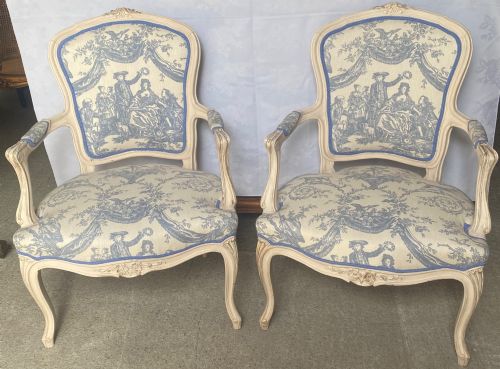
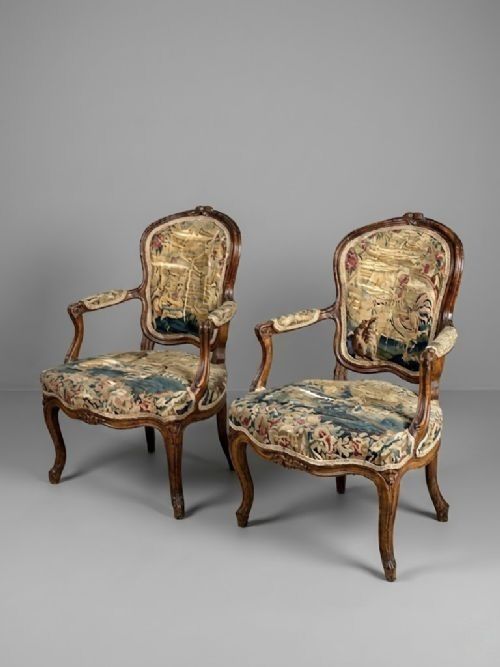
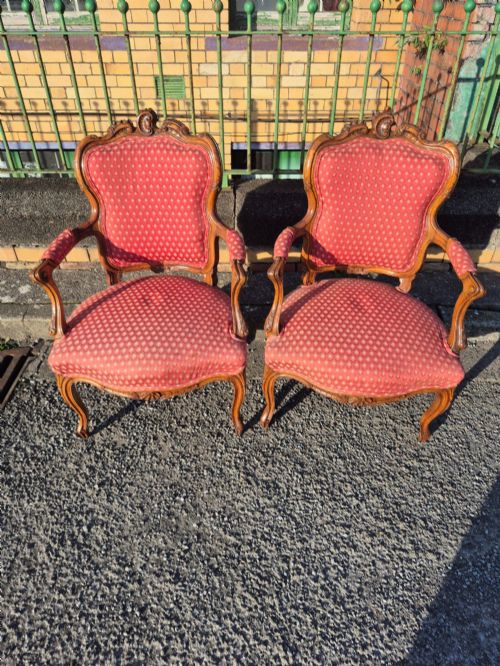
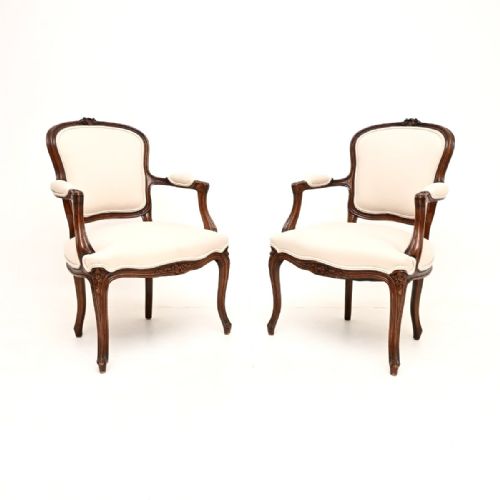
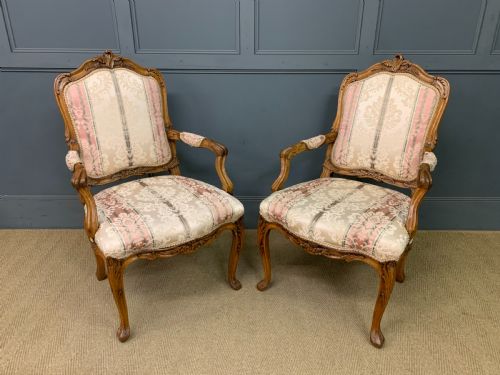
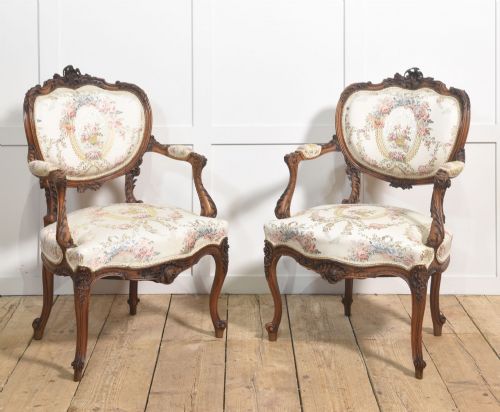
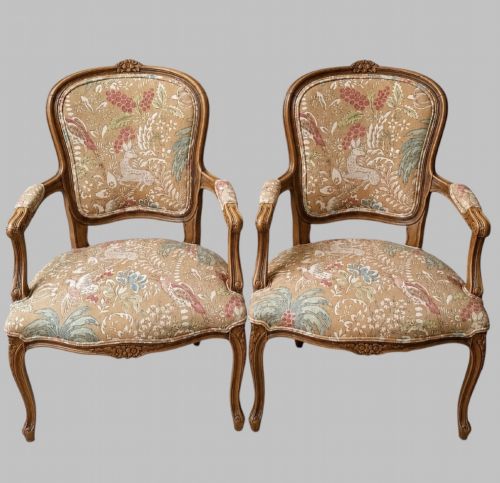
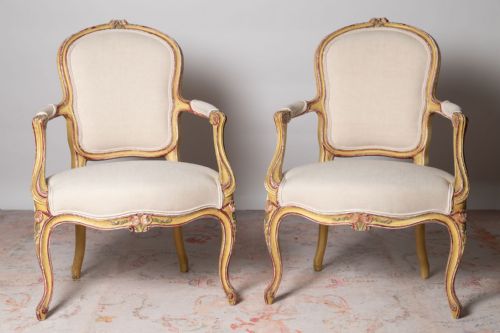
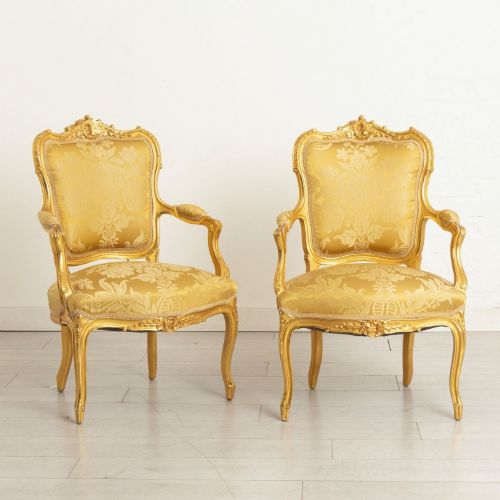


Pair Rococo Fauteuils
These pair rococo fauteuils bring unmistakable French and Italian style to a room, offering open arms and carved frames for formal seating.
Pair Rococo Fauteuils
A pair rococo fauteuils consists of matched open-armed chairs designed for the salon or drawing room, emerging in origin from eighteenth-century Italy and France before being reinterpreted across the nineteenth and twentieth centuries. Buyers encounter numerous nineteenth-century French revival examples alongside eighteenth-century originals and later twentieth-century painted interpretations.
The form relies on a distinct upholstered back and seat framed in exposed timber, resting on cabriole legs with carved detail. These seats function as matching pairs for symmetrical placement in a drawing room or formal salon.
Materials and construction
Frames are constructed from solid timbers including walnut, beech, mahogany and rosewood, shaped through curvilinear carving. Many examples receive a surface of giltwood, gesso, silver gilt or paint to enrich the carved ornament.
Upholstery uses traditional stuffing methods finished in fabrics such as silk, velvet, needlework or modern textiles. The wood is worked by hand to create the characteristic asymmetrical scrolls and floral motifs of the style.
Listings span from the 18th century through to the 1930s, featuring walnut, beech, giltwood and painted finishes.
Assessing quality in the seating
The distinction between ordinary and superior pieces rests in the crispness and depth of the wood carving. Fine examples display sharply defined asymmetry and fluid lines worked directly into the timber or gesso, rather than soft or cast ornamentation.
Proportion and scale dictate the visual weight of the seating, with superior frames maintaining harmonious curves and balanced construction across both chairs in the matching pair.
The Pair Rococo Fauteuils Glossary
- Fauteuil
- An open-armed upholstered armchair originating in France. The wooden frame remains visible around the back and seat.
- Giltwood
- Timber coated with a thin layer of gold leaf over gesso or size. This finish creates a reflective and decorative surface.
- Cabriole
- A furniture leg that bends outward and then tapers inward. It mimics the shape of an animal's leg.
- Gesso
- A plaster mixture applied to wood surfaces as a base for gilding or painting. It allows intricate relief work to be formed.
- Rococo
- An artistic style characterised by ornate curves, scrollwork and asymmetry. It developed in France during the eighteenth century.
Pair Rococo Fauteuils: Frequently Asked Questions
How do I use pair rococo fauteuils in a modern room?
Place the matching chairs opposite a sofa or beside a fireplace to create a balanced seating arrangement. Their open arms keep the floor plan feeling light despite the ornate carving.
Combine them with plain walls and simple furniture to let the curved frames and gilt or painted surfaces stand out as focal points.
Are these chairs comfortable for daily sitting?
The upholstered seat and angled back provide a supportive sit suited for conversation and reading. The open arm design accommodates various sitting postures.
Original webbing and padding may feel firmer or softer depending on when the upholstery was last restored.
How can I tell an eighteenth century chair from a nineteenth century revival?
Examine the tool marks and the timber ageing beneath the finish. Eighteenth-century pieces show hand-cut joinery and period-specific wear patterns on the bare wood.
Revival pieces from the nineteenth or twentieth centuries often utilise machine-sawn elements and standardised joinery methods typical of later manufacturing.
What is the difference between giltwood and painted finishes?
Giltwood involves applying metallic leaf over a prepared surface to create a bright, reflective sheen. Painted finishes use pigmented coatings, often in muted tones with subtle accent lines.
Both finishes were utilised across different periods to complement the carved wooden frames of the seating.