
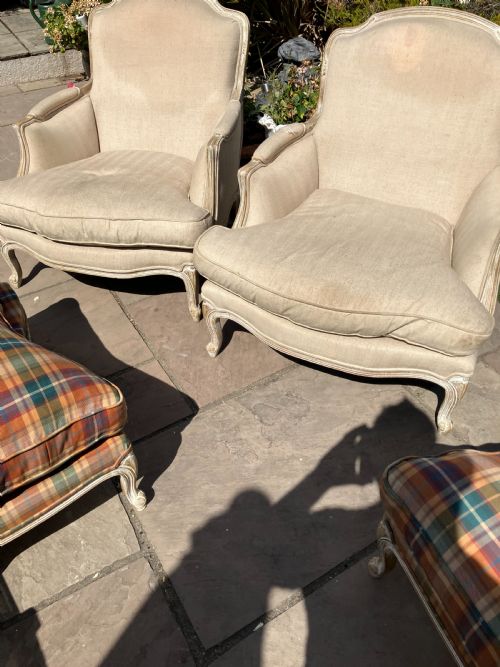
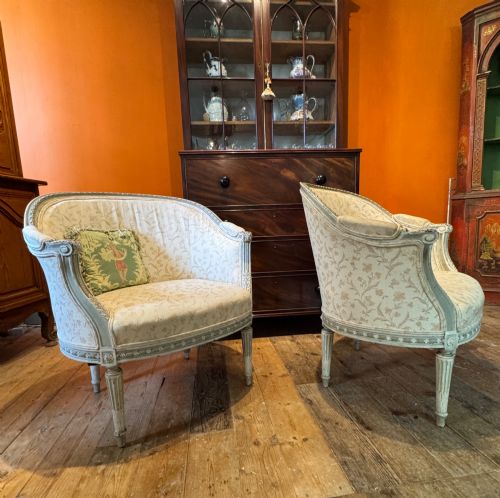
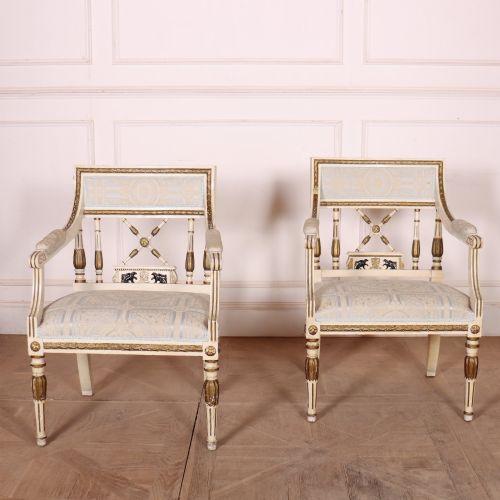
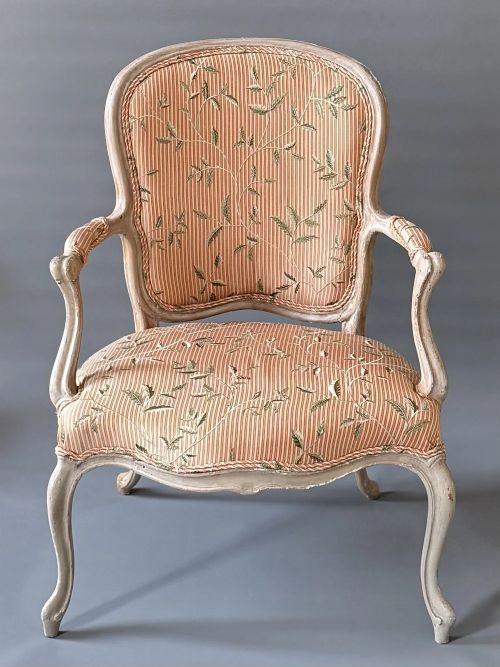
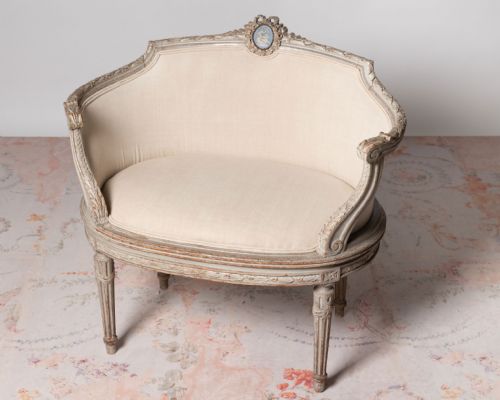


Cream Painted Armchairs
Cream painted armchairs bring classical elegance and tactile warmth to a room through centuries of European design traditions.
Defining Cream Painted Armchairs
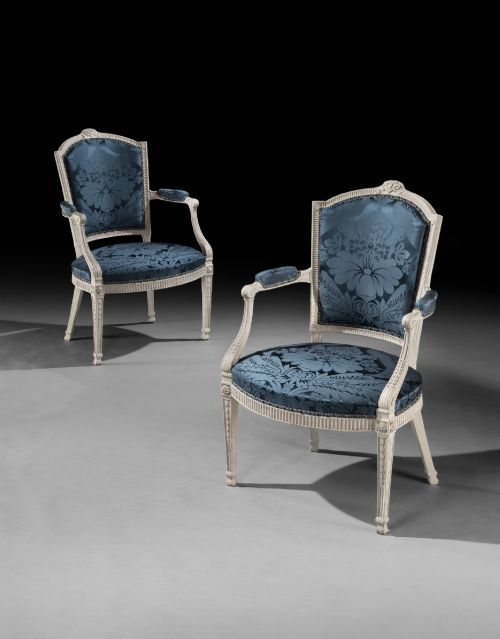
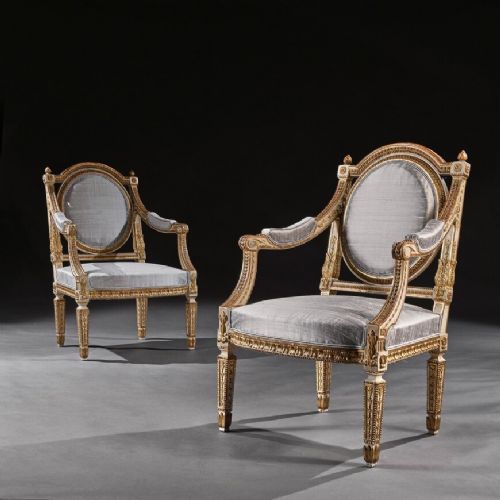
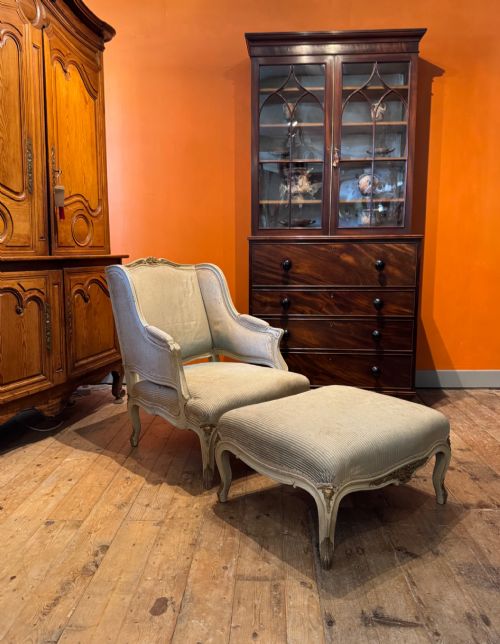
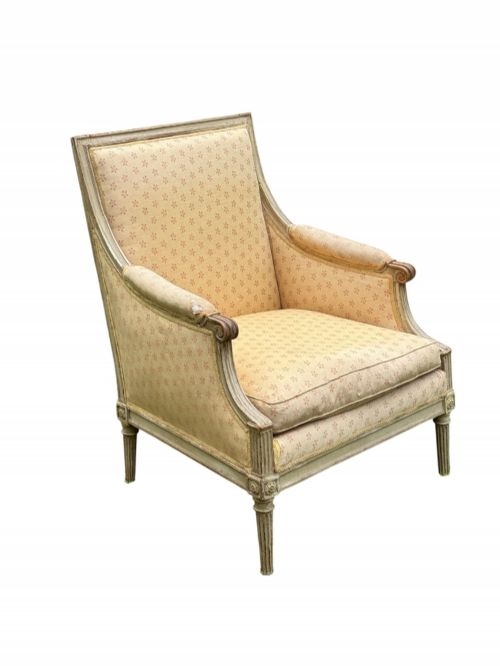
Cream painted armchairs span multiple periods from the eighteenth century through the twentieth century, bringing distinct regional interpretations to a room. Buyers searching for cream painted armchairs encounter pairs originating from Swedish, French, Italian, and English workshops.
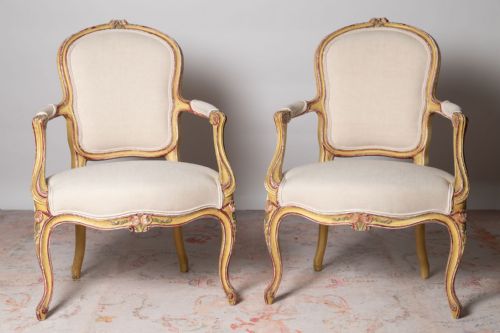
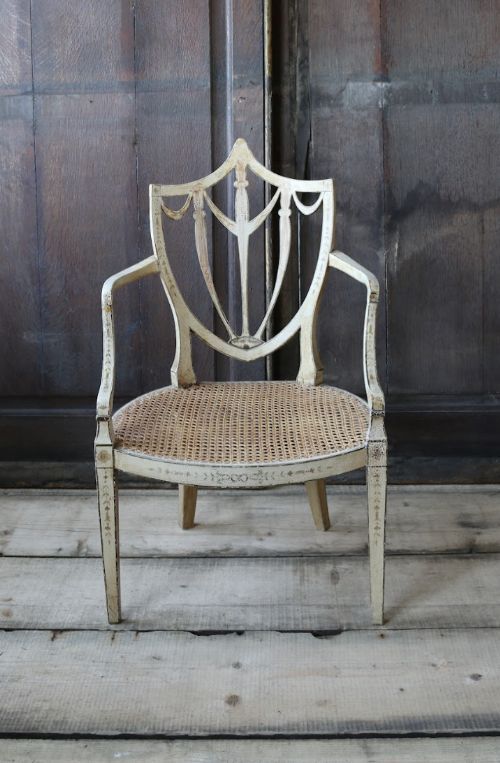
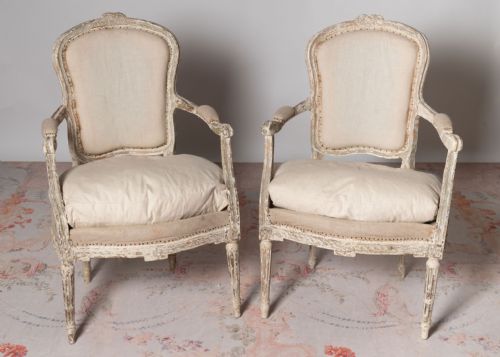
The selections on this page feature iconic styles including George III neoclassical, Regency, Swedish Empire, Louis XV revival, and French Directoire. These seating options appear in configurations primarily dominated by matching pairs rather than single chairs.
Materials and Construction
Craftsmen built these armchairs using sturdy timber foundations, applying paint finishes directly to the wood to achieve soft cream aesthetics. Giltwood accents occasionally highlight carved details, while brass tacks secure upholstery edges firmly.
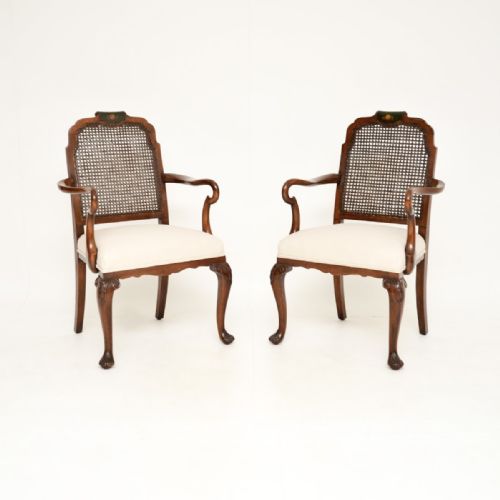
Seating surfaces incorporate diverse textures ranging from traditional cane panels to woven fabric and needlework. Damask fabric provides a plush finish on upholstered cushions and backrests, complementing the painted wooden frames.
Retail Price Guide 2026
Typical UK retail prices for cream painted armchairs, calculated from the Sellingantiques database of over a million retail prices indexed since 2003. This retail price guide relies exclusively on Sellingantiques data; no external sources or auction records are used, so the figures do not describe the wider market.
Early twentieth-century craftsmen clearly loved a good French revival, eagerly painting sturdy timber to look like chateau heirlooms.
Judging Quality and Craftsmanship
Superior quality rests in the crispness of carved wooden details and the harmonious execution of the painted finish over timber. The integration of period-appropriate textiles, such as fine needlework or damask fabric, elevates an armchair significantly.
Structural integrity of the frame and the preservation of original cane or giltwood elements distinguish exceptional pieces from ordinary reproductions. The refinement of stylistic proportions, whether in a Swedish Empire or a Louis XV revival form, dictates the piece's overall standing.
The Cream Painted Armchairs Glossary
- Bergere
- An enclosed upholstered armchair with wooden framing exposed around the padded back and sides. These pieces often feature cane panels on the exterior.
- Giltwood
- Timber treated with gold leaf or gold paint to highlight decorative carvings and mouldings. This technique adds luminous contrast to painted chair frames.
- Neoclassical
- A style drawing inspiration from classical antiquity, characterised by symmetrical lines and restrained ornamentation. It appears prominently in George III designs.
- Needlework
- Hand-stitched textile art utilising yarn on canvas, frequently applied to seat covers and backrests. It introduces intricate patterns and varied colour palettes.
- Directoire
- A transitional French design period bridging Louis XVI and Empire styles, marked by simplified classical motifs. Chairs from this era display understated elegance.
Frequently Asked Questions
What periods do these armchairs come from?
The inventory encompasses pieces originating from the eighteenth century, the Regency era, and the nineteenth century. Twentieth-century examples from decades like 1910, 1920, and 1930 also feature strongly.
Many of these later twentieth-century pieces adopt revival styles, faithfully replicating earlier eighteenth-century French and Swedish aesthetics.
Are these chairs sold individually?
The selection on this page consists predominantly of matched pairs rather than single seating items. Buying in pairs ensures visual symmetry for interior spaces.
Pairs appear across various styles, including Swedish Empire, George III, and Louis XV revival designs.
What materials are used for upholstery?
Upholstery materials vary from woven fabric and damask to intricate hand-stitched needlework. Some models also incorporate woven cane panels on the backrests and sides.
Brass tacks frequently secure these textile elements to the painted wooden framework.
How do I identify a revival style?
Revival pieces replicate the architectural lines and decorative motifs of earlier historical periods, such as the court styles of Louis XV. Makers in the twentieth century utilised these historical templates.
Examining the construction methods, wear patterns, and timber characteristics helps distinguish a revival piece from an original eighteenth-century antique.
Where were these chair styles developed?
Design origins span across several European countries, with notable contributions from French, Swedish, Italian, and English workshops. Each region imparted distinct regional characteristics to the frames.
French ateliers favored ornate curves, while Swedish makers leaned towards brighter, restrained neoclassical interpretations.