
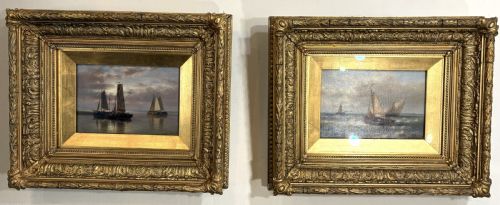


Pair of Coastal Paintings
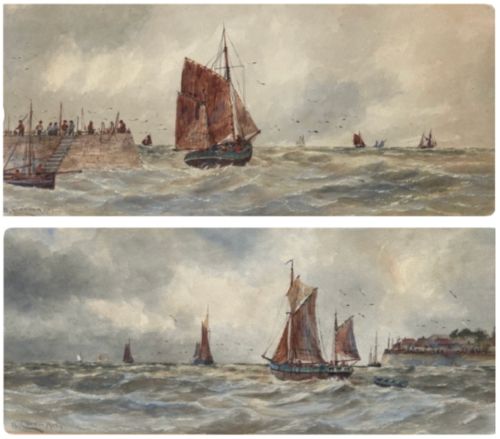
These pair of coastal paintings capture marine views across the nineteenth and early twentieth centuries, offering buyers matching scenes of shores, shipping, and fishing boats.
Pair of Coastal Paintings
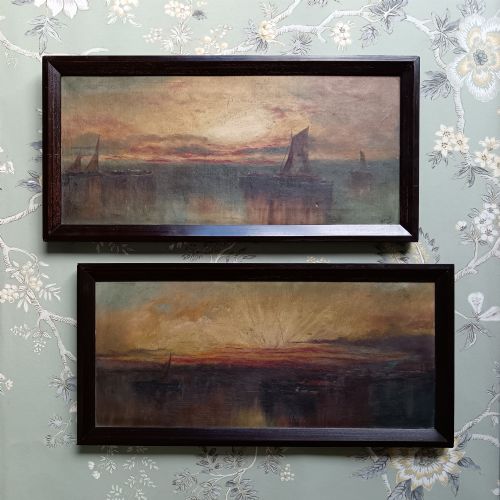
A pair of coastal paintings delivers balanced marine views, most often depicting paired subjects such as sunrise and sunset or matching shoreline harbours. These matching works originate primarily from the nineteenth century and the Edwardian era, spanning Victorian marine art and early twentieth-century British and continental seyscapes.
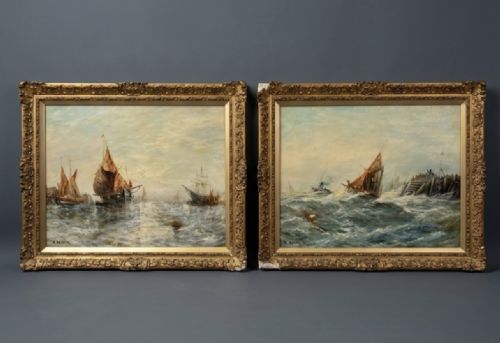
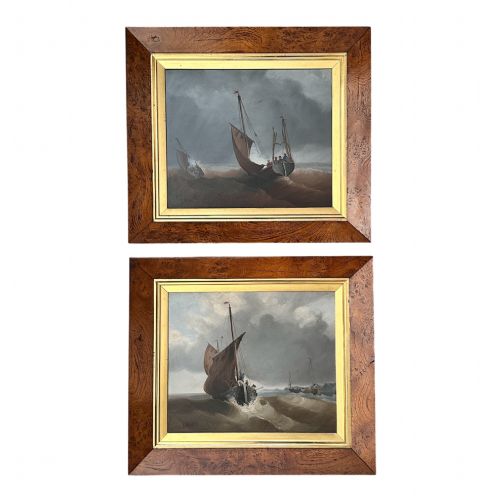
Buyers encounter oil paintings on canvas or board alongside watercolour paintings on paper, frequently housed within period gilt wood, gesso, or ebonised frames. Subjects range from local fishing boats on British rivers and Dutch shores to broad maritime scenes and Mediterranean views of Naples.
Works appear either unsigned or attributed to known artists of the period, offering matched compositions designed to hang together as a pair on domestic walls.
Materials and technique
Painters utilised oil paint on canvas, wood panels, or gouache and watercolour on paper, applying pigment to capture the shifting light of sea and sky. Canvas supports were stretched over wooden frames, while watercolours were mounted behind glass on paper.
Frames play a structural and aesthetic role, constructed from wood finished with gesso and gilt leaf or ebonised surfaces. These frames complete the presentation of the paired artworks.
Artists frequently paired calm morning harbours with dramatic evening sunsets so owners could experience two tides in one sitting.
Variations in quality
Quality rests in the precision of the brushwork and the harmony between the two paired compositions, particularly how the artist handles atmospheric light and maritime detail. Finer works display controlled handling of water, shipping vessels, and coastal topography rather than formulaic repetition.
The survival of original gilt wood or gesso frames significantly influences the integrity of the pair, as matching period framing preserves the intended visual balance of the artworks.
William Cannon·B Nash·John Moore of Ipswich·Abraham Hulk I·Gustave De Bréanski·Pieter Cornelis Dommersen·Adrian Van Porten·George Dodgson Callow·Robert Buchan Nisbet·Leslie Rackham·Thomas Bush Hardy·Hubert Thornley·John James Wilson·John W Morris·Walter Meegan·Thomas Rose Miles·John Mc Ghie·Walter Williams
The Pair of Coastal Paintings Glossary
- Gesso
- A plaster-like mixture applied to wooden frame mouldings as a base for gilding. It provides a smooth surface for decorative relief work.
- Giltwood
- Wood that has been coated with thin layers of gold leaf. This finish defines many traditional Victorian picture frames.
- Marine art
- Artwork that depicts or draws its main inspiration from the sea, ships, and coastal views. This genre includes both calm harbours and stormy seas.
- Watercolour
- A painting method in which the paints are made of pigments suspended in a water-based solution. Works on paper require protection behind glass.
Pair of Coastal Paintings: Frequently Asked Questions
How should I hang a pair of coastal paintings?
Display the two pictures at eye level with a small, uniform gap between them to maintain their visual balance. Matching frames allow the pair to anchor a wall together.
Ensure they hang away from direct sunlight and damp conditions to protect the canvas, paper, and gilt frames over time.
What subjects appear in these marine paintings?
Artists typically recorded fishing boats, shipping vessels, harbours, and coastal cliffs under various weather conditions. Paired scenes often contrast sunrise with sunset or calm waters with active shipping.
Locations range from British shores and Dutch coastlines to Mediterranean views of Naples.
How do I identify the period of the frames?
Nineteenth and early twentieth-century frames use wood and gesso construction finished with hand-applied gilding or ebonising. Corner ornaments and moulding profiles help confirm period authenticity.
Original frames show natural ageing and wear consistent with their age, matching the era of the paintings inside them.
What is the difference between oil and watercolour pairs?
Oil paintings utilise pigment bound in oil on canvas or board, presenting a textured surface that does not require glass. Watercolours use pigment on paper and need glass protection against moisture.
Both mediums were frequently paired by artists to create balanced decorative statements for domestic interiors.