


Pair Japanese Cloisonne
A pair japanese cloisonne offers matching symmetry in vitreous enamel work, bringing balanced historical craft into a room.
Pair Japanese Cloisonne
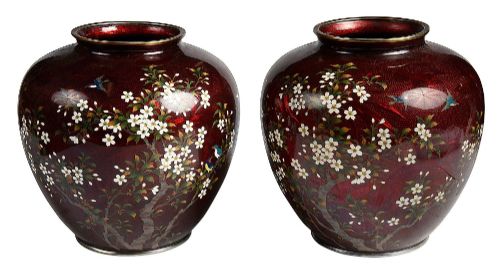
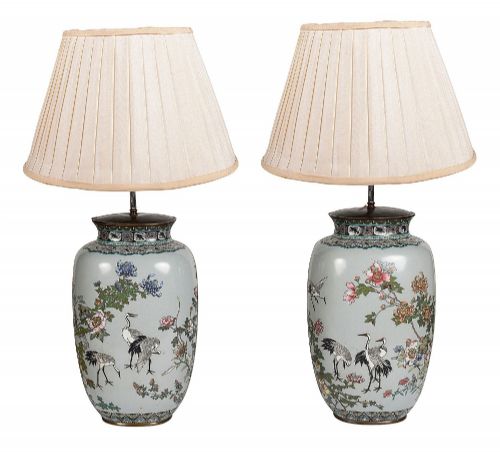
When searching for pair japanese cloisonne, collectors encounter matched sets of vessels, plates, and lamps created in the nineteenth and early twentieth centuries. The selection spans standard decorative vases and ginger jars alongside large palace pieces and wall chargers.
Most examples originate from the Meiji period, reflecting a time of intense technical refinement in Japanese metalwork and enamel. Pieces range from miniature cabinet items to monumental floor-standing lamps adapted from earlier vessels.
Materials and construction
The foundation rests on a metal body formed from copper or brass, onto which flat wires of silver, gold, or base metals are soldered to map out the decorative design. These thin metal ribbons create tiny cellular compartments known as cloisons.
Enamel paste is packed into the cells and fired repeatedly in a kiln until vitrified, then ground smooth and polished to a lustrous finish. Variations include silver foil underlays and porcelain or ceramic body bases beneath the cloisonne layer.
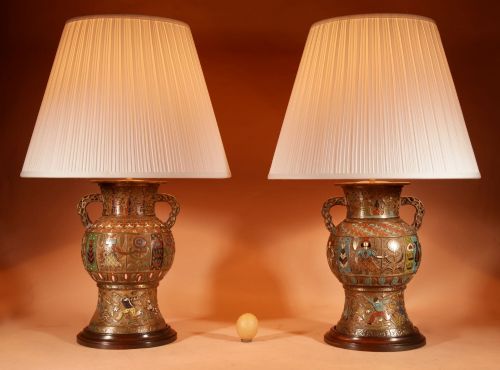
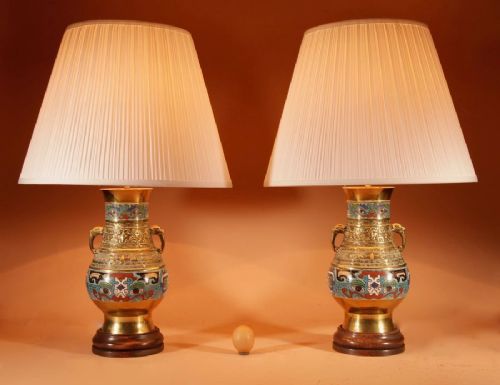
Several heavy table lamps began life as temple jars before Victorian electricians intervened.
Factors determining quality
Quality rests upon the precision of the wirework and the control achieved during the firing process. Finer wire creates intricate, flawless geometric or pictorial motifs without pitting or cloudiness in the coloured enamel fields.
The weight of the metal base and the finish of the rim and mounts contribute to the standing of a pair. Consistency between the two individual objects in a set dictates whether they remain a true matched pair.
ANDO COMPANY·HAYASHI
The Pair Japanese Cloisonne Glossary
- Cloisonne
- Enamel decoration applied within raised metal wires soldered to a metal base. This technique defines the primary aesthetic of the search category.
- Meiji Period
- A historical era spanning from 1868 to 1912 noted for rapid modernisation and exceptional decorative arts output. Most surviving pairs originate from these decades.
- Ginbari
- A technique involving translucent enamel applied over an embossed foil background. This method creates a textured, shimmering pattern beneath the surface.
- Totai Shippo
- Cloisonne enamel created upon a porcelain body rather than a traditional metal base. Such pieces bridge ceramic traditions and metalwork.
- Champleve
- Enamel work where troughs or cells are carved directly into the metal plate rather than built up with wires. It appears frequently on lamps and heavy vessels in this category.
Pair Japanese Cloisonne: Frequently Asked Questions
Were these pieces made for export?
Many fine examples from the late nineteenth century were produced specifically for Western export markets through international exhibitions and trade houses. Japanese craftsmen adapted traditional forms to suit European and American interior tastes.
This accounts for the presence of converted table lamps and ormolu mounts found on several items.
How should I clean my cloisonne?
Dust the surface gently with a soft, dry cloth to prevent the accumulation of grit between the metal wires. Avoid chemical cleaners, abrasive cloths, or immersion in water, which can damage the aged metal and enamel.
Professional restoration is recommended if structural damage occurs to the wire cells.
How do I date an antique pair?
Dating relies on the style of the metal wires, the vibrancy of the enamel colours, and any base signatures or mounting styles. Meiji period pieces typically display crisp wirework and rich, varied palettes.
Later pieces from the twentieth century often adopt standardised production methods with simpler decorative motifs.