



Pair Genre Scene Artwork
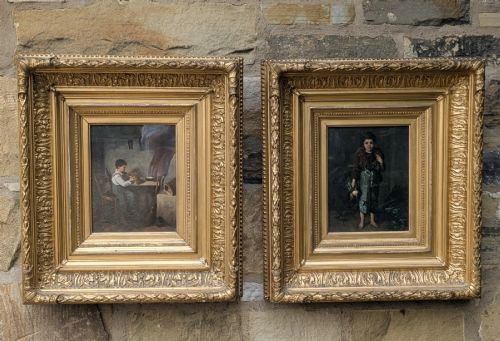
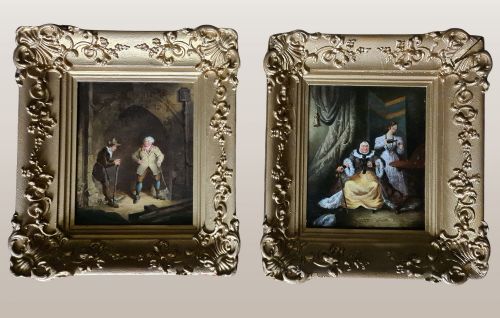
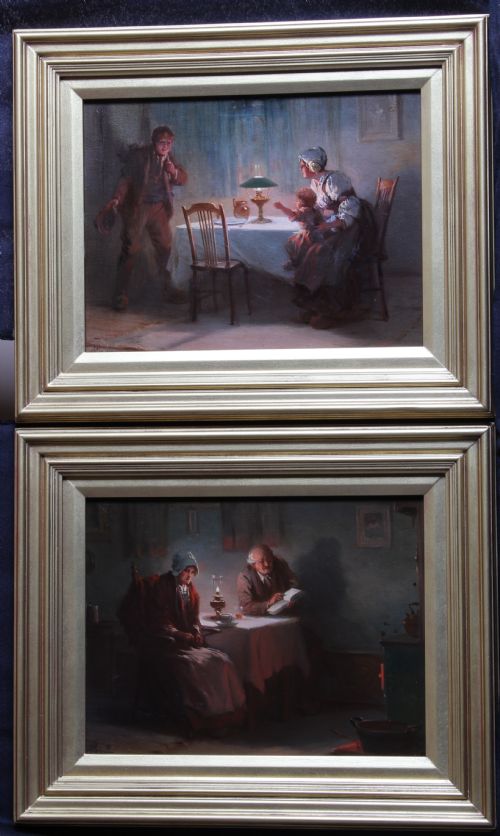
A pair genre scene artwork brings everyday life into focus, offering matched snapshots of domestic interiors, rural moments and social encounters.
Pair Genre Scene Artwork
When you search for pair genre scene artwork, you encounter matched visual narratives that capture human activities and domestic moments. These decorative pairs span periods from the Georgian era through the Victorian epoch and into the early twentieth century.
The selections on this page appear as oil paintings on canvas or board, watercolours, engravings and crystoleoms. Subjects range from peasant scenes and interior domestic spaces to rural landscapes and figure studies.
Origin points vary across British, Irish and Continental workshops. You find works by named painters alongside anonymous pieces created during the nineteenth century.
Materials and construction
Makers utilised traditional canvas, paper, wood panels and tin as supports for oil and watercolour pigments. Engravings on paper record graphic skill, while crystoleoms employ glass layers over printed bases.
Frames combine wood, gesso and gilt finishes to enclose and protect the artwork. The physical components reflect the period standards of nineteenth and early twentieth century framing workshops.
A pair of nineteenth century images records the quiet drama of a pinch of snuff alongside the domestic comfort of a pretty slipper.
Assessing quality and execution
Execution of detail in figures and interior elements distinguishes finer examples from simpler output. The dexterity of brushwork or line work defines the visual success of each composition.
Condition of the support material, paint layer and original framing influences desirability. Intact surfaces without extensive restoration retain their original character most clearly.
Alexander Rosell·R. Palnay·Robert Richard Scanlan·Federico Andreotti·Joseph Emmanuel Weiser·Leon Girardet·Frank Dadd R.I.
The Pair Genre Scene Artwork Glossary
- Genre painting
- A style depicting scenes from everyday life, typically involving ordinary people engaged in common activities. This form became particularly popular during the Victorian period.
- Crystoleom
- A Victorian technique where a photograph or print is made transparent on glass, hand-coloured from behind, and mounted. This process creates a luminous depth unlike standard paper prints.
- Gesso
- A plaster-like mixture applied to wood frames before gilding or painting. It provides a smooth surface for intricate moulded ornament.
- Oil on canvas
- Pigment bound in drying oil applied to a woven fabric stretched over a wooden frame. It represents a primary medium for nineteenth century fine art.
- Watercolour
- Painting method where paints are made of pigments suspended in a water-based solution. Paper serves as the standard support for these delicate works.
Pair Genre Scene Artwork: Frequently Asked Questions
What defines a genre scene?
A genre scene depicts everyday life, ordinary people and domestic interiors rather than grand historical or mythological subjects. These works capture moments from daily routines, social gatherings and rural labour.
Such subjects gained significant popularity among nineteenth century collectors who appreciated recognisable human narratives in their decorative arts.
Why are these artworks sold in pairs?
Pairs were created to hang together on domestic walls, often balancing compositions by subject, season or narrative theme. Artists painted or printed matched scenes to complement each other visually.
Keeping them together preserves the original display intent of the creator and the period interior for which they were chosen.
How do I date a piece?
Dating relies on stylistic markers, framing materials, inscriptions and recorded artist working periods. Nineteenth century works often display characteristic clothing, interior furnishings and handling of paint.
Signatures or period stamps on the reverse of the canvas or frame also provide documentation for the date of creation.
Where should I hang these?
These works suit domestic living spaces, studies and hallways where viewers can examine the detail of the figures and settings. Wall placement should avoid direct sunlight to protect pigments and paper supports.
Pairings require balanced wall space to maintain their visual symmetry and narrative connection.