
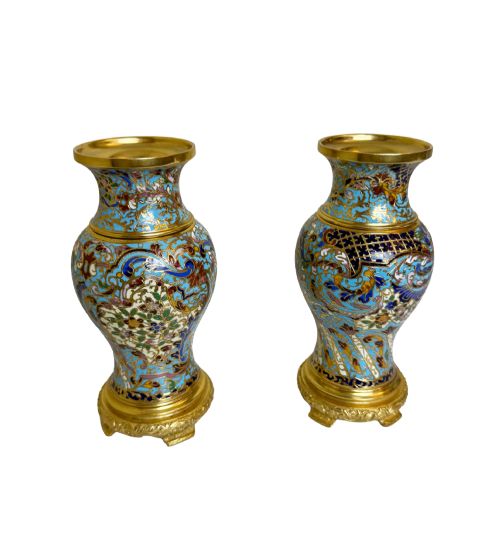
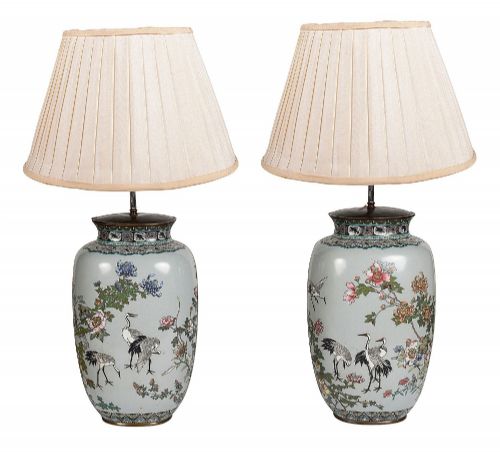


Pair Blue Cloisonne Vases
These pair blue cloisonne vases bring vibrant colour and intricate wirework to a room, offering striking focal points for a mantelpiece or side table.
Pair Blue Cloisonne Vases
A pair blue cloisonne vases search leads you to decorative vessels fashioned with metal wire cells soldered to a base and filled with enamel paste. The examples you meet on this page span the nineteenth century, the Victorian and Edwardian eras, and the early twentieth century, taking the form of standard vases, ginger jars, and occasionally lamps or candelabra.
Origin points diverge into distinct traditions, featuring pieces from the Meiji and Edo periods of Japan alongside Chinese Export, Qing Dynasty, and nineteenth century French workshops. Many of these matching pairs have been adapted into table lamps over time while retaining their original enamel bodies and decorative motifs.
How they were made
Craftsmen built these vessels by soldering thin brass, copper, or gilt metal wires onto a metal foundation to form raised compartments known as cloisons. They then applied coloured enamel paste into these intricate cells before firing the piece in a kiln and polishing the surface until smooth.
Mounts in gilt bronze or ormolu frequently frame the upper and lower rims of French interpretations, while Japanese and Chinese makers relied primarily on the exposed wire mesh and rich enamel ground to define the silhouette.
Listings feature brass, copper, and gilt metal foundations paired with both traditional enamel work and fabric silk shades.
What varies in quality
Quality rests heavily on the precision of the wirework and the depth of the enamel ground. Superior vessels exhibit perfectly uniform cells with fine, straight wire borders that maintain their alignment without distortion across complex curves.
The density and purity of the enamel also dictate the upper tier, where colours remain rich and consistent without pitting or cloudiness. Heavier base metals and refined ormolu or gilt bronze mounts further distinguish the finer workshops from standard production items.
Jules Vieillard
The Pair Blue Cloisonne Vases Glossary
- Cloisonne enamel
- A decorative metalwork technique where fine wire is soldered to a body to create cells filled with enamel paste. This method produces intricate patterns defined by thin metallic outlines.
- Ormolu
- Finely ground high-carat gold cast and chased onto a bronze base, used for mounts and decorative trims. French makers frequently applied this technique to frame enamel vessels.
- Champleve
- An enamelling process where troughs or fields are carved directly into a metal plate and filled with enamel. This differs from wirework by sinking the design into the solid material.
- Meiji period
- A historic era in Japan running from eighteen sixty-eight to nineteen twelve, noted for the high standard of its metalwork and export wares. Pieces from this time often feature meticulous wire patterns.
- Ginger jar
- A wide-mouthed storage vessel with a rounded shoulder and flat base, originally designed for spices. Enamelled versions serve purely decorative functions as matching pairs.
Pair Blue Cloisonne Vases: Frequently Asked Questions
How are pair blue cloisonne vases cleaned?
Dust these vessels gently with a soft, dry cloth to protect the delicate wirework and polished enamel surfaces.
Avoid using liquid cleaners or chemical polishes, as moisture can seep beneath the wire cells and damage the metal foundation.
Were these vases made as lamps originally?
Many surviving examples began life as decorative vessels and were converted into table lamps during the twentieth century to suit modern interiors.
Fittings are typically added without altering the core enamel body, allowing the original form to remain intact.
How can I tell Japanese from Chinese cloisonne?
Japanese pieces from the Meiji period often display exceptional wire precision with subtle floral or avian motifs against a dark blue ground.
Chinese equivalents, including Qing Dynasty and export pieces, frequently feature bolder palettes and heavier brass or bronze foundations.