

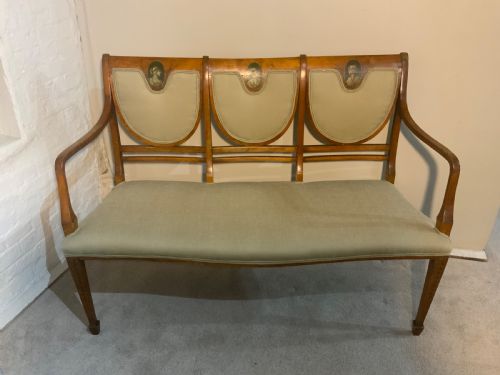


Painted Wooden Sofa
A painted wooden sofa brings lightness to a room, offering seating shaped by centuries of Swedish, French, and English craftsmanship.
Painted Wooden Sofa
A painted wooden sofa combines structural timber with decorative surface finishes, ranging from formal French settees to country benches. These seating pieces span the eighteenth, nineteenth, and early twentieth centuries, reflecting diverse regional aesthetics across Europe.
Swedish Gustavian designs and French Louis styles appear frequently alongside English satinwood pieces and Austrian settles. Forms vary from small caned couches and window seats to large triple-back settees and storage benches.
Buyers encounter everything from elegant neoclassical frames on fluted legs to rustic country benches. The selection includes bergere sofas with upholstered frames and minimalist Thonet bentwood loveseats.
How they were made
Carpenters utilised solid woods such as pine, beech, and satinwood to construct sturdy frames for these settees and benches. Surfaces received decorative paint layers, sometimes combined with gilding or polished satinwood details.
Upholstery methods incorporated fabric and linen, while seating sections frequently utilised woven cane. Structural joinery supported carved wooden elements, fluted legs, and curved backs defined by neoclassical or country styles.
Listings feature items from the eighteenth, nineteenth, and early twentieth centuries, including Edwardian and Regency periods.
What varies in quality
Quality rests in the finesse of the timber selection and the execution of the painted finish. Finer examples display carefully detailed carving on satinwood or beech frames, alongside well-preserved original paint surfaces.
Construction integrity distinguishes refined salon furniture from rustic utility benches. The precision of joinery in framed backs, cane panels, and fluted legs dictates the overall standard of the piece.
The Painted Wooden Sofa Glossary
- Gustavian
- A Swedish neoclassical design style characterised by restrained classical carving, pale painted finishes, and elegant proportions. This style emerged during the late eighteenth century under King Gustav III.
- Bergere
- An enclosed upholstered armchair or sofa featuring wooden frames and upholstered sides. These French seating pieces often include exposed painted wood elements.
- Cane
- Woven material made from rattan peel utilised for light, flexible seat and back panels. Canework appears frequently on Edwardian and turn-of-the-century couches.
- Satinwood
- A durable hardwood featuring a lustrous, satin-like grain utilised for fine eighteenth and nineteenth-century furniture. It provides a smooth surface for polished or painted decoration.
- Settle
- A wooden bench featuring a high back to block drafts, often incorporating built-in storage beneath the seat. Country versions appear frequently in Swedish and Austrian traditions.
Painted Wooden Sofa: Frequently Asked Questions
How do I identify a Gustavian sofa?
Gustavian sofas typically display pale painted finishes, fluted legs, and restrained neoclassical carving derived from French styles. They reflect Swedish interpretations of eighteenth-century design.
Look for clean lines, symmetrical frames, and light colour palettes that distinguish these pieces from more ornate French or Italian alternatives.
What is a bergere settee?
A bergere settee is an upholstered seating piece with solid wooden frames and enclosed sides. These French-inspired designs often feature exposed painted wood and comfortable cushioned seating.
The style emphasises upholstered luxury combined with structural wooden woodwork, commonly found in nineteenth-century examples.
Are painted wooden sofas comfortable?
Comfort depends on the specific form, ranging from upholstered fabric and linen sofas to wooden storage benches and caned couches. Many designs accommodate loose cushions or built-in padding for daily use.
Rigid wooden settles and benches offer structured seating, while bergere and sofa designs provide softer upholstered support.
Where were these painted sofas made?
These pieces originate from various European traditions, with significant representation from Sweden, France, Italy, Austria, and England. Each region developed distinct aesthetic preferences in paint colours and woodworking.
Swedish workshops favoured pale Gustavian finishes, whereas French makers concentrated on Louis-style curves and English makers utilised satinwood.