
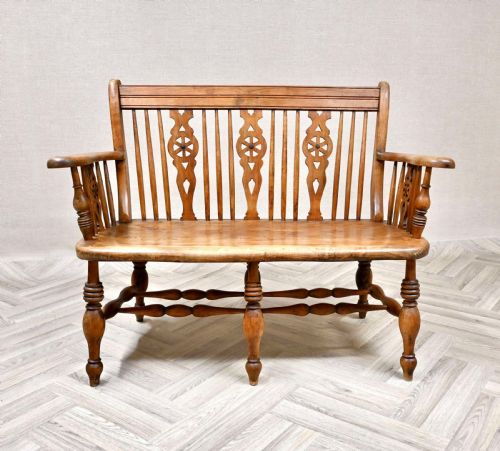


Pierced Splat Bench
These pieces known as a pierced splat bench combine formal backrests with long seating across 18th century, Victorian, and Edwardian forms.
Pierced Splat Bench
A pierced splat bench brings together traditional seating forms, appearing most frequently on this page as mahogany settees and chair back seats from the 18th century, Victorian, and Edwardian periods.
Buyers encounter various formats including double and triple chair back settees, window seats, and Windsor bench seats utilising styles from Chippendale and Hepplewhite to English country.
The objects serve as long seating and settees, constructed from woods like mahogany, elm, ash, and yew, sometimes featuring fabric upholstery or velvet.
How they were made
Cabinet makers utilised solid timbers such as mahogany, elm, ash, and yew, shaping backrests with pierced splats and shield backs through traditional joinery.
Upholstered versions incorporate fabric and velvet surfaces over sturdy wooden frames, while painted finishes appear on specific Edwardian couches.
Several pieces double as chair back end of bed seats, proving that sitting upright in the bedroom was once a serious architectural commitment.
What varies in quality
Quality rests upon the crispness of carved details in mahogany frames and the structural integrity of joined backrests.
The sophistication of the stylistic reference, moving from country vernacular to refined Chippendale or Hepplewhite interpretations, defines the tier of the piece.
The Pierced Splat Bench Glossary
- Pierced splat
- The central vertical slat of a chair back that has been carved or cut through to create an openwork decorative pattern. This feature defines the visual character of the bench backrest.
- Shield back
- A chair back shape resembling the outline of a heraldic shield, popular in Hepplewhite designs. It curves inward toward a narrow base.
- Windsor bench
- A long seat built with turned spindles and a solid wooden saddle-shaped seat, drawing on country traditions. These utilise timbers like elm, ash, and yew.
- Settee
- A long wooden or upholstered seat with a back and arms, designed for multiple occupants. They appear in double and triple chair back formats.
Pierced Splat Bench: Frequently Asked Questions
What is a pierced splat bench?
A pierced splat bench is a long seat featuring openwork vertical slats along the backrest, combining the form of a settee with chair back construction.
These pieces emerge across 18th century, Victorian, and Edwardian periods in mahogany, elm, ash, and yew.
How were these benches used?
Such benches functioned as principal seating in parlours, salons, and bedrooms, offering extended seating capacity for multiple people.
Specific variants like window seats and end of bed seats served specialised positions within period interiors.
How do I identify Chippendale style?
Chippendale style pieces display carved mahogany frames, elaborate pierced splats, and classic proportions derived from 18th-century cabinet making traditions.
Later Victorian and 1900 iterations replicate these formal motifs with varying degrees of carved depth.
What woods were used?
Makers constructed these seats primarily from mahogany for formal urban pieces, alongside country timbers like elm, ash, and yew for Windsor forms.
Beech also appears within the structural framework of upholstered settees and couches.