





Painted Wood Demi Lune
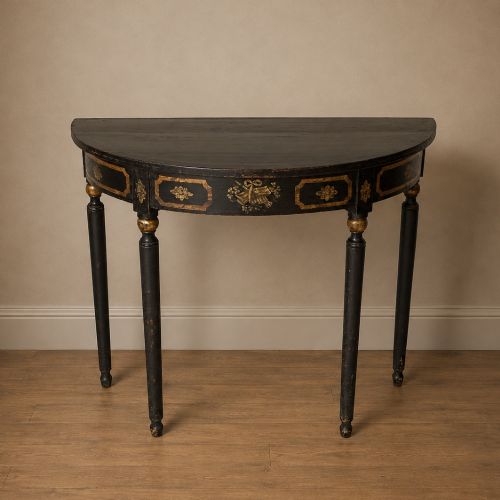
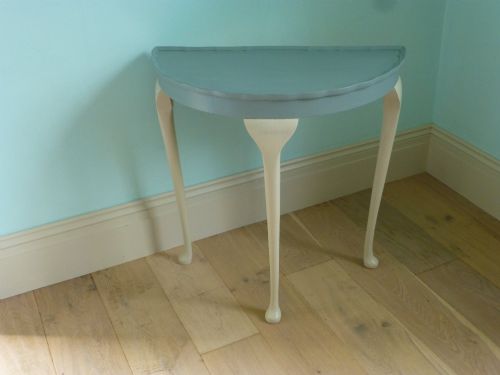
A painted wood demi lune offers a flat-backed crescent silhouette that hugs a hallway or parlour wall with understated architectural grace.
Painted Wood Demi Lune
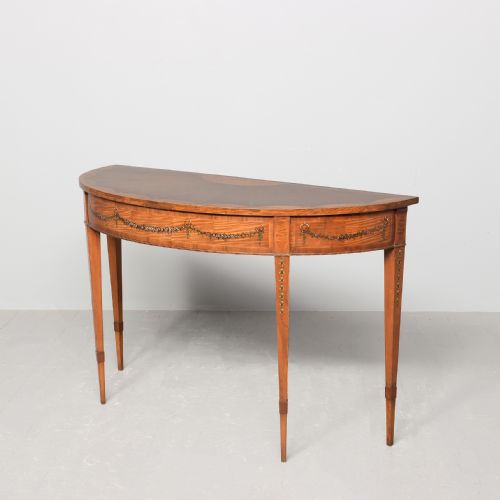
When you search for painted wood demi lune, you encounter half-round furniture designed to stand flush against a wall, principally console tables and side cabinets. The examples recorded here span from the early eighteenth century through the twentieth century, taking in George III, Regency, and French or Swedish neoclassical styles.
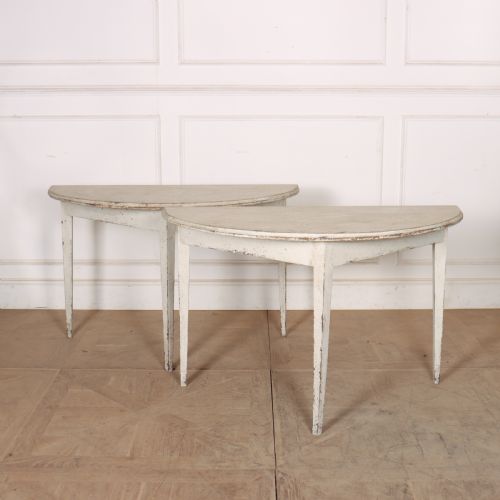
Console tables dominate the selection, often appearing in matched pairs alongside freestanding commodes and wall brackets. These half-moon surfaces frequently adopt Gustavian, Louis XVI, or Scandinavian country aesthetics, finished in muted tones or rich lacquer.
Materials and Construction
Makers utilised pine, timber, and satinwood as foundational substrates for decorative schemes involving layered paint, gold leaf, and giltwood. Surfaces often received elaborate brushwork, parcel gilding, or red lacquer to imitate more costly exotic materials.
Joinery techniques relied on traditional cabinet-making practices suited to curved aprons and tapered legs, accommodating both freestanding console formats and enclosed side cabinets with doors.
Swedish country styles account for multiple matched pairs of console tables finished in original painted wood.
Judging Quality
Differentiation in these pieces rests upon the precision of the hand-painted decoration and the crispness of any carved wood detailing, such as parcel gilding or neoclassical motifs. Tables finished in delicate satinwood with refined floral panels separate themselves from simpler pine or utilitarian utility pieces.
Proportion and structural integrity dictate value, particularly where curved aprons meet slender tapered legs. Retaining original paint surfaces rather than later overpainting elevates the standing of any console or commode.
Wright and Mansfield
The Painted Wood Demi Lune Glossary
- Demi-lune
- A half-moon shape used in furniture design to describe tables and cabinets with a flat back and curved front. This profile allows the piece to fit neatly against a vertical surface while projecting minimally into a room.
- Console table
- A table supported by wall brackets or legs, designed to stand against a wall. They frequently appear in pairs within formal hallways and reception rooms.
- Parcel gilt
- Woodwork partially covered in gold leaf or gold paint to highlight specific carved details or mouldings. This technique adds subtle illumination to dark or painted surfaces.
- Satinwood
- A durable tropical hardwood with a lustrous, satin-like sheen, frequently used as a fine veneer or solid timber in eighteenth and nineteenth-century cabinet work. It accepts painted decoration exceptionally well.
- Commode
- A low cabinet or chest of drawers, often standing on legs, originating in French furniture design. They provide enclosed storage within a decorative half-round format.
Painted Wood Demi Lune: Frequently Asked Questions
Where should I place a demi lune table?
These half-round pieces suit narrow hallways, entrance passages, or blank wall spaces in living areas where a full rectangular table would obstruct movement.
Because their flat backs sit flush against the vertical surface, they provide a stable display surface for lamps or decorative objects without dominating the floor plan.
Can I use a demi lune as a desk?
Standard console versions lack the knee clearance and internal depth required for comfortable seated work. They function primarily as decorative side surfaces rather than writing desks.
Card table variants open to provide a larger baize-lined surface, though their primary historic use was social gaming rather than daily administration.
How do I distinguish French from Swedish styles?
French examples often display neoclassical carvings, giltwood accents, and rich colour palettes derived from Louis XVI traditions. Swedish pieces tend towards restrained Gustavian minimalism with lighter painted tones and simpler geometric framing.
Examining the underlying timber and the character of the brushwork usually clarifies the regional workshop tradition.
Are these tables sturdy enough for daily use?
Most console formats rely on attachment to the wall or possess slender tapered legs designed for domestic display rather than heavy weight-bearing duties. Placing heavy items near the curved edge requires caution if the piece lacks a central third or fifth leg.
Gentle placement of lamps, ceramics, or correspondence suits their historical design purpose.