
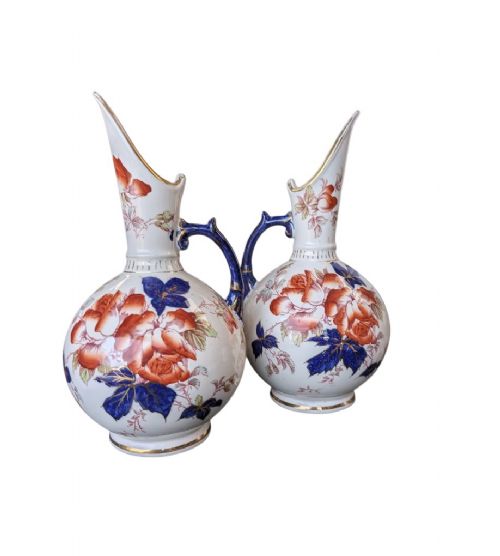


Painted Porcelain Ewer
These painted porcelain ewer options bring sculptural presence and hand-finished detail to a room, spanning centuries of decorative ceramic artistry.
Painted Porcelain Ewer
A painted porcelain ewer takes the ancient form of a water vessel and turns it into an ornamental centrepiece. The pieces gathered here trace a path from eighteenth-century soft-paste porcelain cream jugs and dolphin ewers to grander Victorian and early twentieth-century decorative forms.
You are most likely to encounter late nineteenth-century and early twentieth-century pieces, particularly from factories like Royal Worcester, alongside French, German, and Asian-influenced examples. These range from blush ivory pedestal vessels to hand-painted jugs and wine ewers displaying floral panels and landscape scenes.
While some early examples served practical functions at the table as cream boats or jugs, the majority of the items listed function purely as decorative display pieces, vases, or scent bottles shaped with handles and spouts.
How they were made
Potters shaped these vessels using hard-paste and soft-paste porcelain, sometimes forming intricate bodily contours such as lamprey handles or dolphin supports. Enamel colours were applied by hand and fired onto the ceramic body.
Gilding, gold leaf, and gold gilt provide metallic contrast to the painted surfaces, accentuating rims, handles, and moulded relief details. Many pieces combine painted floral arrangements or mythological figures with elaborate gilt scrollwork.
Materials appearing across these ceramic vessels include hard-paste porcelain, soft-paste porcelain, enamel, gold leaf, and gilt.
What varies in quality
The sophistication of the hand-painting sets apart the standard production pieces from the exceptional ones, particularly where artists signed their floral panels or figural scenes. Crispness in the moulded relief work, such as scales on a dolphin handle or fluting on a pedestal, reveals the skill of the original workshop.
The preservation of the gilding and enamel work over time dictates the desirability of an ewer. Pieces that retain their original gold leaf and bright polychrome palette without excessive rubbing command greater attention from collectors.
Royal Worcester·John Rose Coalport·Doulton Burslem·Vienna porcelain·Minton·Volkstedt Porcelain
The Painted Porcelain Ewer Glossary
- Ewer
- A large jug or pitcher with a wide spout and handle, historically used for pouring water but frequently made as an ornamental display piece in porcelain.
- Hard-paste porcelain
- A dense, durable ceramic composed of kaolin and petuntse, fired at high temperatures to create a vitrified, non-porous body.
- Soft-paste porcelain
- An early ceramic composition fired at lower temperatures, producing a softer body with a distinctive warm glaze texture often found in eighteenth-century pieces.
- Blush ivory
- A matte cream-coloured porcelain body popular in late Victorian ceramics, often decorated with delicate pastel floral painting and gilt highlights.
- Gilding
- The application of gold leaf, gold paint, or gold gilt to ceramic surfaces to highlight rims, handles, and decorative motifs.
Painted Porcelain Ewer: Frequently Asked Questions
What is a painted porcelain ewer?
A painted porcelain ewer is a ceramic vessel shaped with a handle and spout, decorated with hand-painted enamels and often finished with gilding. They evolved from practical water and cream jugs into purely decorative mantel and cabinet ornaments.
Most examples found on the market date from the eighteenth century through to the early twentieth century, showing styles that range from Rococo Revival curves to classical pedestal shapes.
How were these ewers used?
While early eighteenth-century examples functioned as cream jugs, cream boats, or table water vessels, later nineteenth-century ewers served as decorative vases, wine ewers, or scent bottles.
They were designed for display on sideboards, mantelpieces, and pedestals within formal Victorian and Edwardian interiors, highlighting the wealth and taste of the household.
How do I date an antique ewer?
Dating relies on factory marks stamped or painted on the base, such as puce marks or specific crown ciphers used by makers like Royal Worcester. Stylistic clues also help, as Rococo Revival curves point to the nineteenth century, while simpler forms or soft-paste bodies often indicate eighteenth-century origin.
Examining the palette, gilding technique, and underlying ceramic body provides further context for the period of manufacture.
How do I care for porcelain ewers?
Care involves dusting gently with a soft, dry brush to protect delicate painted surfaces and raised gold leaf from abrasion. Avoid using water, chemical cleaners, or immersion, as historic enamels and gilt highlights can be fragile.
Display the pieces away from direct sunlight and areas prone to sudden temperature changes to preserve the integrity of the porcelain and glaze.