
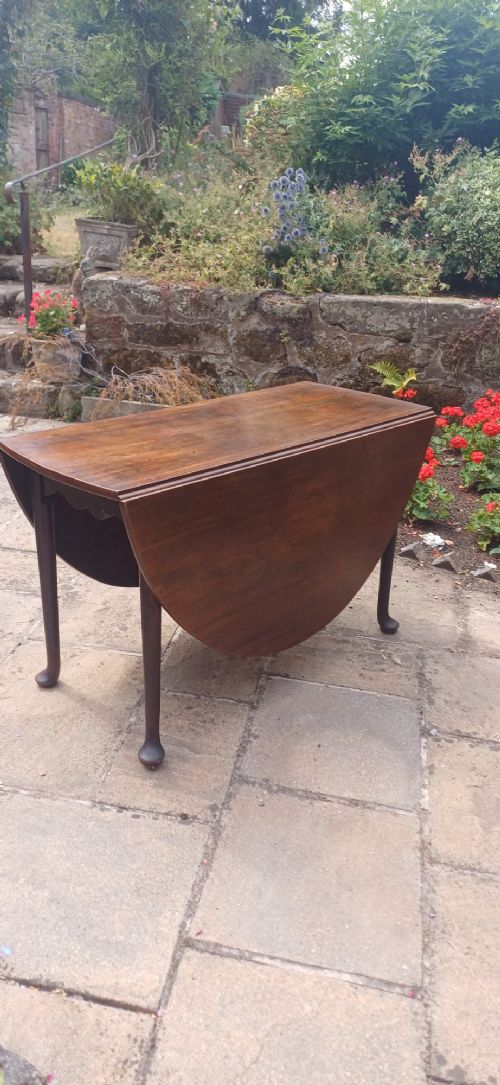
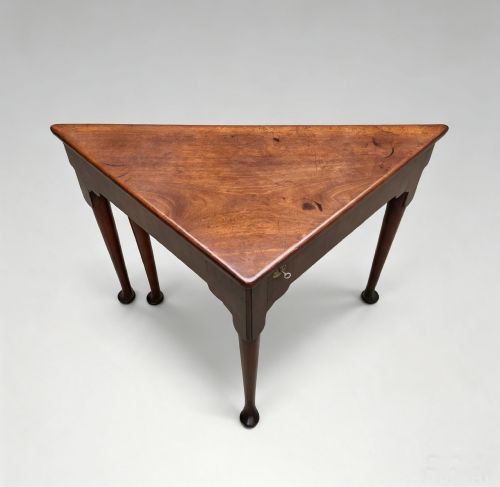
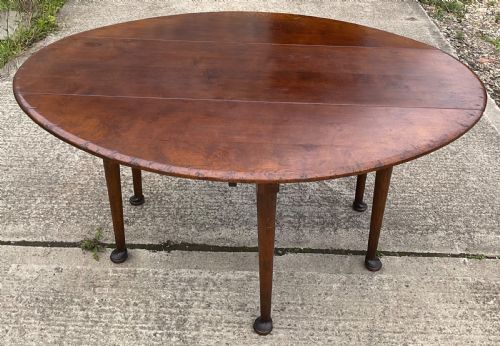
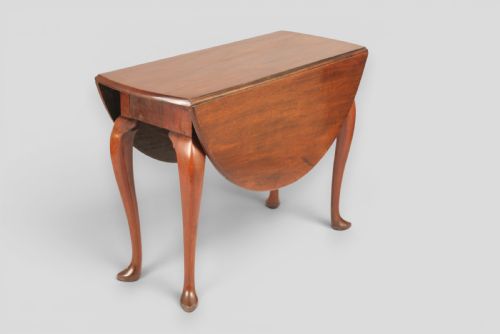
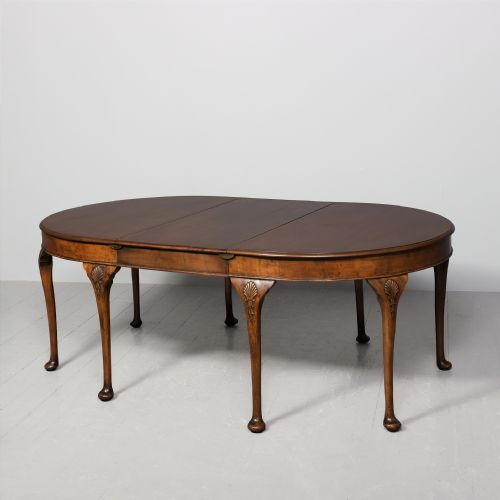


Pad Foot Drop Leaf Table
These pad foot drop leaf table examples combine eighteenth-century versatility with rich mahogany timbers.

Pad Foot Drop Leaf Table
A pad foot drop leaf table is a dual-purpose piece designed to expand for dining and fold down for compact storage against a wall. The form relies on hinged flaps supported by swing legs or gateleg actions, allowing a small side table to transform into a generous dining surface. Most pieces encountered on this page originate from the eighteenth century and the Georgian era, though later nineteenth- and twentieth-century interpretations also appear.
Makers produced these tables in various scales, ranging from small occasional tea tables and corner variants to large oval dining tables suited for country houses. Timber choices reflect the period of manufacture, with Cuban mahogany, red walnut, and solid oak frequently appearing across the listings. Buyers select these items for their architectural presence and practical space-saving utility in modern dining rooms.
How they were made
Cabinet makers built these tables primarily using dense hardwoods such as mahogany, walnut, and oak, often selecting Cuban mahogany for its deep grain and substantial weight. Construction involved sturdy frame joinery with pivoted gatelegs or swing brackets to support the heavy hinged leaves under daily use.
The characteristic pad foot finish at the base of the cabriole or straight legs required precise hand-carving to create a smooth, rounded pad that rests evenly on the floor.
Pad Foot Drop Leaf Table Retail Price Guide 2026
Typical asking prices for pad foot drop leaf table among the pieces listed under this phrase on Sellingantiques today, from the lower quarter to the upper quarter. They describe what is for sale here now, not the wider market.
Listings feature mahogany, red walnut, and solid oak across eighteenth-century Georgian periods, alongside Victorian and twentieth-century revival interpretations.
What varies in quality
Quality in a pad foot drop leaf table depends upon the selection of timber figures, such as highly figured Cuban mahogany, and the crispness of the hand-carved cabriole legs. Superior examples display harmonious proportions when fully extended, maintaining structural stability across the folding leaf joints.
The integrity of the original gateleg pivots, hinge placements, and the preservation of the pad feet dictate the historical standing and finish of the table.
The Pad Foot Drop Leaf Table Glossary
- Pad foot
- A simple rounded foot resting flat on the floor, commonly found on cabriole legs of the eighteenth century. This foot style provides a stable base without excessive ornamentation.
- Gateleg
- A table construction where hinged legs swing outward like a gate to support the drop leaves. This mechanism allows the table to bear considerable weight when open.
- Cabriole leg
- A furniture leg that curves outward in a convex arc and tapers inward to a concave arch near the foot. It draws inspiration from animal limbs and typifies Georgian design.
- Cuban mahogany
- A dense, dark hardwood imported from the West Indies during the eighteenth century. Furniture makers favoured it for its rich patina and resistance to wear.
Pad Foot Drop Leaf Table: Frequently Asked Questions
How do I seat guests around a drop leaf table?
Raise both hinged leaves and swing the supporting gatelegs firmly into position beneath the edges. Position the legs so guests have adequate knee clearance while the leaves remain fully supported.
Fold the leaves downward and push the table against a wall when not in use to reclaim floor space in smaller rooms.
What is the difference between a gateleg and a drop leaf table?
All gateleg tables are a form of drop leaf table, but not all drop leaf tables use a gateleg action. Standard drop leaves often rely on pull-out wooden brackets or swinging arms rather than a pivoting leg frame.
Tables with six or more legs frequently utilise a double gateleg system to support larger oval or circular dining surfaces.
How do I date an eighteenth-century mahogany table?
Examine the timber density, the hand-cut joinery marks beneath the frame, and the specific profile of the pad feet. Earlier pieces from the George I and George II periods often feature robust proportions and rich red walnut or early mahogany timbers.
Later nineteenth-century revivals tend to use lighter or different mahogany species and display machine-finished components rather than hand-shaped joints.
Can I use an antique drop leaf table daily?
These tables served as primary dining furniture for centuries and withstand regular daily use provided the hinges and gateleg pivots remain secure. Clean the timber surfaces with a soft, dry cloth and avoid excessive moisture to protect the antique polish.
Lift the table by the main frame rather than the leaves when moving it across the room to prevent strain on the hinges.