

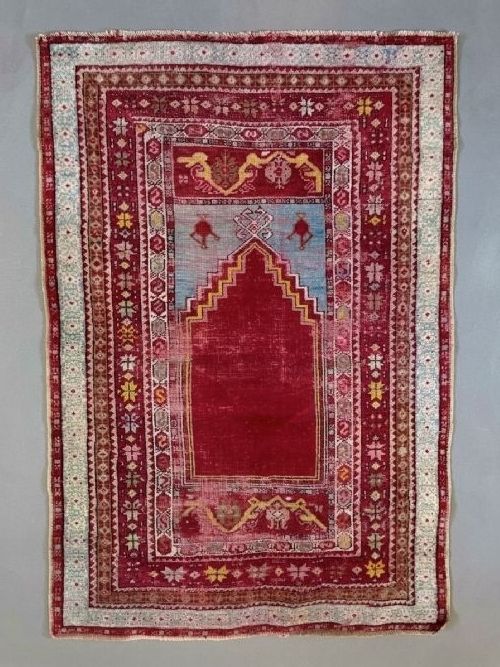


Ottoman Mihrab Prayer Rug
An ottoman mihrab prayer rug brings centuries of textile artistry into a home, offering tactile history and distinct architectural design.
Ottoman Mihrab Prayer Rug
An ottoman mihrab prayer rug is a woven textile featuring the characteristic arch motif that denotes the direction of prayer towards Mecca. Buyers looking at this page find regional examples originating primarily from Anatolian weaving centres such as Ghiordes, Ladik, Milas, and Konya. The pieces vary from village works to formal pieces produced across the nineteenth century.
The version met most frequently here is the nineteenth-century Turkish prayer rug, created in formats suited for domestic floor placement or wall display. These textiles range from compact village formats to larger area rugs carrying traditional columns, lamps, and floral motifs within the central arch. Each region employed specific design idioms that separate rural weaving from urban workshop production.
How They Were Made
Weavers constructed these rugs using wool, hand-spun wool, cotton foundation threads, and occasionally silk for finer urban commissions. Natural dyes provided the deep blues, reds, and yellows that define the palette of these textiles, yielding soft patinas as the materials aged.
The craft relied on knotted pile techniques executed on vertical looms, combining sturdy cotton or wool warps and wefts with dense wool knots. Workshops and village weavers handled the carding, spinning, and dyeing processes locally before executing intricate traditional patterns by hand.
Ottoman Mihrab Prayer Rug Retail Price Guide 2026
Typical asking prices for ottoman mihrab prayer rug among the pieces listed under this phrase on Sellingantiques today, from the lower quarter to the upper quarter. They describe what is for sale here now, not the wider market.
Listings here feature wool, cotton, and silk materials spanning the eighteenth, nineteenth, and early twentieth centuries.
What Varies in Quality
The refinement of the drawing inside the central arch and the crispness of the border motifs distinguish superior examples from simpler village pieces. Knot density and the handling of the wool contribute significantly to the tactile presence and long-term durability of the weave.
Depth and saturation of the natural dyes separate the upper tier of rugs from those with duller colour distribution. The integrity of the original borders and the balance of the composition govern the overall aesthetic power of the piece.
The Ottoman Mihrab Prayer Rug Glossary
- Mihrab
- The architectural arch motif on a prayer rug that symbolises the direction of Mecca. It forms the focal point of the design.
- Ghiordes
- A historic Turkish weaving centre known for prayer rugs featuring distinctive column designs and floral borders. The term also designates a specific knot type used in carpet construction.
- Ladik
- An Anatolian town famous for producing prayer rugs with multiple columns and characteristic lily motifs. These pieces date predominantly to the eighteenth and nineteenth centuries.
- Warp
- The vertical threads stretched on a loom before the weaving begins. The fringe of the rug is typically a continuation of these foundational threads.
- Natural Dyes
- Colourants derived from plants, insects, and minerals used traditionally before synthetic aniline dyes appeared. They produce harmonious tones that age with subtle variation.
Ottoman Mihrab Prayer Rug: Frequently Asked Questions
What is an ottoman mihrab prayer rug?
An ottoman mihrab prayer rug is a hand-knotted textile created in Turkish and Anatolian regions, distinguished by a central arch design. These rugs served both devotional functions and domestic decoration.
Weavers utilised local wool and natural dyes to produce formats ranging from small village rugs to detailed urban workshop pieces.
How do I identify a Ghiordes prayer rug?
Ghiordes prayer rugs are recognised by their architectural mihrab outlines, frequently flanked by columns and topped with floral arrangements. The border patterns typically feature stylised carnations or tulips.
These rugs originate from western Anatolia and display a high degree of knot precision compared to standard village weaving.
Where were these rugs made?
These textiles were produced across Anatolia, encompassing urban centres and rural villages such as Ladik, Milas, Konya, and Panderma. Each region developed distinct colour palettes and border motifs.
Village weavers worked independently using local sheep's wool, whilst urban workshops utilised finer materials and more formal layouts.
How should I care for an antique prayer rug?
Antique prayer rugs require gentle maintenance, including regular low-suction vacuuming without a rotating brush bar to protect the pile. Professional textile cleaning is recommended for deep maintenance.
Keeping the rug away from direct sunlight prevents natural dyes from fading over time.