


Ornate Gilt Armchairs
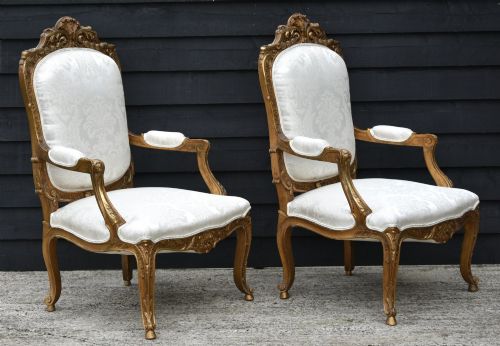
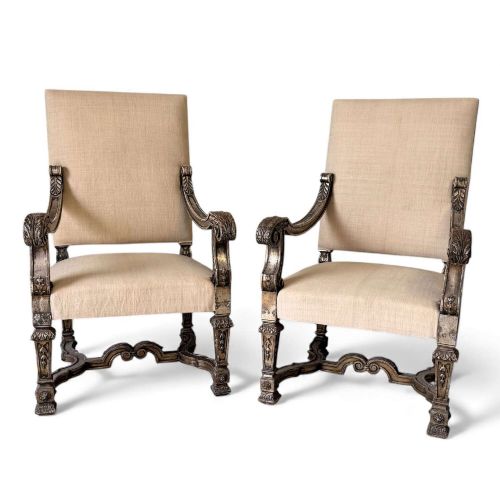
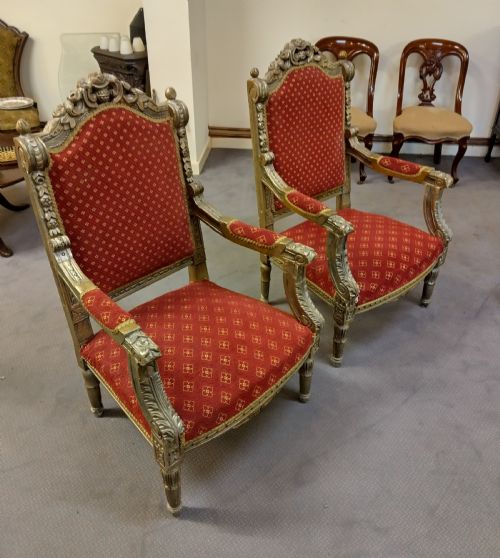
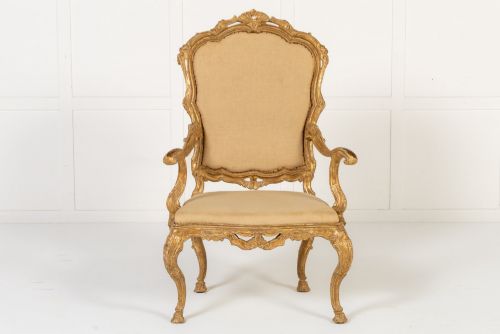
These ornate gilt armchairs combine carved timber with gold leaf, bringing French and Italian revival styles directly into your interior.
Ornate Gilt Armchairs
When you search for ornate gilt armchairs, you look at seating designed to make a dramatic statement through lavish surface decoration and substantial frames. These pieces span periods from the eighteenth century through to the early twentieth century, capturing historical revivals like French Baroque, Rococo, and Louis styles.
The origins stretch across European workshops, with Italian carved pieces and French chateau designs appearing alongside Napoleon III creations. Each armchair employs distinct regional flourishes while adhering to the overarching tradition of gilded woodwork.
How they were made
Makers constructed the structural frames from solid timbers such as walnut and general wood, carving intricate details directly into the material before finishing. Artisans then applied gold leaf or gilt finishes to the surfaces to create a luminous, metallic sheen across the woodwork.
Upholstery completed the seating, utilising traditional textiles like damask, linen, and leather secured to support the frame. Brass components sometimes appear in the construction, adding structural support or decorative accents to the finished armchair.
Materials recorded across the page include solid timber, walnut, giltwood, gold leaf, brass, damask, linen, leather, and fabric.
What varies in quality
Depth and precision of the carved details separate the finest armchairs from simpler productions. Master carvers achieved fluid, crisp lines in the wood, whereas lesser pieces display softer, shallower ornamentation that lacks definition.
The application and preservation of the gold leaf influence the overall character of the piece. Smooth, even gilding that adheres closely to the carved contours demonstrates superior craftsmanship compared to uneven or heavily retouched finishes.
The Ornate Gilt Armchairs Glossary
- Giltwood
- Timber covered with a thin layer of gold leaf or powder. This finish provides the characteristic metallic brilliance seen on antique frames.
- Damask
- A reversible figured fabric traditionally woven on a jacquard loom. It frequently appears as the upholstery material on formal French revival chairs.
- Baroque Revival
- A nineteenth-century style drawing inspiration from seventeenth-century Baroque art. It is characterised by dramatic curves, heavy ornamentation, and grand proportions.
- Wingback Armchair
- A high-backed chair featuring protective side panels designed to shield the sitter from draughts. This form appears in nineteenth-century French pieces.
- Napoleon III
- A design period spanning the mid to late nineteenth century under the French Second Empire. It encompasses eclectic revivals utilising rich gilding and decorative upholstery.
Ornate Gilt Armchairs: Frequently Asked Questions
What periods do these armchairs come from?
The pieces span from the eighteenth century up to the early twentieth century. Nineteenth-century items form the largest group.
Revival styles from this era draw heavily upon earlier French and Italian aesthetic movements.
Are these chairs sold as pairs?
Many listings feature matching pairs of armchairs designed for formal reception rooms or parlours. Single statement pieces also appear among the selection.
Pairs often share identical carving motifs and upholstery fabrics.
What materials are used in the frames?
Makers utilised solid timbers such as walnut and general wood for the underlying structural framework. These wooden frames were then carved and finished with gold leaf.
Brass elements occasionally supplement the construction for added detail.
How do I identify French revival styles?
French Rococo and Baroque revivals display flowing asymmetrical curves, floral motifs, and elaborate crest rails. Louis XV and XVI styles exhibit more structured symmetry and tapered legs.
Giltwood surfaces and traditional upholstery fabrics like damask complete the look.