
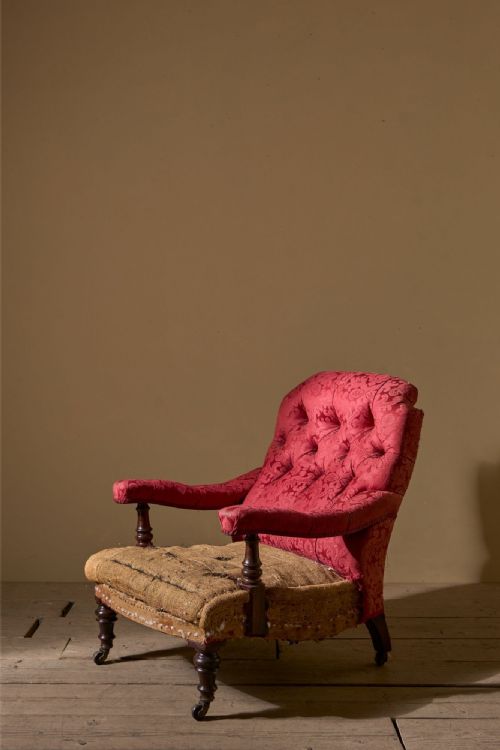
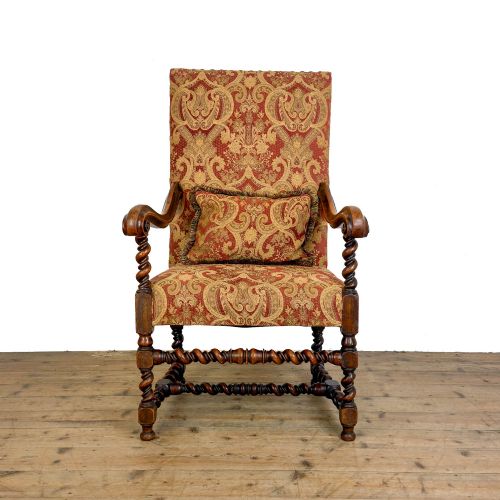
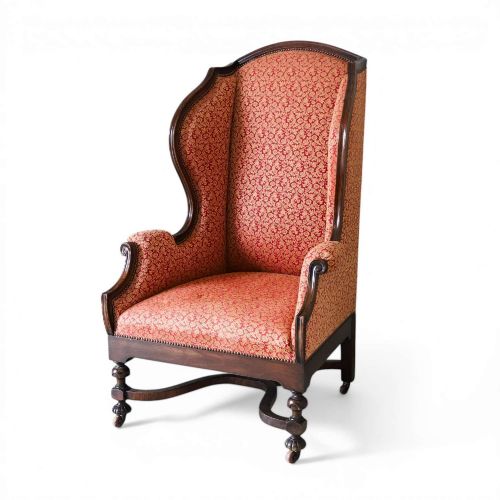
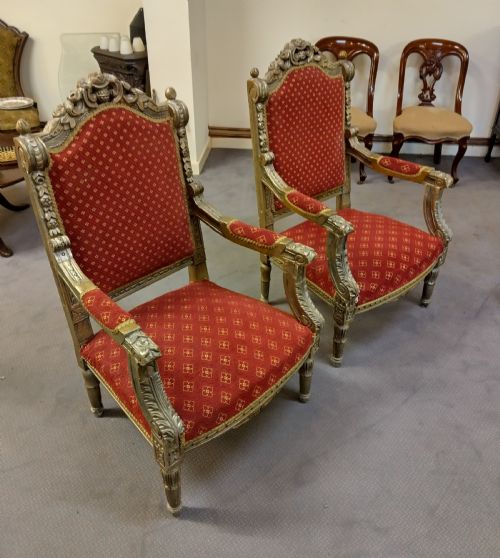
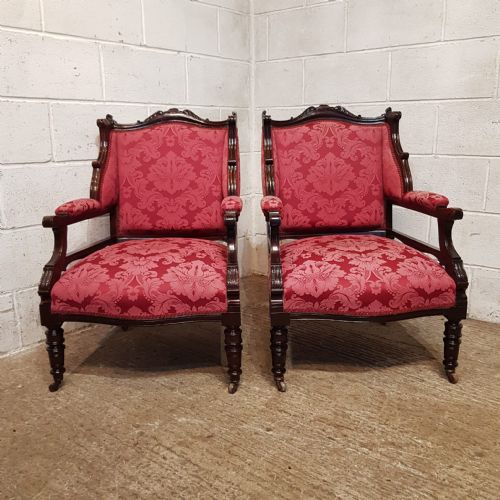
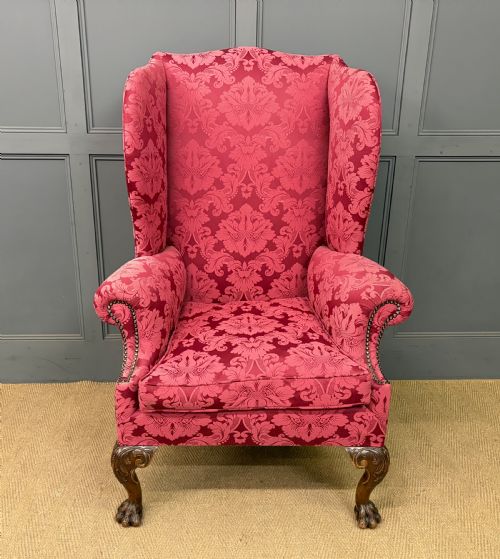


Red Damask Armchairs
Red damask armchairs bring theatrical colour and tactile warmth to a room, upholstered in rich patterned silk or wool textile.
What Red Damask Armchairs Are
Red damask armchairs encompass seating upholstered in patterned textile, appearing across periods from the eighteenth century to the early twentieth century. When searching for red damask armchairs, buyers encounter diverse revival styles including French Baroque, Renaissance, Chippendale, and George III neoclassical forms.
The frames supporting these textile coverings vary significantly in material and silhouette. Mahogany, walnut, timber, and giltwood provide the structural support for elbow chairs, tub chairs, Savonarola chairs, and fauteuils.
How They Were Made
The construction of these pieces relies on traditional cabinetmaking timber frames paired with woven textile upholstery. Workshops utilised mahogany, walnut, and giltwood, shaping them through carving and joinery techniques appropriate to each period.
Upholstery methods applied damask fabric directly to the chair frames, securing the patterned textile to complement the carved woodwork of styles ranging from Art Nouveau to Chippendale revival.
Retail Price Guide 2026
Typical UK retail prices for red damask armchairs, calculated from the Sellingantiques database of over a million retail prices indexed since 2003. This retail price guide relies exclusively on Sellingantiques data; no external sources or auction records are used, so the figures do not describe the wider market.
Listings feature pieces spanning from the eighteenth century through to 1910, incorporating mahogany, walnut, and giltwood frames.
What Varies in Quality
Quality differences emerge in the execution of the timber carving and the sophistication of the frame design. Finer examples display deeply detailed manual carvings on mahogany or giltwood, whereas simpler pieces rely on basic turned or shaped timber.
The integration between the textile upholstery and the wooden frame dictates the aesthetic success of the chair. Superior pieces feature damask fabric precisely fitted to honour the proportions and historical style of the underlying structure.
White, Allom and Co.
The Red Damask Armchairs Glossary
- Damask
- A reversible figured fabric with patterns formed by contrasting weaves, historically utilised for opulent upholstery. This textile provides the defining red surface of these chairs.
- Fauteuil
- An open-armed French upholstered armchair with exposed wooden armrests and framework. This form appears in walnut revival pieces.
- Giltwood
- Timber coated with a thin layer of gold leaf or gilt finish. This material enhances heavily carved nineteenth and early twentieth century frames.
- Savonarola
- A folding armchair constructed from intersecting wooden slats, forming an X-shaped frame. Named after the Renaissance frieze, these chairs offer historical seating profiles.
Frequently Asked Questions
What periods do these armchairs come from?
The pieces span the eighteenth century, the nineteenth century, and the early twentieth century, including Georgian and Edwardian examples.
Revival movements heavily influence the design vocabulary across these chronological eras.
What wood types are used in the frames?
Frames are constructed from mahogany, walnut, and general timber, alongside gilt finish options.
These materials support the textile upholstery according to the specific revival style of the chair.
Are these chairs sold individually?
Many listings feature matching pairs of armchairs rather than single items.
Pairs often exhibit symmetrical carving details and identical red damask textile coverings.
What styles are represented in the seating?
Styles include Renaissance Revival, French Baroque Revival, Art Nouveau, and George III neoclassical.
Chippendale revival forms also appear alongside traditional fauteuil and tub chair shapes.