






Ornate Brass Carriage Clock
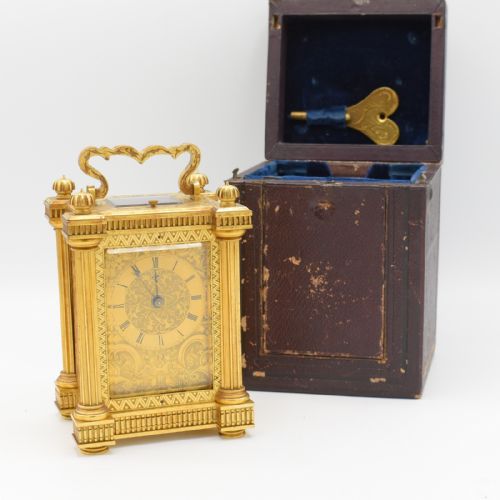
An ornate brass carriage clock is a portable timekeeper designed for travel, combining heavy metal cases and glass panels with precise mechanical movements.
Ornate Brass Carriage Clock
When you search for an ornate brass carriage clock, you are looking at portable mechanical timekeepers housed in glazed metal cases. The versions most commonly met on this page originate from the nineteenth century, particularly the decades around eighteen-nineteen, through to the Edwardian era.
Many examples stem from French workshops, though English makers also produced distinctive variants. Forms range from standard carriage clocks and miniature travel timepieces to larger mantel clock formats and specialised repeating mechanisms.
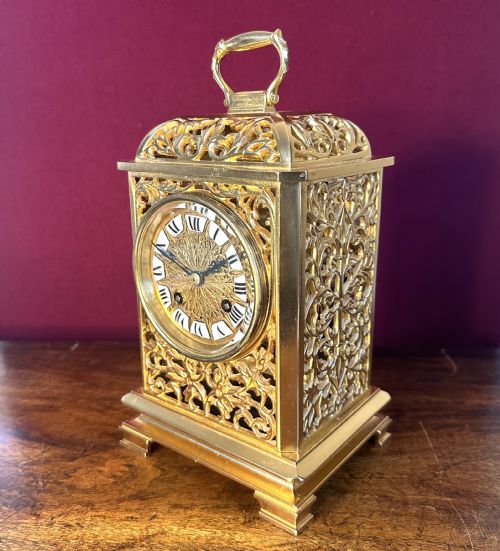
The aesthetic vocabulary draws heavily on French nineteenth-century styles, including Rococo Revival, Second Empire, and Victorian Gothic Revival. Cases frequently exhibit cast, chased, or engraved decoration across the brass or gilded frames, occasionally incorporating enamel panels or lapis elements.
Materials and construction methods
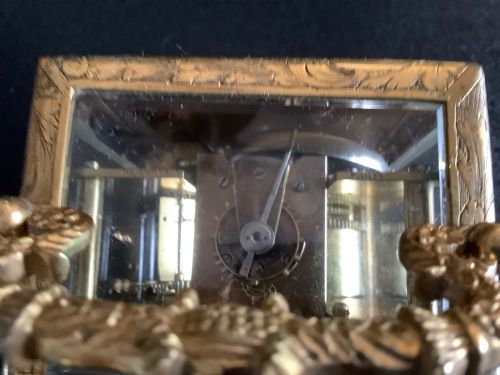
Construction relies primarily on brass, gilt brass, gilded brass, and ormolu for the structural framework and decorative mounts. Bevelled glass panels fit tightly into the metal chassis, allowing light to reach the internal escapement and dial.
Movements are intricate brass assemblies powered by springs, utilising platforms, escapements, and occasionally fusee mechanisms. Dials are frequently executed in white enamel with delicate painted numerals, sometimes complemented by Limoges enamel or inset decorative side panels.
Ornate Brass Carriage Clock Retail Price Guide 2026
Typical asking prices for ornate brass carriage clock among the pieces listed under this phrase on Sellingantiques today, from the lower quarter to the upper quarter. They describe what is for sale here now, not the wider market.
Periods represented span from the mid-nineteenth century through the Victorian and Edwardian eras up to nineteen-sixty.
Distinctions in execution and finish
Quality separates objects by the crispness of the cast and chased decoration on the brass case. Finer examples display deep, sharp engraving across all sides rather than shallow, uniform machine stamping.
The sophistication of the internal movement dictates grade. Pieces featuring repeating mechanisms, alarm functions, grand sonnerie striking, or signed platforms by notable makers represent the higher tier of production.
Howell & James London·Brunelot·Gontard & Bolviller Paris·Thomas Cole and James Cole·Hunt And Roskell·E.J.Dent·Paul Garnier·James Moore·Tiffany·Luxor
The Ornate Brass Carriage Clock Glossary
- Repeater
- A mechanical complication that sounds the hours and quarters on demand when a lever or button is pressed. This feature required considerable skill to assemble within a compact brass housing.
- Escapement
- The mechanism inside that controls the release of power to regulate the movement. Platform escapements sit visibly near the top of the clock behind glass.
- Ormolu
- Finely ground high-carat gold mercury-gilded onto a bronze or brass base. The technique creates a warm, rich surface lustre on antique metalwork.
- Fusee
- A conical pulley used with a cord or chain to maintain even force on the gear train as the mainspring winds down. English models frequently employ this system.
- Grand Sonnerie
- A complex striking train that chimes the hours and the current quarter-hour automatically on every passing quarter. Such movements denote high-grade horological production.
Ornate Brass Carriage Clock: Frequently Asked Questions
Were these clocks actually carried during travel?
Nineteenth-century travellers utilised these portable timepieces inside leather protective cases during coach and rail journeys. The sturdy brass frames and heavy glass panels protected the delicate gear train from motion.
Today, they function primarily as stationary desk or mantel pieces rather than travel companions.
How can I tell a French clock from an English one?
French production frequently emphasises platform escapements visible through the top glass and utilises standard spring barrel movements. English examples often incorporate fusee movements within heavier, profusely engraved brass cases.
Signatures on the dial or backplate often confirm the origin of the workshop.
What is the difference between a timepiece and a clock?
In horological terms, a timepiece simply indicates the hours and minutes without a striking train. A clock includes a mechanism that chimes the hours or quarters on a bell or gong.
Both configurations appear frequently across Victorian and Edwardian brass travel clocks.