
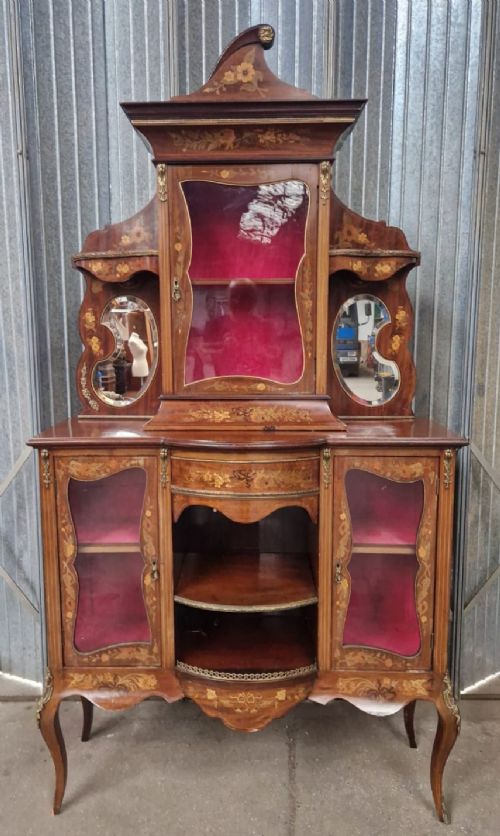
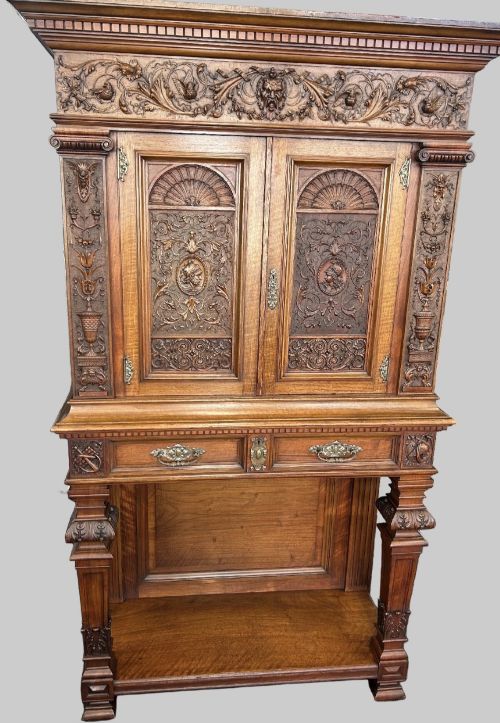
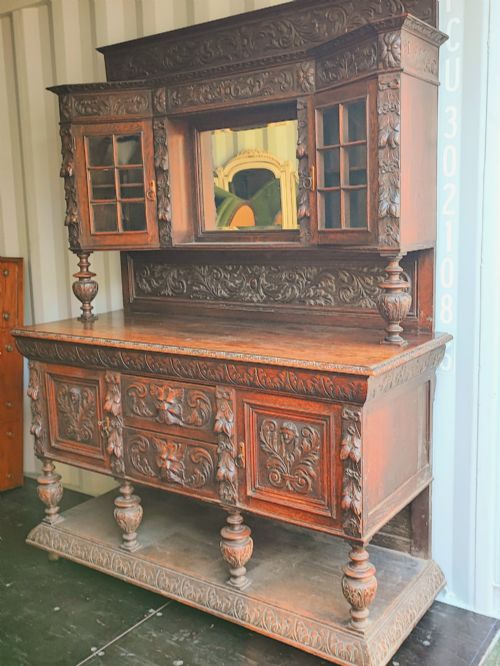
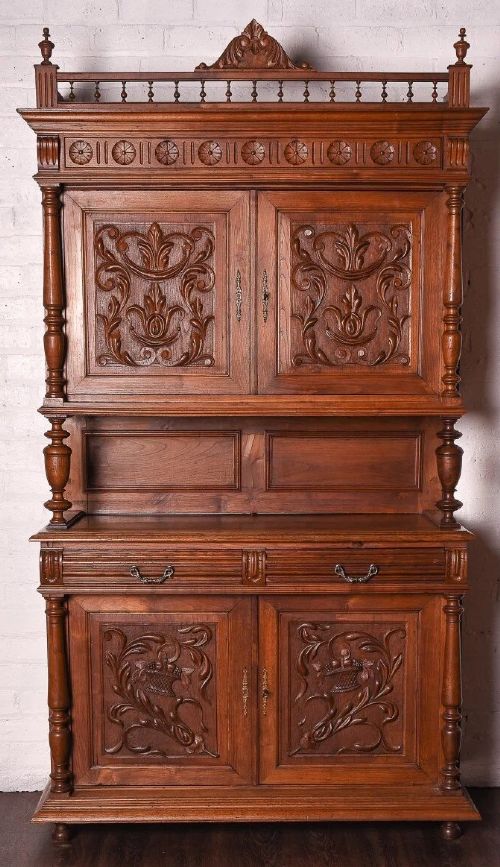





Ornate Sideboard
An ornate antique sideboard brings heavy timber and elaborate carving into a dining room or hall, offering substantial display and storage space.
Ornate Sideboard
An ornate antique sideboard serves as a major storage and display piece, frequently appearing in forms such as credenzas, buffets, and cabinets. These items originate predominantly from the nineteenth century, with Victorian examples appearing alongside revival styles.
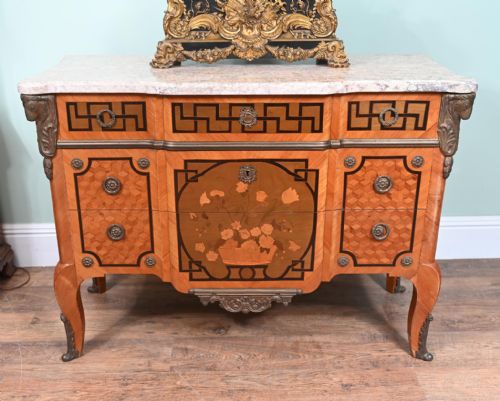
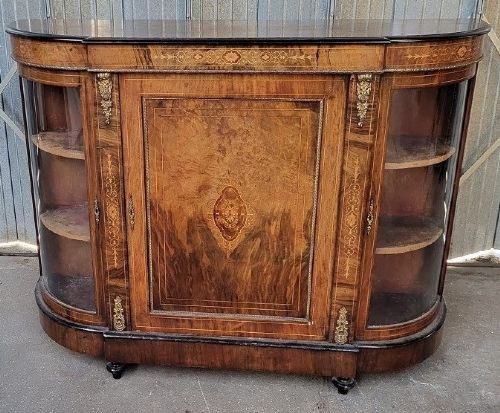
The selection ranges from British oak pieces to continental walnut and burr walnut designs, often incorporating mirrors, marble tops, or inlaid marquetry. Buyers encounter substantial architectural furniture built to anchor a formal dining space or large hallway.
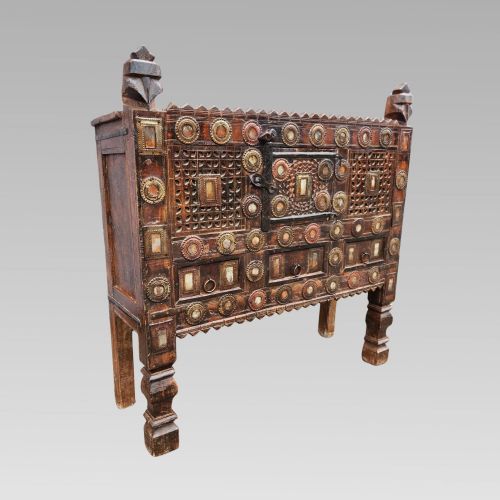
Makers and workshops from various regions contribute distinctive regional flavours, from French Louis revival pieces to Anglo-Indian padauk and teak storage cabinets. Each variation reflects the specific taste for heavy ornamentation prevalent during its period of manufacture.
How they were made
Cabinet makers utilised dense hardwoods such as oak, walnut, and teak as the primary structural foundations, frequently applying burr walnut or satinwood veneers for decorative impact. Marquetry inlay techniques introduce contrasting timbers into the surface designs.
Metal ornamentation played a crucial role in the construction, incorporating cast brass handles, ormolu mounts, and gilt bronze details to accentuate the carved woodwork. Marble slabs frequently provided durable tops for credenzas and cabinets.
Deep relief carving defines the ornamentation, executed by hand on solid timber panels, mirror backs, and cupboard doors. Joinery methods relied on traditional pegged and dovetailed joints to support the considerable weight of the marble and timber.
What varies in quality
The depth and ambition of the hand carving separate standard production furniture from exceptional workshop pieces, where figures and foliage show crisp undercutting. Timber selection also dictates the grade, with figured burr walnut and dense padauk commanding greater visual presence than plain utility woods.
Integration of secondary materials marks the tier of a piece, particularly the weight of the ormolu mounts, the figuring of inlaid marquetry, and the thickness of the marble top. Superior examples maintain crisp joinery that resists the seasonal movement common in large timber assemblies.
Sigmund Jaray Wien
The Ornate Sideboard Glossary
- Credenza
- A low cabinet or sideboard, frequently fitted with glass doors and ormolu mounts, popular in Victorian drawing rooms. These pieces often feature mirror backs and burr walnut veneers.
- Ormolu
- Gilded bronze used for decorative mounts and feet on nineteenth-century furniture. It provides a bright metallic contrast against dark walnut and mahogany timbers.
- Marquetry
- The art of applying small pieces of veneer to a structure to form decorative patterns and pictures. Craftsmen utilise various coloured woods to achieve floral or geometric motifs.
- Breakfront
- A cabinet design where the central section projects forward from the flanking wings. This architectural arrangement creates depth and shadow across the front of the sideboard.
- Damchiya
- A traditional low storage cabinet or dowry chest originating from India, often heavily carved from teak. These items feature hinged panels and deep relief work.
Ornate Sideboard: Frequently Asked Questions
What is an ornate antique sideboard used for?
These large timber pieces provide enclosed storage for dining linens, tableware, and glassware while offering a wide top surface for serving food. The upper surfaces and mirror backs also serve to display decorative ceramics, lamps, and silver.
In modern interiors, they function as focal storage credenzas in dining rooms, large hallways, or living spaces. Their substantial presence anchors a room while keeping clutter hidden behind heavy carved doors.
How do I identify a Victorian sideboard?
Victorian sideboards typically feature dense oak, mahogany, or burr walnut construction combined with deep relief carvings and architectural mirror backs. They often incorporate revival elements such as Renaissance or Gothic details.
Look for heavy brass hardware, ormolu mounts, and marble inserts which were characteristic of high-status nineteenth-century production. The joinery relies on hand-cut dovetails and pegged framing rather than modern fasteners.
How do I live with an antique sideboard?
Position the piece away from direct heat sources and strong sunlight to prevent the timber veneers from drying and lifting. Maintain a stable room temperature to protect antique wood and marble surfaces from thermal shock.
Clean the timber using appropriate wax polishes rather than modern silicone sprays to preserve the patina. Ensure the floor surface is level to prevent distortion in large timber carcases over time.
What is the difference between a sideboard and a credenza?
A sideboard is traditionally a dining room piece designed for serving food and storing tableware, often featuring drawers and cupboards. A credenza is typically a lower cabinet without legs, frequently featuring glass doors and elaborate ormolu mounts.
Credenzas emerged as drawing room furniture focused on display rather than dining service, though both terms are frequently used interchangeably in trade descriptions. The presence of mirror backs and fine marquetry usually points toward the drawing room credenza tradition.