
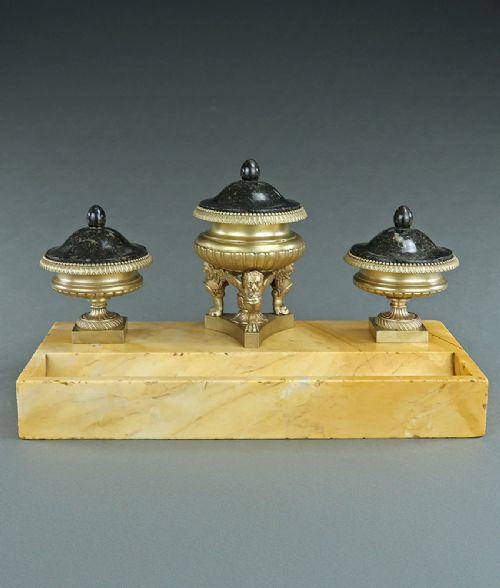
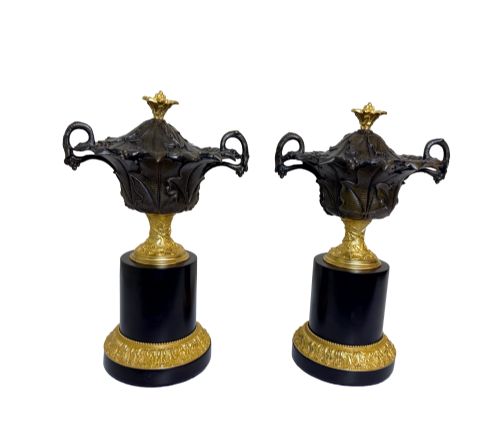
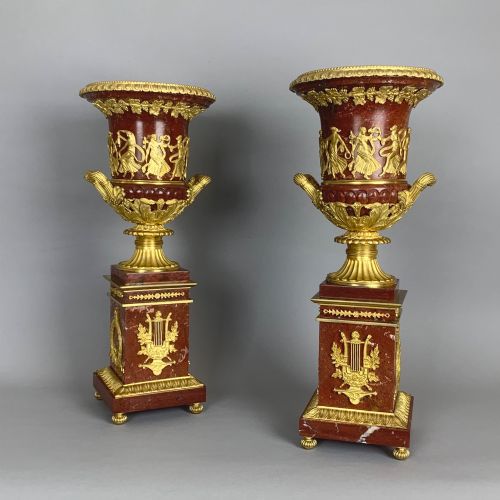
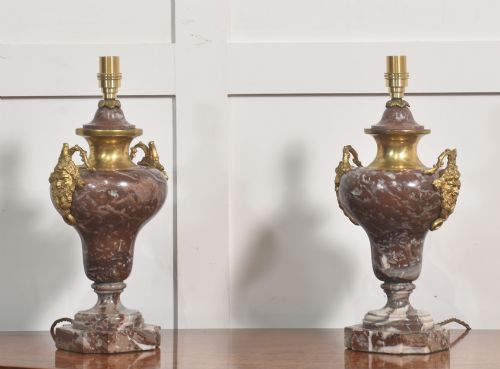
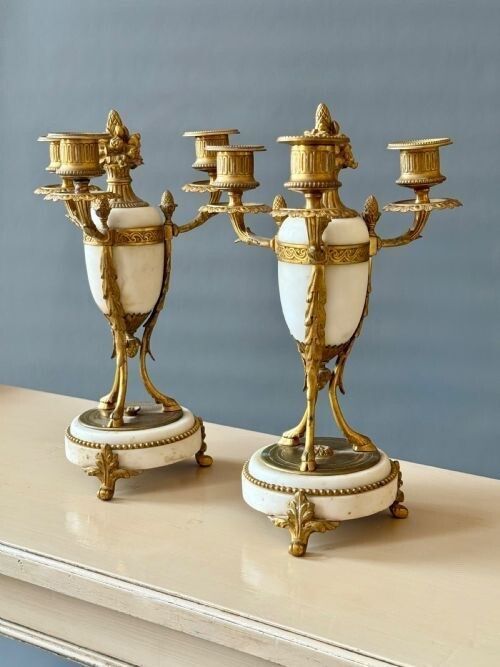
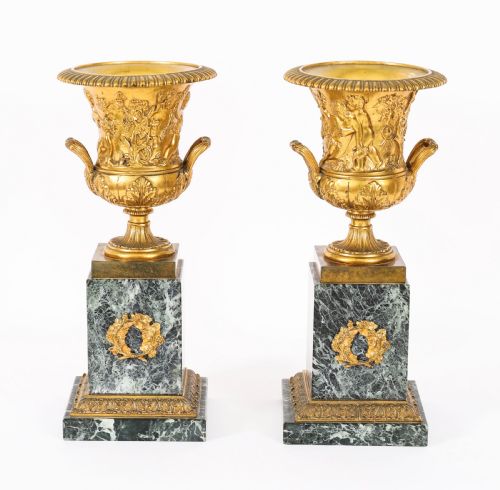
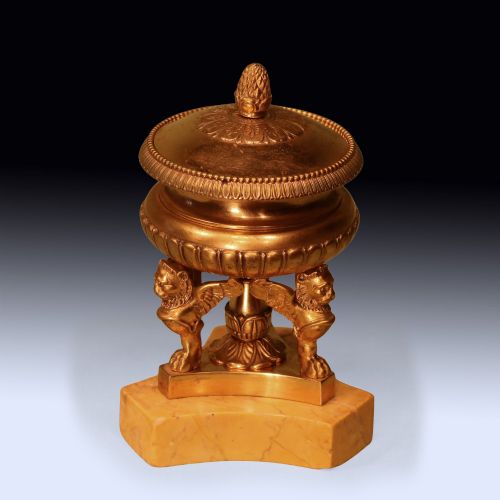
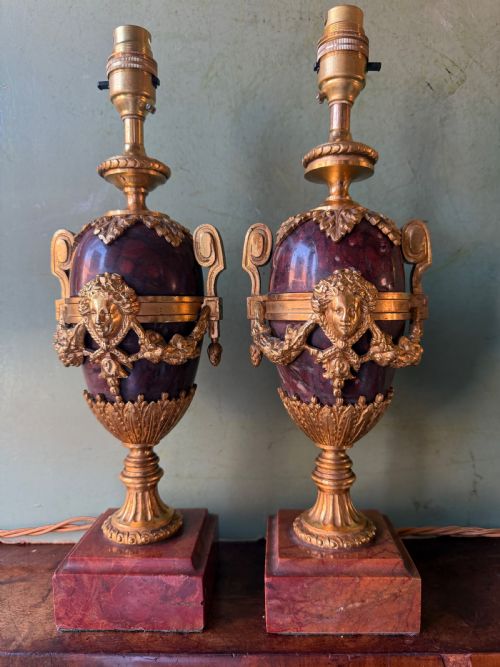
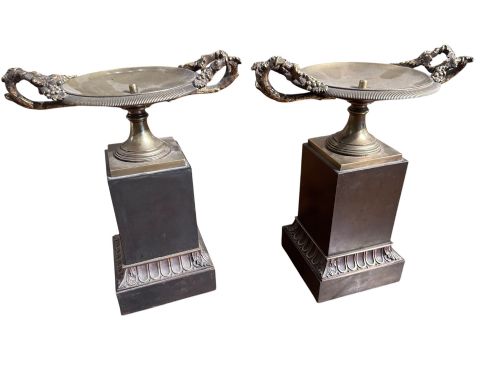
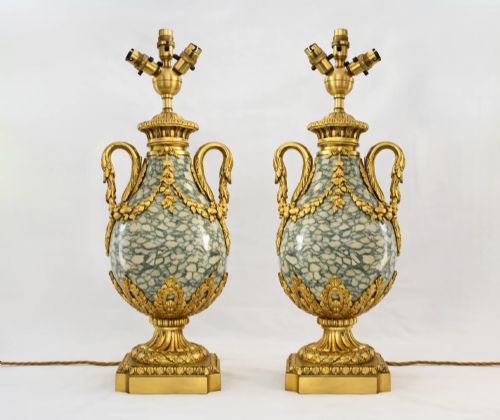


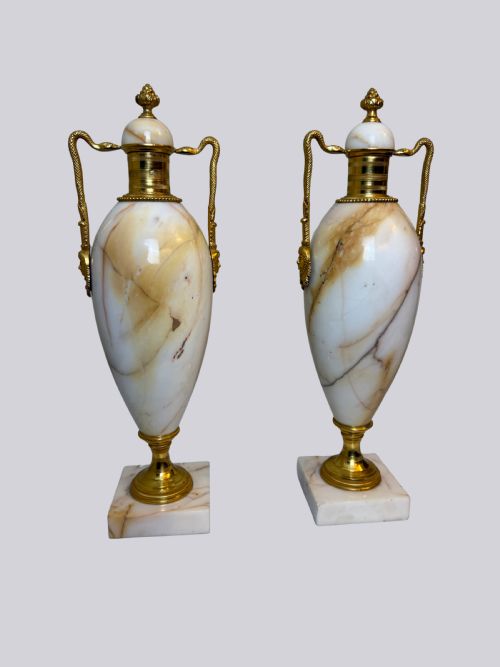


Ormolu Marble Urns
Orisun marble urns combine polished stone with cast and gilded metal to create neoclassical decorative objects that anchor a formal room.
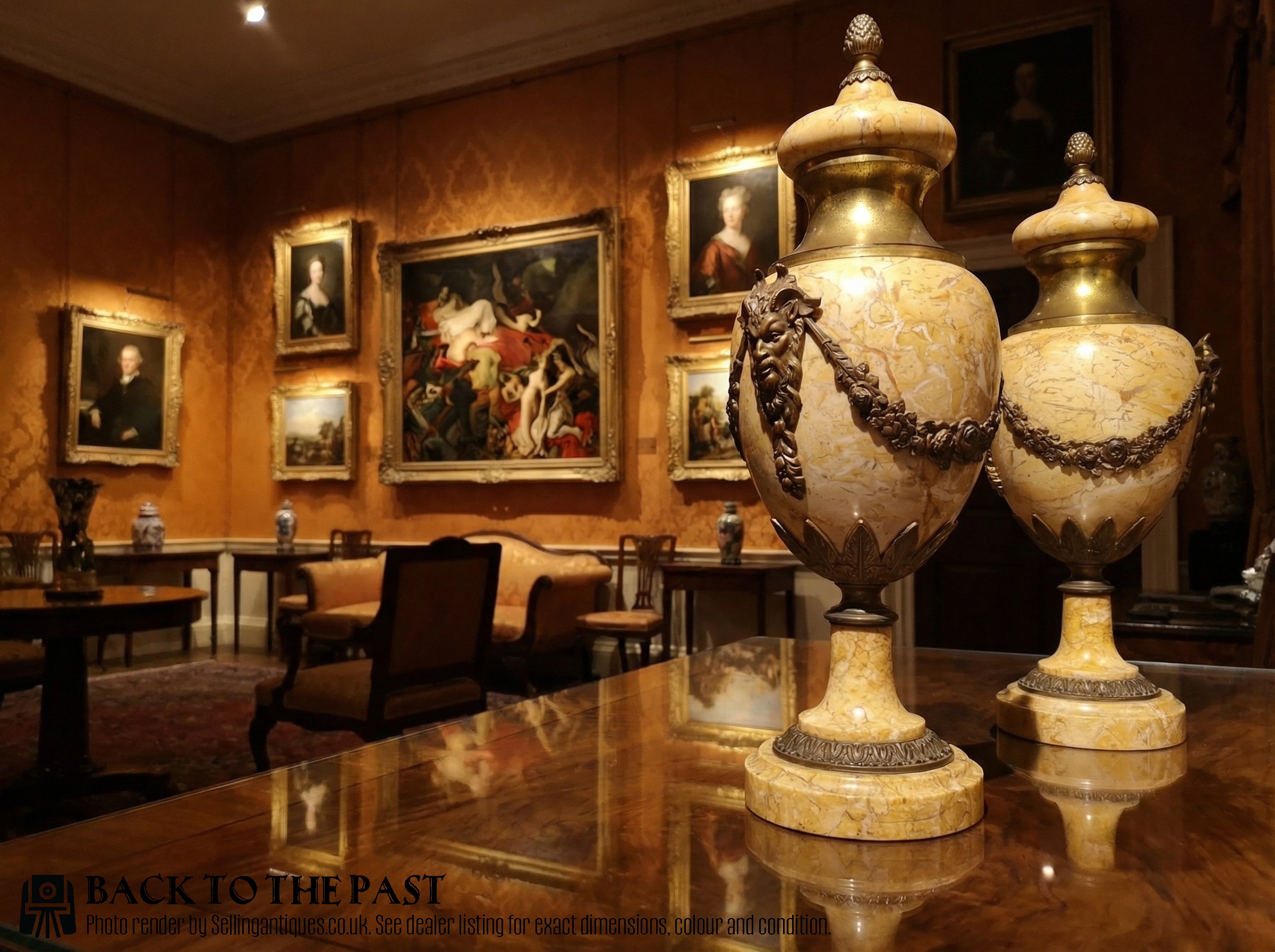
Ormolu Marble Urns
When you search for ormolu marble urns, you encounter decorative vessels, cassolettes, and lamps produced primarily during the nineteenth century in France. These pieces pair solid stone bodies with cast metal mounts inspired by classical antiquity and the Louis XVI revival.
The version you meet most frequently on this page is the pair, often adapted later as table lamps or presented as cassolettes with reversible lids. White marble, rouge marble, and green marble predominate, complemented by mercury-gilded bronze components.
Makers drew heavily upon French Empire and Neoclassical design vocabularies, creating items that functioned equally as mantel garnitures and standalone decorative elements.
Materials and Technique
Artisans turned solid blocks of marble, onyx, or quartz on lathes to achieve the smooth, symmetrical bodies of the urns. These stone sections were frequently bored to accommodate later electrical wiring or fitted with internal metal liners.
The metal mounts, commonly referred to as ormolu or gilt bronze, were produced through lost-wax or sand casting before receiving a layer of gold amalgam. Chasers then refined the surface details with punches and gravers to contrast matte and polished areas.
Listings feature items from the 1850s to the 1930s, dominated by French Neoclassical and Louis XVI revival styles.
Distinctions in Quality
The sharpness of the metal chasing separates standard production from exceptional work. Crisp foliage, defined drapery, and deeply articulated classical motifs indicate skilled hand-finishing rather than a soft, cast-as-found surface.
The selection and turning of the stone body also dictate worth. Dense, unblemished marble with harmonious natural veining, coupled with precise turning at the lathe, distinguishes the finest examples from simpler commercial pieces.
Louis Goret·Achille Brocot
The Ormolu Marble Urns Glossary
- Ormolu
- Gilt bronze produced by applying a mercury and gold mixture to cast bronze and firing it. This historic technique yields a warm, durable golden lustre.
- Cassolette
- A dual-purpose decorative vase featuring a reversible lid that transforms from a closed urn into a candleholder or burner. These frequently appear in French nineteenth-century interiors.
- Garniture
- A set of three matching mantel ornaments, typically comprising a central clock flanked by matching candelabra or urns. They formed the visual centrepiece of a nineteenth-century fireplace.
- Grand Tour
- A period of European travel undertaken by upper-class young men to collect classical art and antiquities. Many nineteenth-century French pieces directly imitate the souvenir objects brought back from these journeys.
Ormolu Marble Urns: Frequently Asked Questions
What is an ormolu marble urn?
These decorative objects combine turned stone bodies with cast bronze mounts that have been gilded with gold leaf or amalgam. They emerged from nineteenth-century French workshops reviving classical and Louis XVI styles.
Craftsmen utilised various marbles including white, rouge, and green varieties, mounting them with handles, collars, and bases cast in detailed floral and architectural motifs.
Were these urns used for ashes?
Despite their traditional shape derived from ancient burial vessels, these nineteenth-century pieces served entirely decorative purposes. They were designed to adorn mantelpieces, side tables, and grand entrance halls.
Many examples function as cassolettes with reversible lids or have been adapted as table lamps while retaining their classic silhouette.
How do I style them at home?
Pairs look striking balanced on either end of a long sideboard, console table, or mantelpiece. Their neoclassical lines complement both traditional period rooms and minimalist modern interiors.
When utilised as table lamps, they provide soft ambient lighting while introducing a sculptural element to a desk or reading table.
How can I tell the period?
Nineteenth-century pieces display specific casting methods, hand-chased metal details, and patination that distinguish them from modern reproductions. Examining the construction of the interior bronze screws, nuts, and the composition of the marble helps confirm the date.
French production from the Empire and Louis XVI revival periods often bears distinct stylistic proportions and mounting techniques typical of Parisian ateliers.