
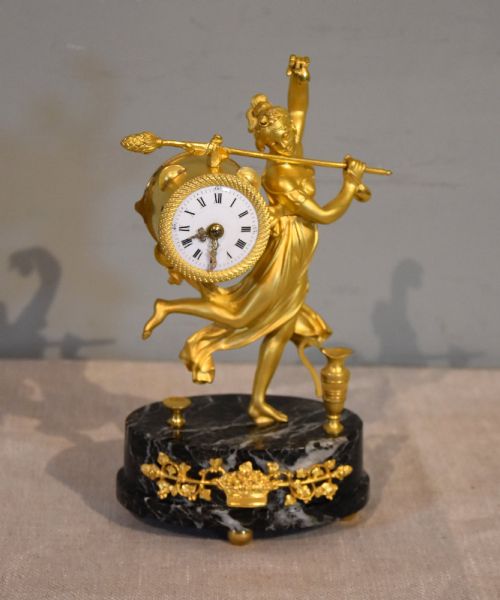
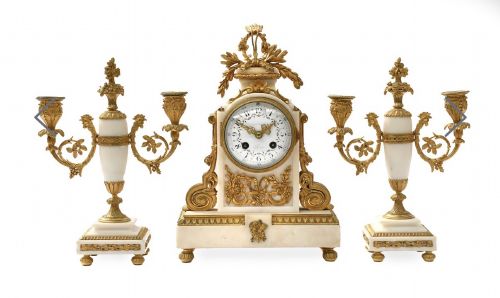
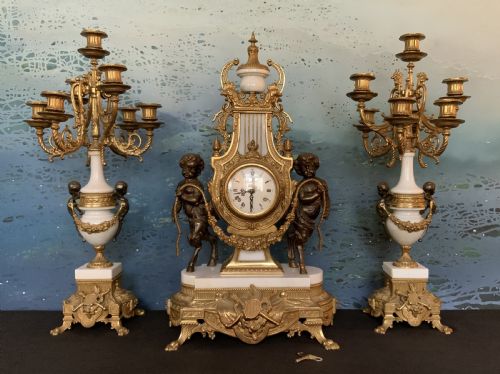


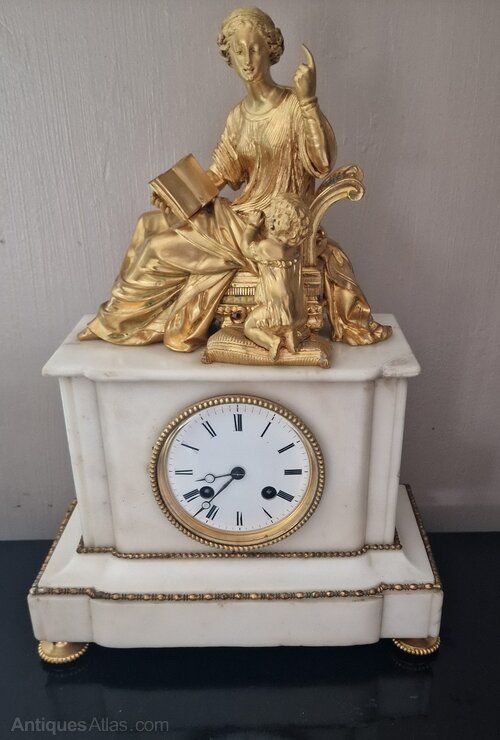

Ormolu Marble Mantel Clock
An ormolu marble mantel clock brings together heavy natural stone and cast, gilded bronze in a stately timepiece designed for the principal rooms of the house.
Ormolu Marble Mantel Clock
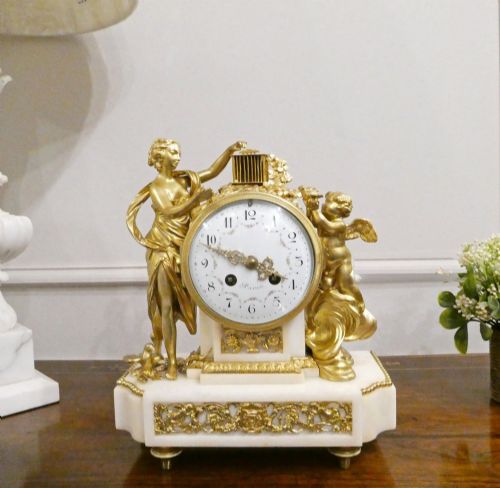
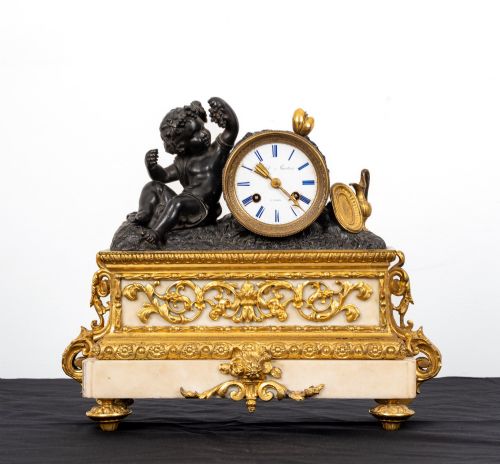
When searching for an ormolu marble mantel clock, a buyer is looking at a dense structural body of stone supporting ornate metallic mounts and a visible dial. These objects combine the cool, heavy presence of quarried marble with the warm, brilliant flash of mercury-gilt bronze.
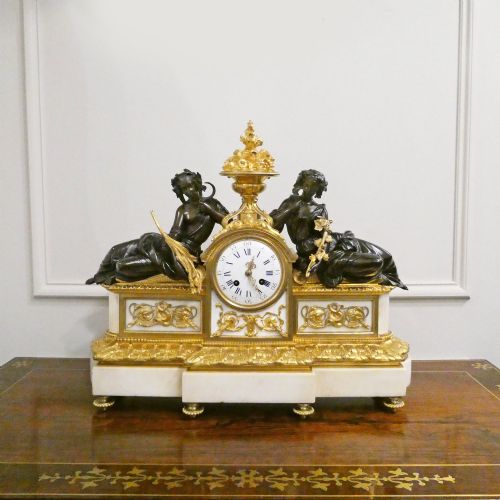
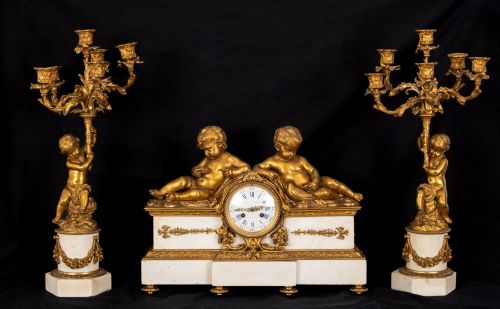
The versions most frequently met on this page originate from nineteenth-century France, spanning the Victorian era and earlier revival styles. They appear both as single freestanding clocks and as larger three-piece garniture sets accompanied by matching candelabra.
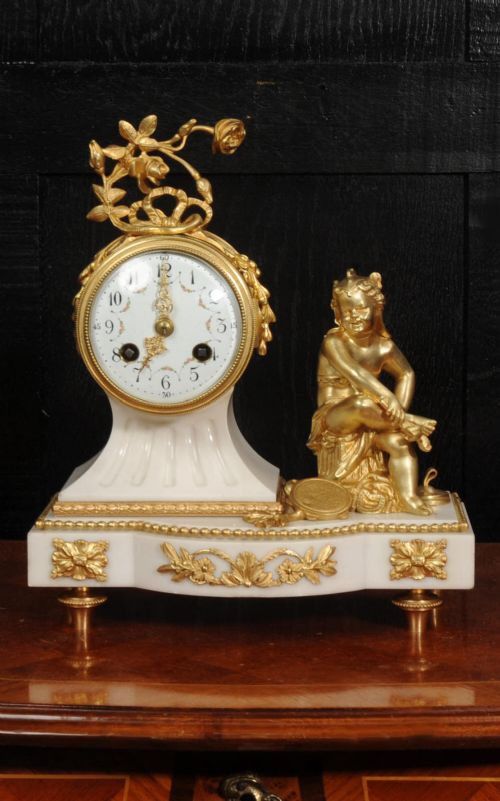
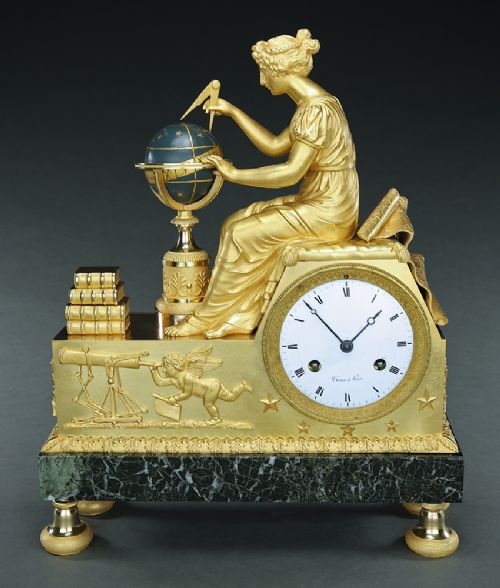
Forms range from strict architectural portico designs and classical urn shapes to elaborate figural compositions featuring cherubs or astronomical motifs. White and rouge varieties of marble dominate the stone bodies, forming solid plinths for the intricate metalwork above.
Materials and Construction
The construction relies on heavy slabs of natural marble, shaped and polished to form the architectural housing for the mechanical movement. Masons cut the stone to precise geometric or curved profiles before receiving cast metal elements.
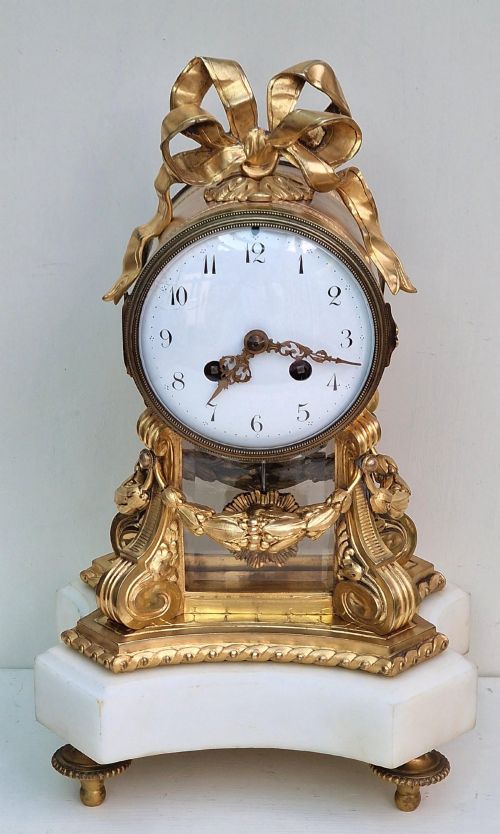
Makers produced the decorative mounts using cast bronze, which was subsequently gilded with a mercury amalgam to achieve the distinctive golden ormolu finish. Enamel dials, often painted with numerals, sit protected behind glass bezels within the metal and stone assemblies.
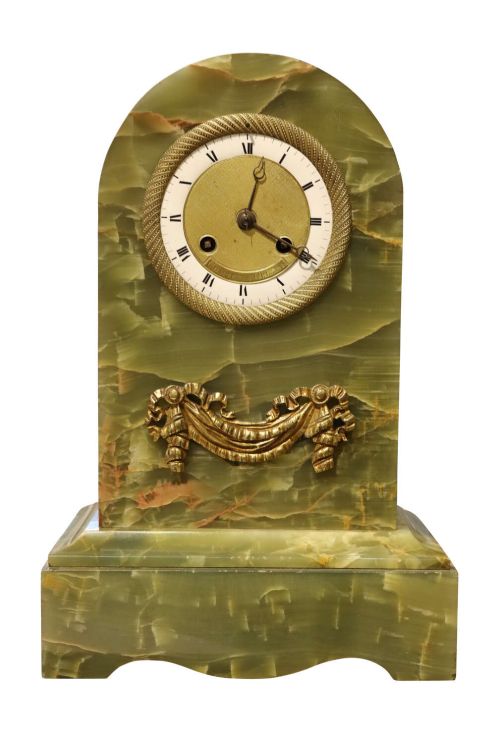
Materials recorded across the inventory include gilt bronze, white marble, rouge marble, green onyx, enamel, and brass.
Distinctions in Quality
Quality rests significantly on the crispness of the bronze chasing and the depth of the mercury gilding. Finer pieces display sharply defined foliage, figures, and mounts where the artisan has hand-tooled the cast metal after removal from the mould.
The selection of the marble itself marks another clear tier, with uniform grain, rich natural veining, and substantial thickness separating superior bodies from simpler containers. Furthermore, the integration between stone and metal, showing tight joints and secure fixings, indicates the standard of the original workshop.
Japy Freres·Charles à Orléans·Vincenti·Siffel and Cartier·Berger Paris·Louis Goret·Mougin·Nicoll Great Portland St London
The Ormolu Marble Mantel Clock Glossary
- Ormolu
- Finely chopped leaf gold applied to a copper-alloy bronze base using a mercury amalgam technique. This historical process yields a deep, lasting lustre unlike modern electroplating.
- Garniture
- A coordinated set of decorative objects for a mantelpiece, usually comprising a central clock flanked by matching candelabra or vases. These balanced groupings became widely popular during the nineteenth century.
- Portico Clock
- A timepiece built within an architectural frame supported by four columns, resembling a classical temple facade. This symmetrical layout often showcases the pendulum swinging in the central open space.
- Mvt
- An abbreviation commonly used in horology to denote the mechanical movement powering the clock. It encompasses the train of wheels, escapement, and striking mechanism.
- Enamel Dial
- A clock face created by fusing powdered glass onto a copper or metal plate at high temperatures. This produces a smooth, glossy surface resistant to fading over generations.
Ormolu Marble Mantel Clock: Frequently Asked Questions
How do I wind an ormolu marble mantel clock?
Most of these timepieces utilise an eight-day mechanical movement wound via key holes positioned directly on the enamel dial. Inserting the matching winding key and turning it gently until resistance is felt powers the mainspring for another week.
Care must be taken not to overwind the mechanism, stopping the moment the spring reaches full tension. Pendulum regulation squares, if present, allow fine adjustments to speed up or slow down the beat.
What is a clock garniture set?
A clock garniture set is a matching arrangement designed to sit together along a mantelpiece or sideboard. The central timepiece is paired with side ornaments such as matching candelabra or urns fashioned from the same marble and ormolu.
This matched grouping provided visual balance and symmetry in formal nineteenth-century interiors. Individual components share identical decorative motifs, finishing techniques, and material palettes.
How do I clean marble and ormolu?
Cleaning requires simple dry dusting with a soft, lint-free cloth to remove surface particles from both the stone and the gilded bronze mounts. Water and chemical cleaning agents must be avoided entirely, as moisture can damage the antique enamel dial and strip old gilding.
Professional horological or conservation advice should be sought before attempting any deeper restoration of the metal or stone surfaces. Protecting the clock from direct sunlight and damp environments preserves the original finish best.
How do I date an ormolu marble mantel clock?
Dating relies on examining the style of the case, the signature or stamp of the maker on the backplate, and the form of the dial. Pieces styled in the French Empire or Louis XVI revivals often date to the nineteenth century, while earlier eighteenth-century examples display distinct hand-carved mounts and simpler movements.
Maker stamps and serial numbers stamped onto the movement plates provide direct clues to the active years of the workshop. Comparing the architectural proportions and marble types against documented examples narrows the window further.