


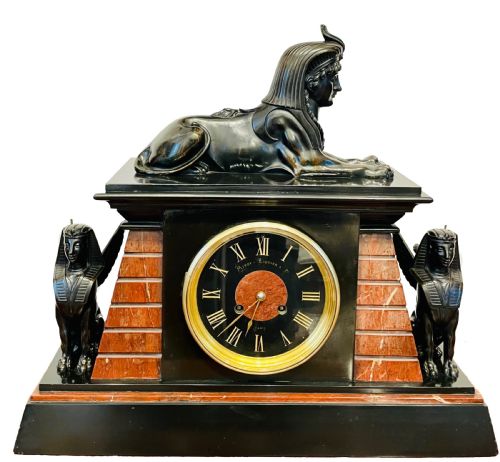
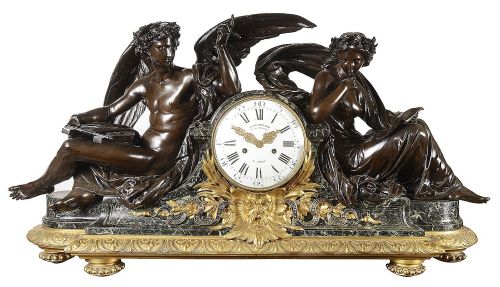


Napoleon III Marble Clock
A napoleon iii marble clock combines heavy stone with gilt bronze mounts to anchor a Victorian interior with architectural weight and precision.
Napoleon III Marble Clock
When you search for a napoleon iii marble clock, you encounter substantial mantel pieces and multi-piece garniture sets hailing from the nineteenth century. These objects combine dense stone bodies in white, pink, rouge, siena, or Verde Antico marble with cast metallic garnitures and dial assemblies.
The prevailing forms on this page include large mantel clocks and three-piece garniture sets accompanied by matching side pieces. Stylistic influences span from French Empire and Neoclassical to Louis XVI Revival and Egyptian Revival, reflecting the eclectic tastes of the period.
Most pieces date between eighteen fifty and nineteen hundred, capturing the Victorian era's enthusiasm for architectural timepieces. They appear alongside specialised variations such as perpetual calendar clocks, swinging cherub movements, and chariot forms.
Materials and Construction
These clocks rely on heavy blocks of natural marble shaped to form architectural cases, paired with cast bronze, ormolu, and brass mounts. Artisans carved and polished the stone bodies to display rich natural veining and deep colour contrasts.
Metallic elements such as ormolu and gilt bronze were cast and fire-gilded to provide bright decorative highlights against the dark or polished stone surfaces. Enamel dials, often protected behind glass bezels, house precision movements designed to drive striking mechanisms and calendar complications.
Napoleon III Marble Clock Retail Price Guide 2026
Typical asking prices for napoleon iii marble clock among the pieces listed under this phrase on Sellingantiques today, from the lower quarter to the upper quarter. They describe what is for sale here now, not the wider market.
Materials recorded on this page include ormolu, glass, bronze, enamel, marble, gilt bronze, brass, and slate.
Assessing Quality and Execution
Quality in these clocks rests upon the crispness of the bronze casting and the depth of the ormolu gilding. Superior examples display sharply chased surface details and heavy, unblemished marble cases with well-aligned joints.
The movement itself determines the mechanical standing of the piece, with signed Parisian makers and complicated gear trains such as perpetual calendars or equation of time indications commanding higher regard. The integration between the stone body and its metal mounts separates standard production from exceptional studio output.
Victor Paillard·Deniere and Cailleaux·Brocot·Farcot·Raingo Fres
The Napoleon III Marble Clock Glossary
- Ormolu
- Gilt bronze created by applying a mercury and gold amalgam to a bronze object and heating it to drive off the mercury. This technique produces a durable golden finish characteristic of fine nineteenth-century French metalwork.
- Garniture
- A set of matching decorative objects designed to be displayed together on a mantelpiece, typically consisting of a central clock flanked by two matching side pieces such as urns or candelabra.
- Verde Antico
- A dark green serpentine marble breccia veined with white calcite, utilised in classical and revivalist decorative arts for its dramatic colouration.
- Enamel dial
- A clock face made by fusing powdered glass to a metal substrate at high temperatures. This creates a smooth, glossy surface resistant to fading and discolouration.
- Striking clock
- A timepiece equipped with a mechanical train that sounds the hours or fractions of hours on a bell or gong.
Napoleon III Marble Clock: Frequently Asked Questions
What is a clock garniture set?
A garniture set comprises a central mantel clock accompanied by two matching side ornaments, often shaped as urns or vases. These pieces share identical marble bodies and ormolu mounts to create a unified display.
Placing the complete set across a mantelpiece achieves the symmetrical arrangement favoured in Victorian and Second Empire interiors.
How do I identify a Napoleon III clock?
Napoleon III clocks are defined by their eclectic revival styles, heavy stone cases, and generous application of gilt bronze or ormolu. They frequently combine architectural marble forms with Neoclassical or Egyptian motifs.
Signatures on the movement backplate or the dial often point to Parisian workshops active during the mid to late nineteenth century.
Where should I place a heavy marble clock?
Because these timepieces utilise dense blocks of natural stone combined with bronze mounts, they require a sturdy, level surface capable of supporting considerable weight. A robust mantelpiece or a secure console table provides an ideal foundation.
Ensuring the surface is level helps the pendulum swing evenly, which keeps the striking mechanism and escapement functioning correctly.