

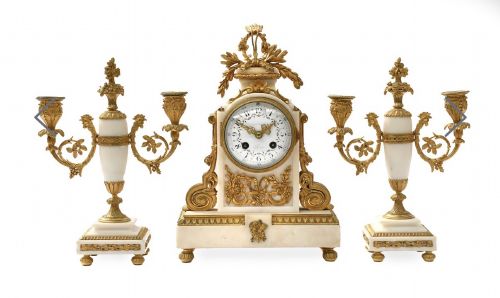
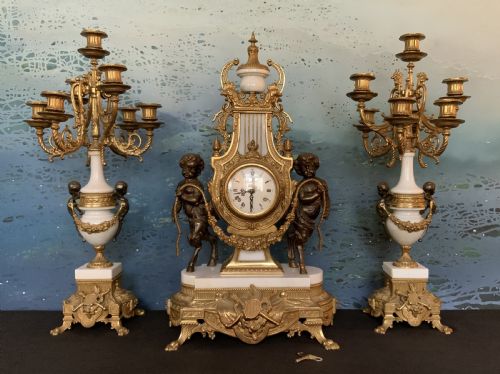


Ormolu Mantel Clock Garniture
An ormolu mantel clock garniture brings a grand focal point to a room, pairing a central timepiece with matching flanking candelabras or urns.
Ormolu Mantel Clock Garniture
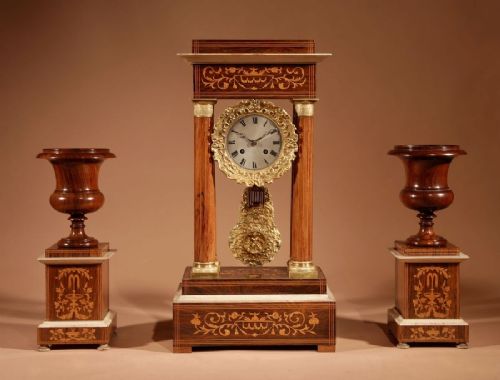
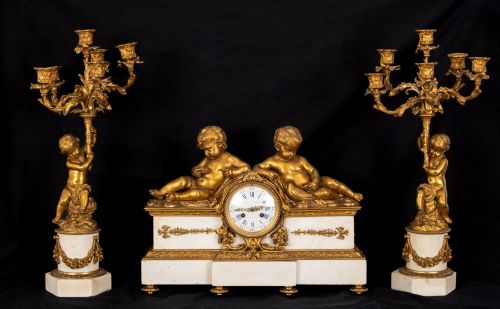
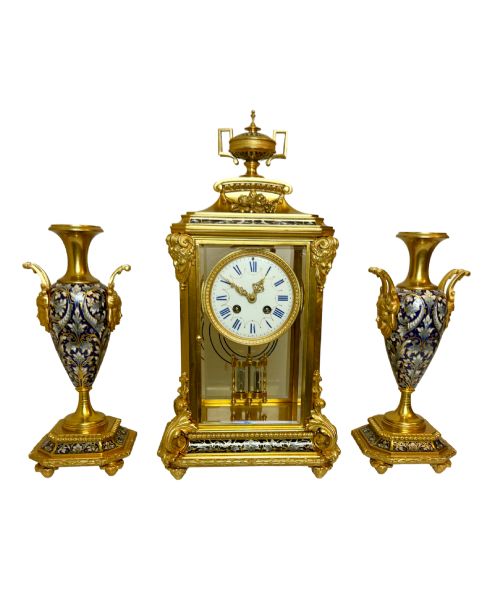
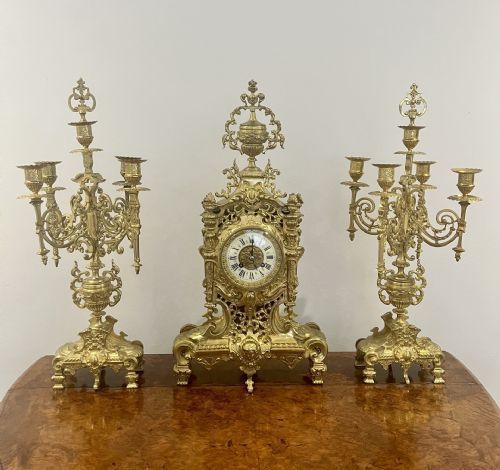
An ormolu mantel clock garniture comprises a main clock flanked by matching side pieces such as candelabras, vases, or urns, designed to create a balanced arrangement on a fireplace mantel.
Most examples found here hail from the nineteenth century, taking the form of French decorative sets spanning periods from the Victorian era through to the late eighteen-eighties and nineties.
Makers and designers drew heavily on historical aesthetics, producing pieces in styles that range from Louis XVI revival and French Rococo to grand Second Empire expressions.
Materials and construction
Craftsmen built these sets using cast metals such as bronze and brass, applying gold gilding known as ormolu to the metallic surfaces to achieve a rich, enduring lustre.
Natural stones such as white marble, red marble, pink marble, and onyx form the sturdy bases and architectural bodies of the clocks and their matching side pieces.
Dials and decorative accents often incorporate enamel, porcelain, and glass domes, frequently driven by eight-day striking mechanical movements.
Assessing quality and craftsmanship
The precision and depth of the metal casting dictate much of the quality, separating sharply chiselled ormolu mounts from softer, less defined ornamentation.
The selection and integration of materials play a major role, with dense natural marbles and hand-painted porcelain panels marking out the superior productions.
The reputation of the movement maker and the harmony of the complete three-piece or multi-piece set determine the overall standing of an individual garniture.
Henry Dasson·A D Mougin·H Luppens Paris·Vincenti of Paris
The Ormolu Mantel Clock Garniture Glossary
- Ormolu
- A technique of applying finely ground high-carat gold to a bronze object. This process yields a warm, golden finish characteristic of decorative French metalwork.
- Garniture
- A set of matched ornamental objects designed to be displayed together. These usually consist of a central clock paired with two side candelabras or urns.
- Champleve enamel
- An enamelling technique where troughs are dug into a metal surface and filled with vitreous paste before firing. The method produces colourful, patterned designs across the metal.
- Bleu de Roi
- A deep, rich royal blue ceramic glaze often seen on porcelain components. Factories utilised this colour to add visual weight and contrast against gilt metal mounts.
- Portico clock
- A distinct architectural clock style supported by columns resembling a classical porch. These often form the centrepiece of elaborate nineteenth-century sets.
Ormolu Mantel Clock Garniture: Frequently Asked Questions
How do I clean an ormolu clock?
Dust the gilded surfaces gently with a soft, dry brush to prevent the accumulation of dirt within the intricate chased details.
Avoid using abrasive metal polishes or chemical cleaners, as these substances can strip away the delicate gold layer entirely.
Where should I place a garniture set?
These sets traditionally sit upon a fireplace mantelpiece, where the central clock anchors the arrangement flanked by matching candelabras.
Ensure the supporting surface is level and sturdy enough to hold the considerable weight of the marble and bronze components.
How do these clocks keep time?
Most period examples utilise mechanical eight-day spring-driven movements that require manual winding using a matching key.
Professional servicing helps maintain the internal gear trains and ensures the striking mechanism operates accurately over time.
How do I identify Louis XVI style?
Louis XVI style pieces display classical symmetry, straight lines, and motifs inspired by ancient Greek and Roman architecture.
Look for restrained ornamentation such as urns, floral garlands, and fluted columns rather than the asymmetrical curves of earlier Rococo designs.