




Rococo Style Garniture
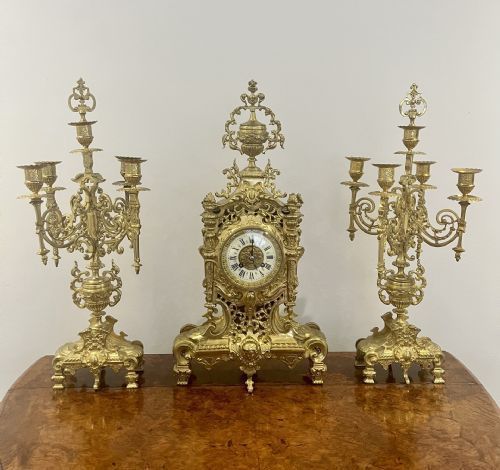
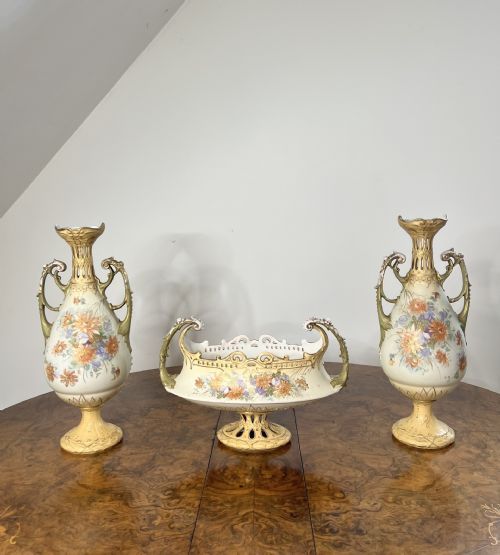
These rococo style garniture sets are elaborate mantel displays of matched clocks, vases and candelabra designed to bring ornamental drama to nineteenth-century interiors.
Rococo Style Garniture
A rococo style garniture typically arrives as a three-piece clock set comprising a central mantel clock flanked by matching candelabra or lidded vases. These decorative ensembles date predominantly from the nineteenth century, including Victorian interpretations and French Revival pieces.
The forms draw heavily upon eighteenth-century French aesthetics, manifested in asymmetrical scrolling, naturalistic floral motifs and sculptural figural elements. Buyers encounter comprehensive clock garnitures alongside standalone pairs of decorative vases and candelabra designed for symmetrical display.
Origins span British Victorian workshops and continental European factories, with French makers dominating the production of ormolu-mounted porcelain sets. The groupings serve both a decorative and a functional purpose on nineteenth-century mantelpieces and console tables.
Materials and Manufacture
Craftsmen utilised porcelain as the primary body for vases and clock panels, frequently employing painted surfaces in the Sevres style. This ceramic base combines with cast metal mounts to create the characteristic layered weight of the garniture.
Metalwork relies on ormolu, gilt bronze, brass and standard bronze, cast and chased to achieve scrolling rococo foliage and shell motifs. Gilding highlights the intricate surface relief, while marble occasionally provides a solid foundation for clock plinths.
Rococo Style Garniture Retail Price Guide 2026
Typical asking prices for rococo style garniture among the pieces listed under this phrase on Sellingantiques today, from the lower quarter to the upper quarter. They describe what is for sale here now, not the wider market.
Listings feature nineteenth-century pieces from Victorian Britain and continental Europe, utilising porcelain, ormolu, bronze and brass.
Evaluating Quality and Execution
The refinement of the casting and chasing in the ormolu or brass mounts distinguishes superior garnitures from simpler commercial production. Crisp detailing in the asymmetric scrolls and floral elements indicates skilled hand-finishing rather than a generic moulded output.
The quality of the painted porcelain panels and the integration of the clock movement within the ceramic or metal housing elevate a set's standing. Matched groupings that retain their original gilding and partner pieces without later replacement demonstrate greater coherence.
Royal Vienna·KPM Berlin·Meissen·VINCENTI of PARIS
The Rococo Style Garniture Glossary
- Garniture
- A set of ornamental objects designed to match and display together on a mantelpiece or sideboard, usually consisting of a clock and two side vases or candelabra.
- Ormolu
- Gilt bronze produced by applying a finely ground high-carat gold mercury amalgam to a bronze object, creating a durable golden surface finish. This technique defines the rich metallic highlights on nineteenth-century French sets.
- Candelabra
- Branched candlestick holders designed to hold multiple candles as part of a matching display set. They form the flanking pieces in many clock garnitures.
- Sevres Style
- Decorative porcelain painting and design mimicking the distinctive soft blues, pinks and gilt-bordered panels associated with the Sevres factory in France. Nineteenth-century makers frequently adopted this aesthetic for garniture vases.
- Rococo Revival
- The nineteenth-century artistic movement that revived the ornate, asymmetrical scrolling and naturalistic motifs of the mid-eighteenth-century French court style.
Rococo Style Garniture: Frequently Asked Questions
What pieces make up a garniture?
A standard garniture set comprises a central mantel clock accompanied by two matching side pieces, such as candelabra, urns or lidded vases. These three items were designed to create a balanced, symmetrical arrangement on a fireplace mantel.
Individual pairs of vases or candelabra also appear under the garniture description if they follow the same decorative scheme. The components share identical materials, styles and ornamental motifs to function as a unified visual display.
Where were these garnitures displayed?
Nineteenth-century households placed these sets on mantelpieces above fireplaces, where they commanded attention as focal points in reception rooms and parlours. They also adorned large console tables, sideboards and pier tables.
The reflective qualities of the gilt bronze or ormolu and the bright porcelain surfaces were intended to catch the candlelight and gaslight of the period.
How do I identify French revival pieces?
French revival garnitures typically feature cast ormolu mounts with characteristic asymmetrical scrollwork, C-scrolls and naturalistic plant forms derived from eighteenth-century designs. Many incorporate porcelain panels painted with pastoral scenes or floral bouquets in the manner of Sevres.
The presence of movement makers from Paris or specific regional bronze-casting signatures further points to French production during the nineteenth century.
Are the clocks usually in working order?
Clock movements in nineteenth-century garnitures vary in their operational status and frequently require professional servicing to run accurately. Many retain their original bell-striking mechanisms and pendulum components.
Buyers should examine specific listings to determine whether a clock has been recently overhauled or remains sold purely as an ornamental antique object.
How do I care for ormolu and porcelain?
Maintenance requires gentle dusting with a soft, dry cloth to prevent the accumulation of dirt in the recesses of the cast metal mounts. Abrasive cleaners must be avoided entirely, as they damage the delicate gilding on both the ormolu and the porcelain surfaces.
Handling should be minimised, particularly when moving multi-piece sets or removing vase lids, to protect the fragile ceramic bodies and gilt finishes.