
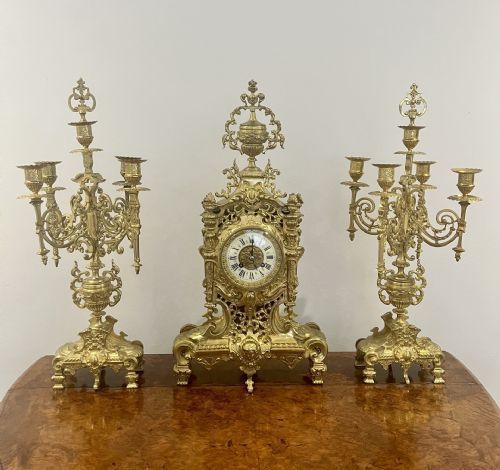


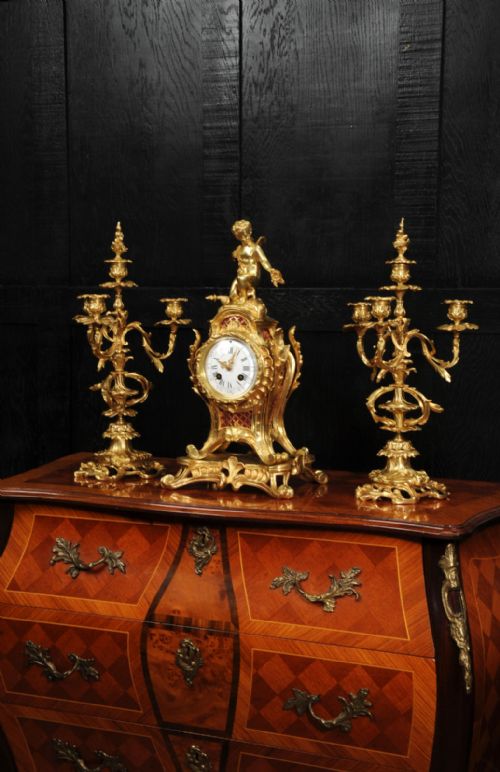


French Rococo Clock Set
A french rococo clock set brings the extravagant curves and gilt brilliance of the nineteenth century straight onto the mantelpiece.
French Rococo Clock Set
A french rococo clock set comprises a central mantel timepiece flanked by matching candelabras or urns, forming an integrated decorative scheme. These ensembles date predominantly from the nineteenth century, emerging during the Victorian era through revivals of Louis XV styles.
Most examples encountered here take the form of clock garnitures featuring figural motifs like cherubs, cupids, or dolphins alongside elaborate scrollwork. The grouping transforms a functional timekeeper into a balanced ornamental focal point for a room.
Materials and Construction
Foundry work relies on cast bronze, brass, and gilt metals such as ormolu, shaping the characteristic asymmetrical C-scrolls and foliage of the revival style. Gilding and polishing bring out the reflective quality of the bronze and brass surfaces.
Many sets incorporate ceramic elements, including painted porcelain panels, Sevres style plaques, and imported Imari wares, alongside red marble and enamel dials. Glass protects the clock face while steel components drive the mechanical movement.
Ensembles frequently pair central mantel clocks with flanking candelabras, incorporating figures of cupids and dolphins.
Distinctions in Quality
Depth of chisel work and crispness in the metal casting differentiate standard production from finer output, particularly where foliage and figural details meet. Heavier gauge bronze and thick ormolu layers hold definition better across complex rococo curves.
The integration of hand-painted porcelain panels and the presence of named maker movements elevate certain ensembles above ordinary commercial sets. Complete, matching garnitures where clock and sidepieces share identical patination and design hold greater cohesion.
Vincenti of Paris·Raingo Fres Paris·Louis Japy·Japy Freres·Verger Freres of Paris·Samuel Marti·Louis Boname·A D Mougin·Fritz Marti·KPM Berlin·Meissen
The French Rococo Clock Set Glossary
- Garniture
- A set of matching decorative ornaments designed to be displayed together on a mantelpiece or sideboard. Typically consists of a central clock flanked by two matching candelabras, vases, or urns.
- Ormolu
- Finely ground high-carat gold applied to a bronze base using a mercury amalgamation technique. This historic process creates a durable, warm metallic finish characteristic of fine nineteenth-century French metalwork.
- Sevres Style
- Porcelain decorated in the manner of the royal French Sevres factory, often featuring hand-painted reserves against rich coloured grounds. These panels are frequently mounted into the brass and bronze cases of mantel clocks.
- Louis XV Revival
- A nineteenth-century design movement recreating the ornate asymmetry, C-scrolls, and naturalistic motifs of the French mid-eighteenth century. This aesthetic dictates the sweeping contours seen on these clock sets.
French Rococo Clock Set: Frequently Asked Questions
How do I tell different periods apart?
Dating relies on examining the materials, casting style, and dial construction, with most pieces belonging to the nineteenth century. Earlier nineteenth-century examples often feature heavier bronze casting and detailed hand-chiselling.
Later Victorian interpretations tend to utilise brighter brass alloys and simpler stamped ornament. Maker marks stamped on the internal brass clock movements also provide reliable chronological markers.
Where were these clock sets made?
The vast majority of these ornamental sets originated in France, particularly within the workshops and factories centred around Paris. Parisian makers supplied luxury goods across Europe and beyond during the Victorian era.
Some pieces incorporate imported porcelain components, such as Imari wares from Japan or factory-painted plaques from Germany, mounted into the French bronze housings.
How should I care for a gilt bronze clock?
Maintenance requires gentle dusting with a soft, dry brush to prevent the accumulation of dirt within the intricate rococo crevices. Avoid chemical polishes, water, or abrasive cloths, which can strip away the delicate gilt or ormolu surface.
Mechanical movements benefit from professional cleaning and oiling by a specialist horologist every few years to ensure reliable timekeeping.