
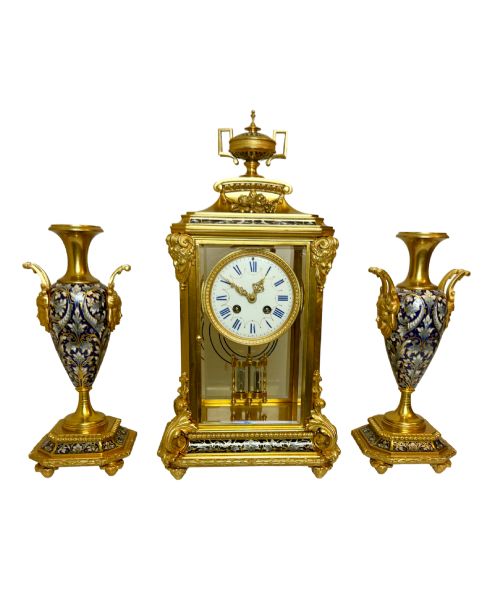


Champleve Mantel Clock
A champleve mantel clock brings together heavy gilt metal and vibrant coloured enamel in a striking centrepiece for the room.
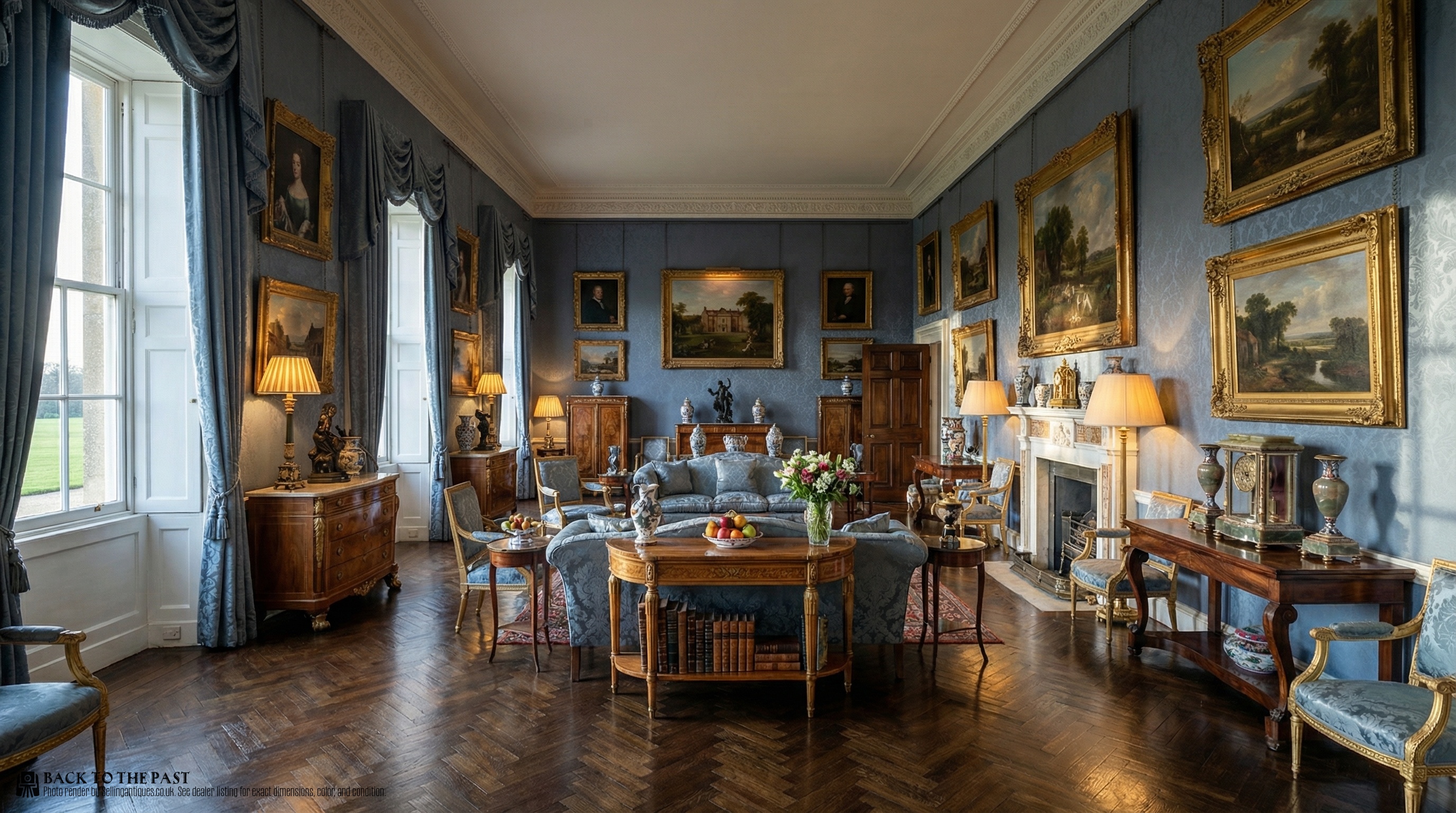
Champleve Mantel Clock
When searching for a champleve mantel clock, collectors generally encounter ornate French horology produced during the nineteenth century, including the Victorian era and the Belle Epoque. These pieces frequently take the form of heavy architectural mantel clocks, crystal regulators, and multi-piece garniture sets featuring matching side urns or candelabra.
The objects combine timekeeping with decorative metalwork and glass casing, often displaying stylistic influences from the Second Empire and the Louis XVI revival. Makers frequently utilised brass, gilt bronze, or ormolu as a foundation to frame vibrant sections of enamelled decoration across the dial, bezel, and columns.
How they were made
The creation of these clocks relied on metal casting combined with the champleve technique, where troughs or cells are hollowed out directly into the surface of the bronze or brass. Artisans then filled these recessed channels with coloured glass enamel powders before firing the metal to fuse the vitreous paste permanently into the design.
Makers finished the cast bronze and brass frameworks through extensive gilt plating, ormolu mercury gilding, or hand-polishing to contrast against the opaque enamel bands and floral panels. Complex brass mechanical movements, including pendulum suspensions and striking trains, were fitted inside the glazed housings by specialised horologists.
What varies in quality
Quality across these timepieces depends heavily on the crispness of the bronze casting and the depth of the hand-chased detail within the metal foliage and geometric mounts. Finer examples display smooth, evenly fired enamel work without surface cracking or pitting inside the recessed metallic channels.
The horological components also dictate overall standard, as signed movements by notable Parisian makers or fully integrated garniture sets command greater appreciation than standard anonymous factory productions. The precision of the glass bevelling in four-glass cases and the preservation of the original mercury gilding further separate standard pieces from exceptional works.
Le Roy and Fils·Samuel Marti·Vincenti·Barwise London·Leroy Paris
The Champleve Mantel Clock Glossary
- Champleve enamel
- A technique where troughs are carved into a metal base and filled with vitreous enamel before firing. This method creates flat or slightly raised coloured patterns bordered by thin metal lines.
- Ormolu
- Gilded bronze produced by applying a mercury and gold amalgam to a cast bronze object and heating it to drive off the mercury. The resulting finish provides a durable golden sheen.
- Clock garniture
- A matching set consisting of a central mantel clock accompanied by side ornaments such as urns, vases, or candelabra. These sets were designed to sit harmoniously on a fireplace mantel.
- Crystal regulator
- A mantel clock housed within glazed panels on all four sides, allowing a clear view of the mechanical movement and pendulum. These designs became popular during the later nineteenth century.
- Striking movement
- A mechanical clock train that chimes the hours or half-hours on a bell or gong. Many nineteenth-century examples utilise rack striking systems.
Champleve Mantel Clock: Frequently Asked Questions
What is a champleve mantel clock?
A champleve mantel clock is a decorative timepiece featuring metalwork decorated with recessed enamel cells. These items originated predominantly in nineteenth-century France and were designed to sit prominently on drawing room fireplaces.
They combine mechanical clockwork with intricate vitreous enamel patterns set into gilt bronze, brass, or ormolu housings. Many survive today as part of larger matching garniture sets.
How do four glass clocks work?
Four glass clocks utilise a visible central mechanical movement suspended between front, back, and side glass panels. This design allows light to pass through the entire housing.
Pendulums in these clocks often feature mercury compensation jars or intricate decorative bobs that swing visibly within the transparent chamber.
How should I clean the enamel?
Enamel surfaces require gentle dusting with a soft, dry cloth to prevent accumulation of debris in the recessed metal channels. Moisture should be kept away from the vintage materials.
Harsh chemical cleaning agents or metal polishes will strip the delicate gilding from the bronze frame and damage the fired glass enamel.
Are these clocks difficult to wind?
Winding requires a matching key inserted into the dial arbors to tension the mainsprings cautiously. Most mechanical movements run for approximately seven to eight days per wind.
Care must be taken not to over-wind the springs, and professional horological servicing is recommended to keep the vintage gear trains running smoothly.