



Victorian Gilt Clock Garniture
A victorian gilt clock garniture brings matching French elegance to a mantelpiece, pairing a central timepiece with flanking candelabras or urns.
Victorian Gilt Clock Garniture
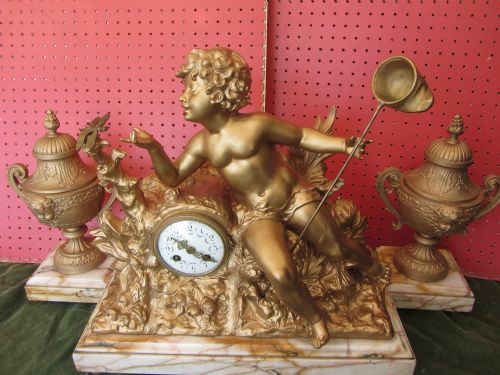
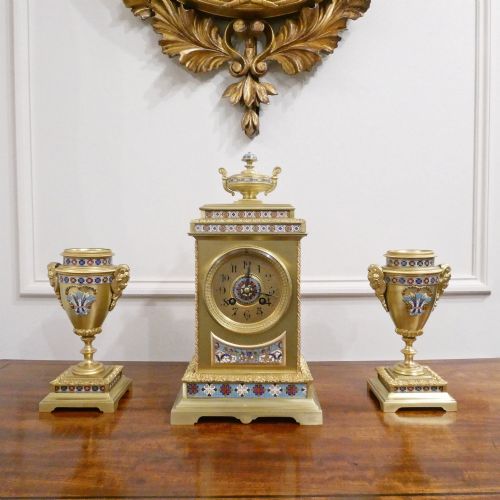
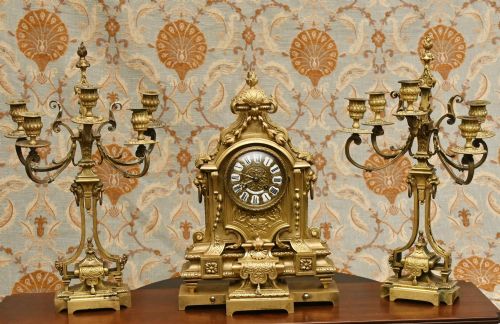
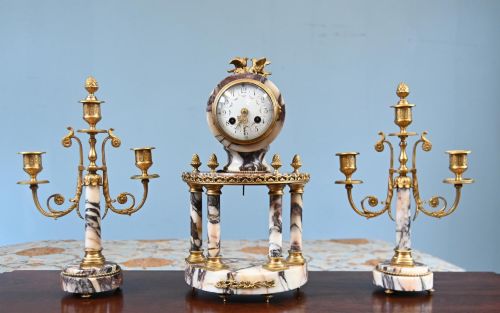
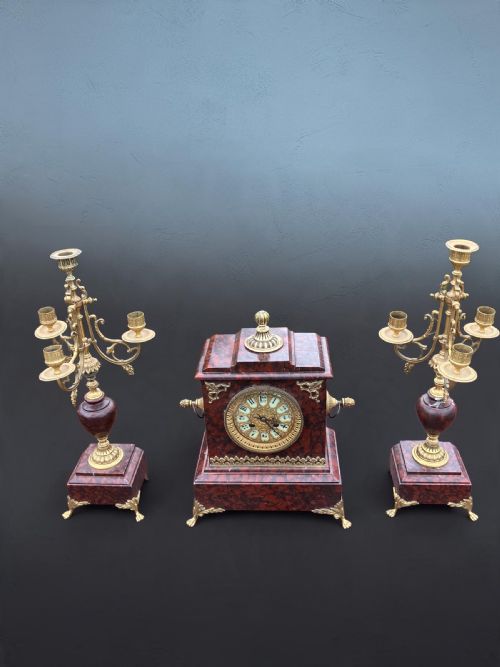
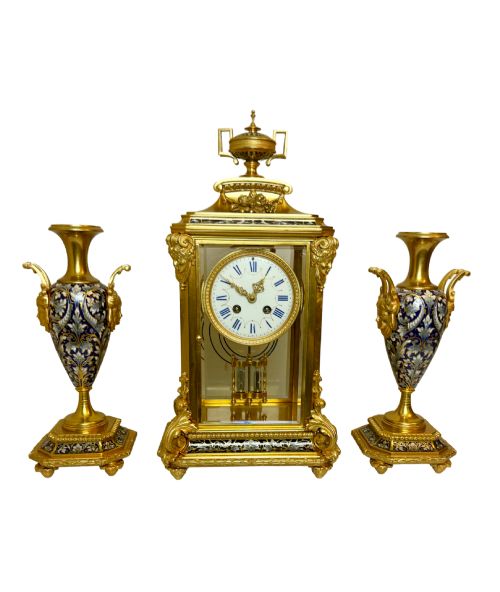
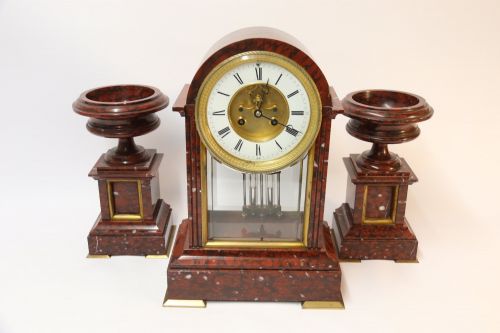
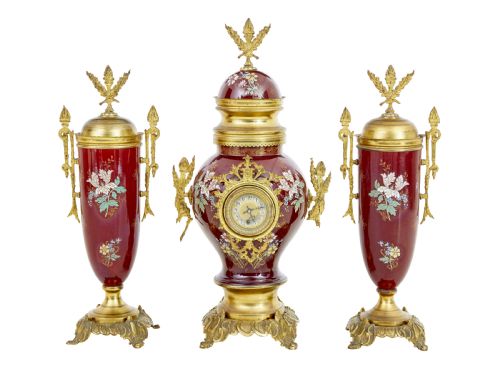
A victorian gilt clock garniture comprises a central mantel clock accompanied by two matching side pieces, typically urns or candelabras, designed to create a symmetrical display on a fireplace. These sets date primarily from the nineteenth century, reflecting the tastes of the Victorian period and the French Second Empire.
The versions most commonly met on this page are French in origin, often executed in styles such as Napoleon III, French Rococo Revival, and Louis XVI Revival. They arrive as complete three-piece arrangements, unifying the decor of a room through matching metals, enamels, and stone bases.
Makers recorded in the archive and current listings include Samuel Marti, A.D. Mougin, Raingo Fres, and Ferdinand Barbedienne. These firms produced the intricate movements and housing that define the category.
Materials and construction methods
The primary structural housings combine cast metals such as bronze, brass, and gilded metal with natural stones including marble, onyx, and slate. Ormolu and gilt bronze finishes provide the characteristic golden sheen across the surface of the clock cases and side garnitures.
Decorative elements frequently incorporate porcelain panels, champleve enamel, and painted details, sometimes protected by glass domes. Movements are mechanical, driving enamelled dials that display the hours and minutes.
Victorian Gilt Clock Garniture Retail Price Guide 2026
Typical asking prices for victorian gilt clock garniture among the pieces listed under this phrase on Sellingantiques today, from the lower quarter to the upper quarter. They describe what is for sale here now, not the wider market.
Current listings feature pieces spanning the 1860s to 1900, incorporating materials like gilt bronze, champleve enamel, marble, and porcelain.
What separates the finest examples
Quality in a victorian gilt clock garniture rests upon the crispness of the metal casting and the depth of the gilding. Superior pieces display finely chased details on the bronze or ormolu mounts rather than soft, mass-produced edges.
The integration of the side pieces with the central clock determines the coherence of the set. Matching stone types, intact enamel work, and signed movements by known makers elevate an assembly beyond standard decorative factory output.
Samuel Marti·A.D Mougin·Raingo Fres Paris·Ferdinand Barbedienne
The Victorian Gilt Clock Garniture Glossary
- Garniture
- A matching set of ornamental objects for a mantelpiece, consisting of a central clock flanked by two matching pieces such as urns or candelabras.
- Ormolu
- Finely ground high-carat gold applied to a bronze base using a mercury amalgamation technique, yielding a rich metallic lustre.
- Champleve
- An enamelling technique where troughs are dug into a metal surface and filled with vitreous paste before firing.
- Napoleon III style
- A nineteenth-century French aesthetic combining eclectic revivals of Louis XIV, Louis XV, and Louis XVI designs with opulent ornamentation.
- Candelabra
- A branched candlestick used as a matching side piece in many garniture sets.
Victorian Gilt Clock Garniture: Frequently Asked Questions
What is a clock garniture?
A clock garniture is a matched set consisting of a central mantel clock and two accompanying decorative pieces, such as urns or candelabras, designed to sit together on a mantelpiece.
These sets gained popularity in the nineteenth century as complete decorative schemes for grand interiors, ensuring visual harmony across the fireplace.
How do I identify French pieces?
French pieces often bear the signatures of prominent clockmakers or foundries on the movement backplate or the dial, alongside characteristic styling like Rococo scrolls or Sevres-style porcelain.
They frequently employ materials such as gilt bronze, ormolu, and champleve enamel, reflecting Parisian manufacturing standards of the nineteenth century.
What stones are used in the bases?
Bases and architectural housings are constructed from various types of marble, onyx, and slate. White marble, black marble, and variegated onyx provide a heavy, stable foundation for the metal garnitures.
These stone elements are often shaped into architectural forms, columns, or stepped plinths to elevate the clock and its matching side pieces.
How do I care for gilt metal?
Gilt metal and ormolu require gentle dusting with a soft, dry brush to prevent the accumulation of dirt in the recessed chased details. Avoid abrasive cleaners, polishes, or liquid solvents, which can strip the thin gold layer from the bronze or brass substrate.
Keeping the pieces away from direct sunlight and damp environments helps preserve the integrity of both the gilding and the underlying stone components.