



Ormolu Cylinder Desk
An ormolu cylinder desk brings architectural presence and concealed writing space into a room, combining fine French cabinet-making with gilded mountings.
Ormolu Cylinder Desk
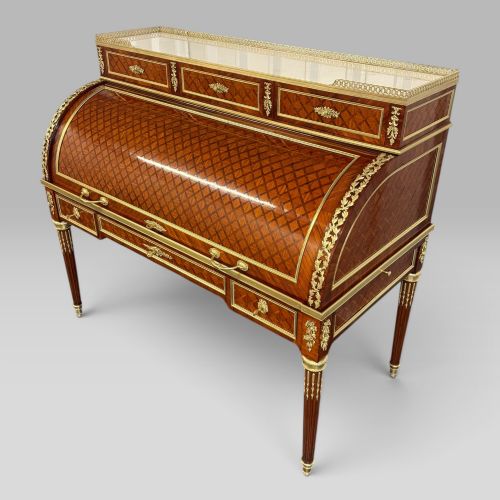
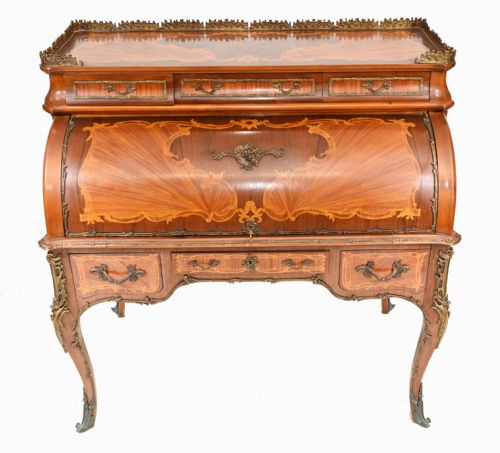
An ormolu cylinder desk combines a curved roll-top closure with detailed gilt-bronze mounts, appearing primarily in nineteenth-century French revival forms such as Louis XVI, Empire, and Louis XV styles. These pieces serve as substantial writing furniture featuring internal compartments and fitted drawers revealed upon rolling back the cylinder.
The variations seen on this page span from flame mahogany Empire designs to intricate parquetry and marquetry bureaus in Kingwood, walnut, and rosewood. Pieces often reflect specific historical revivals, incorporating classic architectural proportions alongside elaborate decorative veneers.
How they were made
Cabinet-makers constructed these desks using solid structural timbers like mahogany and walnut, overlaid with decorative veneers including kingwood and rosewood arranged in geometric parquetry or pictorial marquetry. The curved cylinder mechanism required precise carpentry to ensure smooth movement along internal tracks.
Gilt-bronze or ormolu mounts were cast, chased, and fire-gilded before being fixed to corners, feet, and key escutcheons to accent the timber frames. Additional brass detailing often reinforced edges and framed individual panels of veneer.
What varies in quality
The distinction between standard production and exceptional work lies in the crispness of the ormolu chasing and the complexity of the wood veneers. Finer desks display deeply chiselled gilt bronze and meticulous marquetry composition that aligns seamlessly across moving parts.
Structural integrity of the rolling cylinder mechanism and the selection of cabinet timbers further separate ordinary pieces from masterworks. Richly figured flame mahogany, balanced parquetry patterns, and substantial bronze mounts indicate superior workshop origin.
Francois Linke
The Ormolu Cylinder Desk Glossary
- Ormolu
- Gilt bronze produced by applying a mercury and gold amalgam to shaped bronze and firing it. This technique creates a durable golden finish characteristic of fine French decorative arts.
- Cylinder desk
- A writing desk featuring a quarter-circle rotating wooden shutter that conceals the writing surface and pigeonholes. When rolled back, it automatically retracts internal fitted drawers.
- Parquetry
- Geometric wood inlay work arranged in repeating patterns such as cubes or chequers. Craftsmen utilised contrasting timbers to create three-dimensional optical effects across the desktop and facades.
- Marquetry
- Elaborate decorative veneer work forming pictorial or floral designs using various coloured woods. This technique required precise cutting of thin wood sheets assembled like a puzzle.
- Vernis Martin
- A type of specialised European lacquer developed to imitate Asian lacquerware. It appears on select refined cabinetry with painted decorative scenes under a clear varnish.
Ormolu Cylinder Desk: Frequently Asked Questions
What is an ormolu cylinder desk?
An ormolu cylinder desk is a nineteenth-century writing cabinet featuring a curved wooden roll-top and decorative gilt-bronze mounts. These pieces combine secure enclosed workspaces with elaborate French revival styling.
They typically house interior drawers and pigeonholes beneath the sliding cylinder, offering both functional storage and ornamental presence.
How do cylinder desks work?
The curved wooden cylinder slides along a curved track within the desk frame to open or close. Pulling the writing surface forward or pushing the cylinder back reveals the interior compartments.
This mechanical action often operates in tandem with connected linkages inside the desk body to manage internal storage.
Where should I place one?
These desks suit studies, libraries, or principal reception rooms where their finished backs and decorative veneers can be appreciated from multiple angles. Their architectural proportions demand adequate floor space to sit comfortably within a room.
Keep them away from direct heat sources and strong sunlight to protect the polished wood surfaces and delicate ormolu mounts.
How do I identify Louis XVI style?
Louis XVI style pieces feature straight tapered legs, neoclassical symmetry, and restrained geometric ormolu mounts. The decorative vocabulary draws on ancient Greek and Roman architecture.
In contrast to earlier exuberant curves, these designs emphasise rectilinear forms and balanced proportions.