



French Rolltop Desk
A french rolltop desk brings rich woods and classical revival styling to a study, offering a private workspace with a sliding tambour or cylinder.

French Rolltop Desk
When you search for a french rolltop desk, you are looking at writing furniture featuring a curved sliding cover that conceals an interior of small drawers and pigeonholes. The examples on this page span the eighteenth and nineteenth centuries, taking forms such as cylinder desks, tambour desks, and bureaux.
You are most likely to meet nineteenth-century interpretations on this page, particularly pieces executed in the Louis XVI style, Louis XV style, or Empire revival manner. These desks often combine classical architectural proportions with decorative veneers and gilt-metal mounts.
Origins represented in the current selection lean towards continental workshops, frequently referencing specific French royal periods like Directoire, Baroque, and Rococo. Dimensions range from miniature tabletop examples to large library desks designed for commanding presence in a room.
How they were made
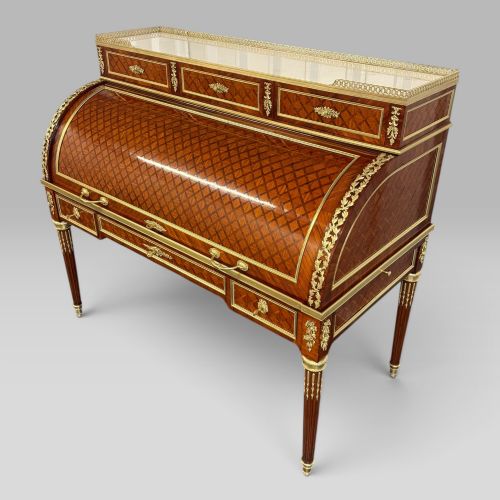
Cabinetmakers constructed these pieces using a foundation of solid timbers like mahogany, walnut, or fruitwood, which were then surface-veneered with exotic woods such as kingwood and rosewood. Parquetry and marquetry patterns are frequently utilised to create geometric or floral imagery across the curved cylinder and flat surfaces.
Decorative detailing relies heavily on cast brass and ormolu mounts applied to corners, escutcheons, and legs, highlighting the structural lines of the revival styles. Tambour strips or solid curved cylinder panels were engineered to slide smoothly within concealed tracks to secure the writing surface.
What varies in quality
The distinction between ordinary and superior pieces rests on the precision of the veneer work and the crispness of the ormolu casting. Finer examples display meticulous parquetry alignment and heavy, well-chased bronze mounts rather than lightweight stamped brass.
Internal complexity also separates the tiers, with better desks offering fitted compartments, concealed secret drawers, and leather-lined writing slides that operate in tandem with the cylinder mechanism.
Linke
The French Rolltop Desk Glossary
- Cylinder desk
- A writing desk with a curved, quarter-circle wooden shutter that rolls back to reveal the writing surface and interior drawers. This mechanism was popular in French cabinetmaking from the late eighteenth century onward.
- Tambour
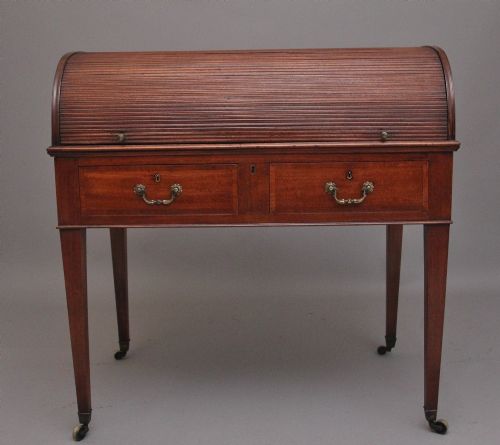
- A flexible shutter made of narrow vertical strips of wood glued to a canvas backing, allowing the cover to slide around a curved track. It serves the same enclosing function as a solid cylinder.
- Ormolu
- Gilded bronze used for decorative mounts and furniture trimmings during the eighteenth and nineteenth centuries. The technique involves applying a gold amalgam to cast bronze before heating.
- Marquetry
- Decorative veneer work arranged in pictorial designs using various coloured woods, shells, or ivory. It differs from parquetry by forming pictures rather than geometric patterns.
- Parquetry
- Geometric wood inlay used to create repeating patterns such as cubes, chequers, or lozenges across furniture surfaces. It provides textural variety without figurative imagery.
- Directoire style
- A transitional French design period bridging Louis XVI and Empire, characterised by neoclassical restraint and simpler lines. It emerged during the French Directory.
French Rolltop Desk: Frequently Asked Questions
What is a french rolltop desk?
A french rolltop desk is a writing table featuring a curved wooden cylinder or tambour shutter that slides down to enclose the writing surface and internal compartments.
These pieces typically showcase continental styling from the eighteenth and nineteenth centuries, incorporating decorative veneers and classical revival motifs.
How do cylinder desks work?
The curved wooden lid runs along recessed tracks within the sides of the desk, rolling backward into the body of the cabinet to open the writing area.
In many sophisticated designs, pulling out the writing slide automatically retracts the cylinder to reveal the fitted interior.
What woods were used?
Cabinetmakers built the structural carcases using solid timbers such as mahogany, walnut, and fruitwood, which provided stability for the moving parts.
Surfaces were then veneered with decorative woods like kingwood and rosewood, often complemented by contrasting parquetry and marquetry inlays.
How to identify Louis XVI style?
Louis XVI revival pieces on this page are defined by straight tapering legs, neoclassical symmetry, and restrained geometric or classical ornamentation.
They stand apart from the more exuberant curves of earlier Louis XV and Rococo revival furniture through their emphasis on architectural proportion.