
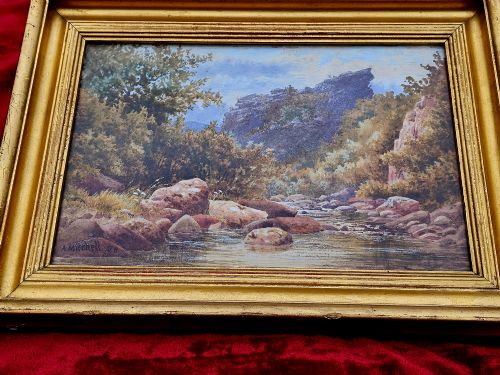


Original Royal Academy Artwork
Original royal academy artwork brings together signed paintings, watercolours and drawings by elected academicians from the seventeenth century onwards.
Original Royal Academy Artwork
Original royal academy artwork consists of paintings, watercolours, pastels and drawings produced by artists elected to the Royal Academy. These pieces span centuries of British art history, recording shifts from traditional academic realism through to mid-century modern idioms.
The works available include oil paintings on canvas and board, delicate watercolours, and mixed media pieces such as pastel over lithograph. Subject matter ranges from detailed landscapes and coastal scenes to intimate portraits and figure studies by notable academicians.
What varies in quality
Quality rests in the sureness of the hand and the strength of the composition, distinguishing hurried sketches from fully realised exhibition pieces. The handling of medium, whether the buttery application of oil paint or the deft wash of watercolour, determines the visual impact.
Condition of both the primary support and any original giltwood framing influences desirability. Works retaining clear signatures, provenance and period framing demonstrate higher integrity.
Reginald Grange Brundrit RA·George Vicat Cole RA·Benjamin Williams Leader RA·Ronald Ossory Dunlop RA·Joseph Farquharson RA·Sir Herbert Hughes-Stanton·Joseph Farington RA·Dame Laura Knight RA·Aubrey Sykes RA·William Collins RA·Peter Greenham·Sonia Lawson RA
The Original Royal Academy Artwork Glossary
- RA
- Royal Academician. This designation indicates full membership of the Royal Academy of Arts, granted through election by peers.
- Oil on Canvas
- A painting technique using pigments bound in a drying oil applied to a stretched woven fabric support. This method allows for rich texture and depth of colour.
- Watercolour
- A painting method where water-soluble pigments are suspended in a water-based solution on paper. It creates luminous, transparent effects.
- Giltwood
- Wood carved and coated with a thin layer of gold leaf or metallic powder. It is commonly found on traditional frames enclosing fine art.
- Pastel
- A dry painting medium in the form of a stick, consisting of powdered pigment and a binder. It produces velvety colours with a direct, powdery surface.
Original Royal Academy Artwork: Frequently Asked Questions
How do I identify a Royal Academy artist?
Look for the letters RA following the artist's signature or recorded in the documentation accompanying the piece. These initials denote formal election to the institution.
Examine the style and period details to ensure consistency with the recorded dates of the academician's working life.
Are these works signed?
Many pieces feature the artist's signature, often inscribed directly onto the canvas, board or paper surface. Some works also include labels or inscriptions on the reverse.
Signatures should be compared with known examples from the specific academician to confirm attribution.
How should I frame and display oil paintings?
Oil paintings on canvas require breathable framing without direct contact between the painted surface and the glazing. Stable indoor environments away from direct sunlight protect both the canvas and the giltwood frame.
Ensure wall fixings are rated to support the weight of heavier wooden frames and stretched canvases.
What is the difference between oil and watercolour?
Oil paint uses a slow-drying oil binder that allows for thick impasto application and rich colour blending on canvas or board. Watercolour employs water-soluble pigment on paper, prized for its translucent luminosity.
Watercolours require protection under glass to prevent moisture and atmospheric damage.