
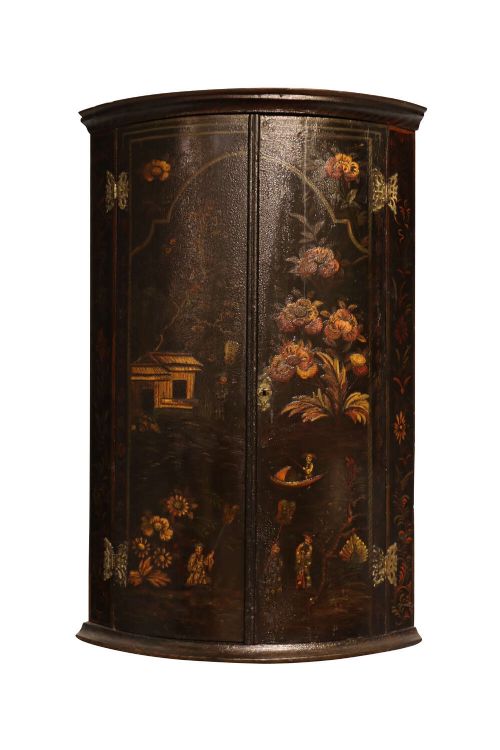


Oriental Style Corner Cabinet
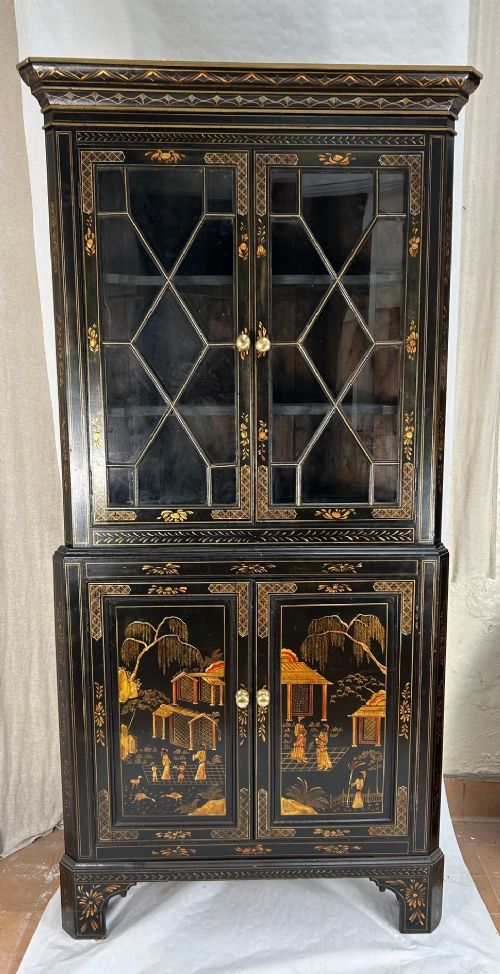
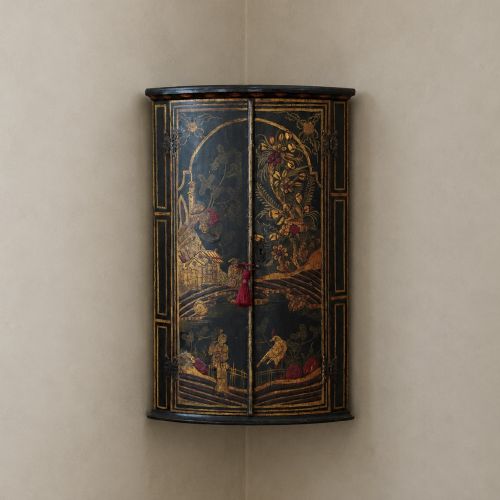
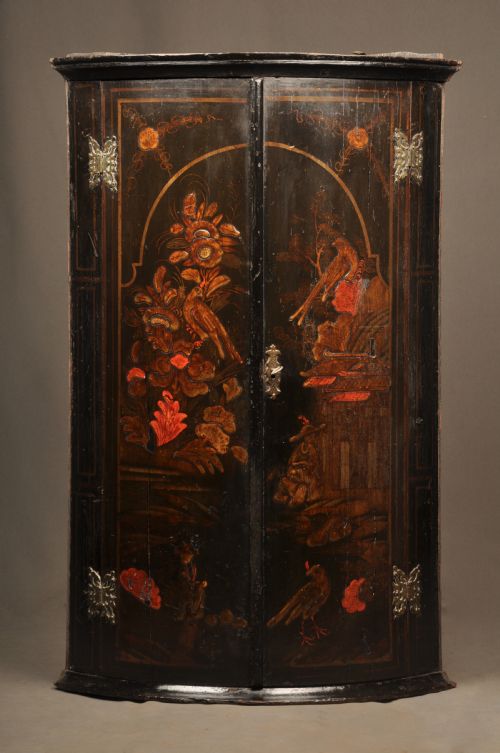
These oriental style corner cabinet pieces bring hand-finished lacquer and painted Chinoiserie ornament directly into awkward wall junctions.
Oriental Style Corner Cabinet
An oriental style corner cabinet turns neglected wall junctions into focal points through specialised triangular housing designed to fit domestic room angles. The selections gathered here span 18th century examples up to Edwardian iterations, incorporating standard cupboards alongside bow front forms.
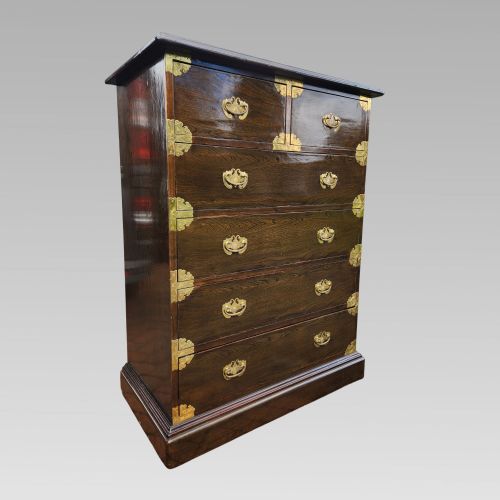
Chinoiserie dominates the visual language of these pieces, alongside related Aesthetic Movement bamboo frames and Korean traditional elm veneer work. Most items rely on wall-mounting or fitted corner footprints to maximise spatial economy while displaying decorative surfaces.
How they were made
Makers built the primary carcase using pine or general wood substrates, preparing the timber to accept layered finishes. Surface ornamentation typically involved lacquer and paint applications, often combined with brass hinges, escutcheons, and occasional glass elements.
Gilt accents frequently highlight raised painted motifs on black or red lacquer backgrounds. Elm veneer and bamboo construction appear in distinct regional variants, separating traditional East Asian cabinetry from British interpretations of the style.
Listings feature wood, lacquer, brass, glass, paint, pine, and elm across 18th century, Georgian, Victorian, and Edwardian periods.
What varies in quality
Depth and preservation of the lacquer surface dictate the visual success of an oriental style corner cabinet. Pieces exhibiting carefully built up layers of paint and gilt detail demonstrate superior workshop execution compared to simpler surface treatments.
Integration of brass hardware and the crispness of Chinoiserie figurative scenes separate standard utilitarian cupboards from more ambitious decorative statements. The handling of corner mitres and door alignment further reveals the underlying competence of the cabinetmaker.
The Oriental Style Corner Cabinet Glossary
- Chinoiserie
- European artistic interpretation of Chinese and East Asian decorative motifs. This style heavily influences the painted lacquer surfaces seen on many corner cupboards.
- Japanned
- European imitation of East Asian lacquerwork produced using successive coats of varnish and heat drying. It frequently appears on 18th and 19th century corner cabinets.
- Bow front
- A convex curved cabinet front that projects outward from the corner walls. This form softens the strict angular geometry of standard corner furniture.
- Aesthetic Movement
- Late 19th century design current promoting visual beauty over narrative content. Pieces from this period often incorporate bamboo framing and lighter structural elements.
Oriental Style Corner Cabinet: Frequently Asked Questions
How do I hang a corner cabinet?
Most corner cabinets utilise internal fixing points through the back striae to anchor securely into wall studs. Professional installation ensures the triangular weight distributes evenly without straining the hinges.
Lighter bamboo or pine variants require simpler wall anchors, whereas heavy lacquer and timber carcases demand robust structural fixings.
What rooms suit an oriental style corner cabinet?
Dining rooms, hallways, and living spaces benefit most from corner cabinets because they utilise dead architectural space efficiently. Their decorative doors add colour and pattern without obstructing floor area.
Placing them at eye level allows the painted Chinoiserie details and brass hardware to read clearly within the interior scheme.
How do I clean lacquered furniture?
Dust lacquered and painted surfaces gently with a soft, dry cloth to prevent abrasion. Avoid modern chemical sprays and solvents that can soften historic varnish.
Maintaining a stable indoor humidity prevents the wooden substrate from expanding and causing the lacquer layer to craze or lift.
How do I date a Chinoiserie corner cupboard?
Examine the secondary woods inside the carcase, such as pine or oak, alongside the construction of the door frames and drawer dovetails. 18th century examples often display heavier timber preparation and hand-mixed lacquer grounds.
Edwardian and later 19th century interpretations tend to show lighter internal framing and more mechanised hardware fixings.