
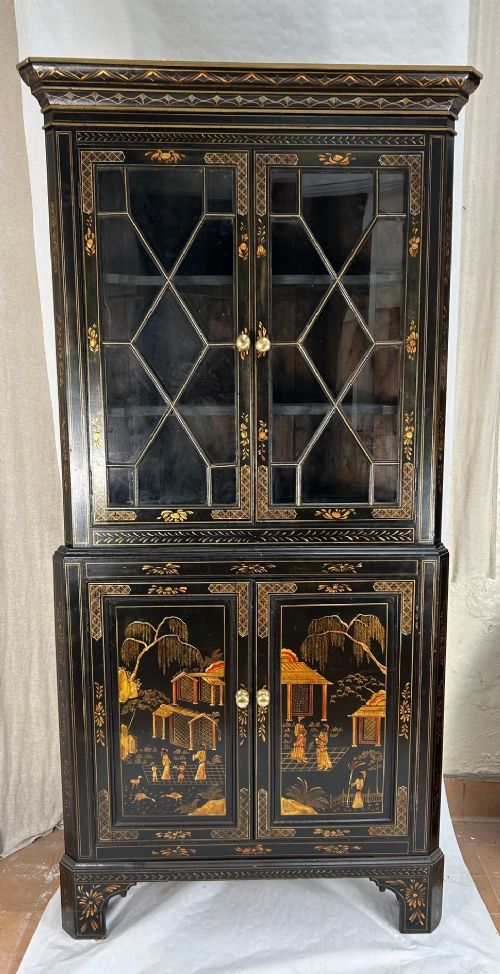
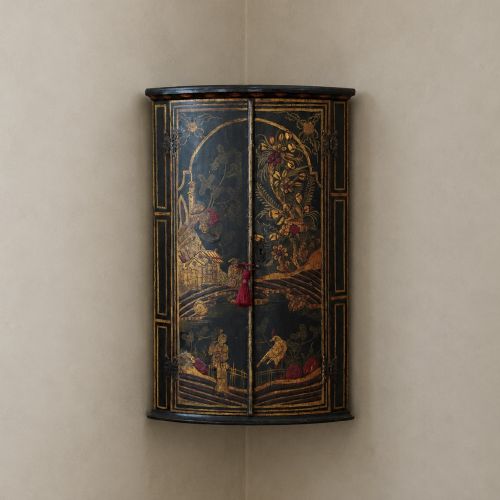
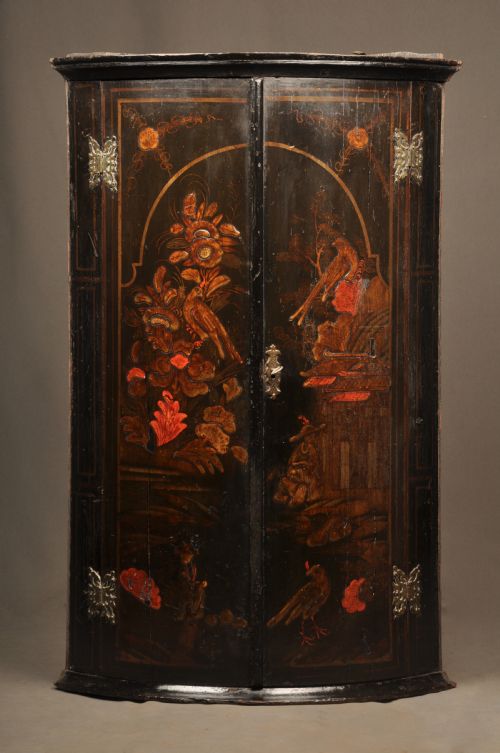
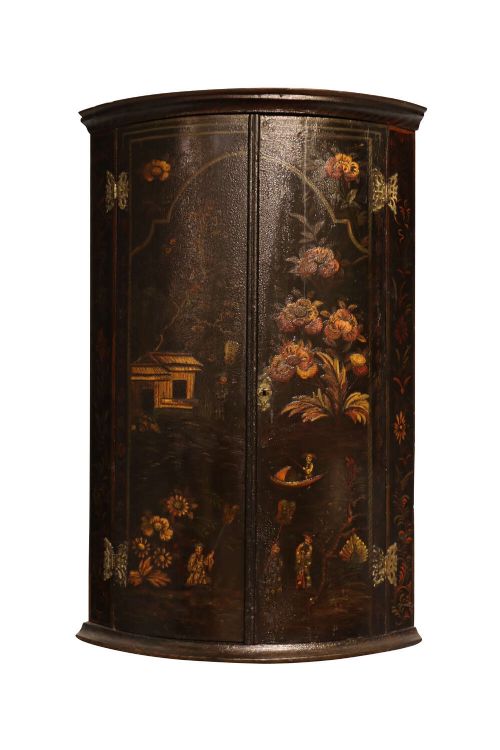


Lacquered Corner Cabinet
These lacquered corner cabinets bring deep black and red ground finishes into tight spaces with genuine period authority.
Lacquered Corner Cabinet
A lacquered corner cabinet provides storage while making use of unutilised room angles in domestic interiors. These pieces appear most frequently in 18th century, Georgian, and Victorian forms.
The objects take the shape of corner cupboards and corner cabinets, often utilising bow fronts or two-door configurations. Chinoiserie decoration dominates the visual language across these examples.
Surviving pieces span from early 18th century and Queen Anne origins through to Edwardian interpretations. The category includes individual items and matched pairs.
Materials and Construction
Construction relies upon traditional timbers including pine and other supportive woods to form the carcase. Surfaces receive layers of lacquer, paint, gilt, and gold leaf to build up the decorated ground.
Finishes are enriched with Chinoiserie pictorial motifs executed in raised or flat metallic and coloured pigments. Brass hinges and key escutcheons complete the hardware on doors that sometimes reveal contrasting scarlet interiors behind glass or solid panels.
Periods represented span the 18th century, Queen Anne, Georgian, Victorian, Edwardian, and Meiji eras.
Assessing Quality
Quality rests upon the depth and intricacy of the lacquer work and the sophistication of the Chinoiserie narrative scenes. Early pieces demonstrate finer hand-drawn detail and more complex layering of gold leaf compared to later iterations.
Proportion and cabinet-making integrity dictate value at the upper end of the scale. The crispness of carved mouldings and the retention of original brass hardware further distinguish superior examples from standard workshop production.
The Lacquered Corner Cabinet Glossary
- Japanned
- European imitation of East Asian lacquerwork. The technique involves building up resin layers and decorative motifs on a wooden carcase.
- Bow front
- A convex, curved front profile. This shape softens the angular lines typical of corner furniture.
- Escutcheon
- A protective plate surrounding a keyhole. These are frequently cast in brass on period cabinet doors.
- Ground
- The primary background colour of a lacquered surface. Black and red are traditional variations found in these cabinets.
Lacquered Corner Cabinet: Frequently Asked Questions
How do I place a corner cabinet?
These cabinets fit directly into 90-degree room junctions to utilise space that standard rectangular furniture ignores.
Position them at eye level where their decorated doors and contrasting interiors catch room lighting.
What is the difference between lacquer and japanning?
True Asian lacquer utilises natural sap from specific trees native to East Asia. European japanning adapts these aesthetic effects using shellac, paints, and varnishes.
Both finishes create a hard, glossy surface capable of holding intricate gold leaf details.
Are these cabinets secure for delicate items?
Most examples feature hinged doors with functional locks and key hardware. They protect stored porcelain or glassware from dust while keeping contents visible or concealed depending on the door panel design.
How do I date a lacquered cabinet?
Examine the carcase timbers, hinges, and the style of the Chinoiserie decoration. Early 18th century and Queen Anne pieces display different pictorial composition and joinery techniques compared to Victorian or Edwardian revivals.