
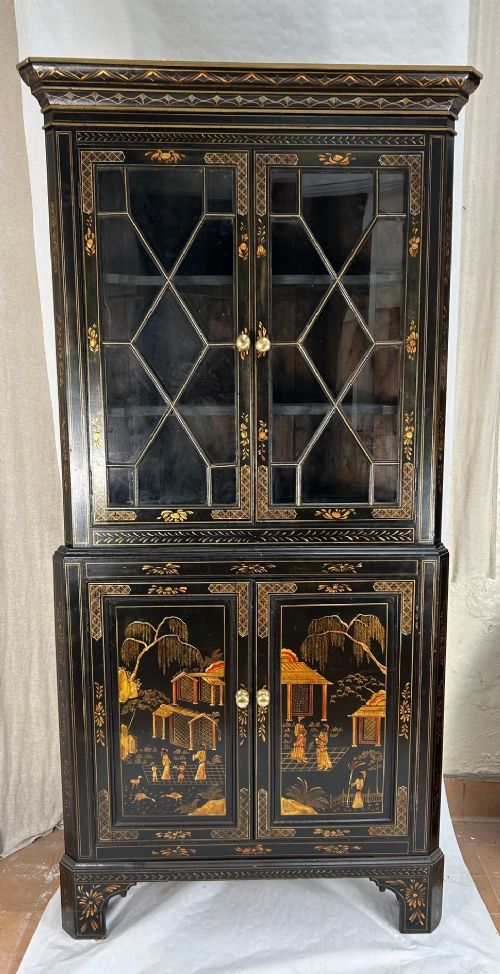
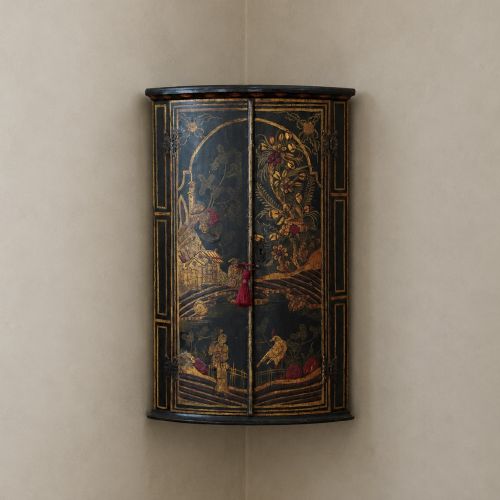
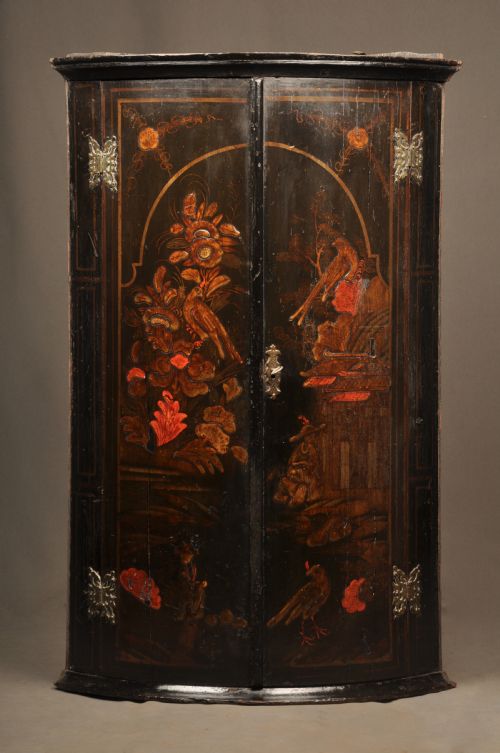
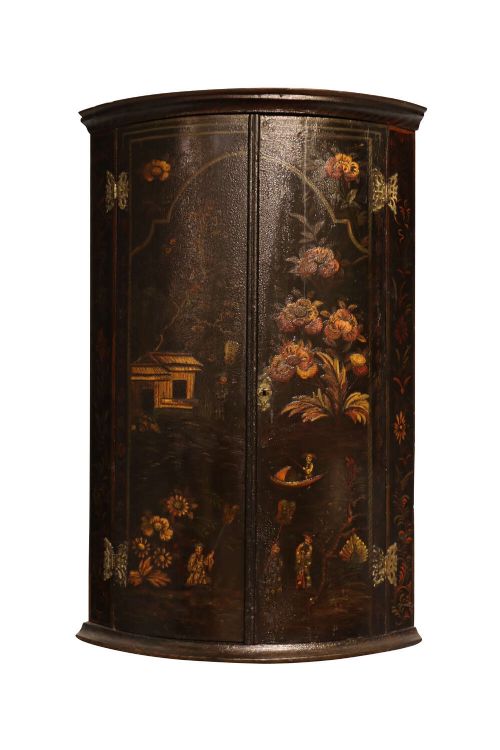


Chinoiserie Corner Cabinet
These chinoiserie corner cabinet examples bring hand-painted narrative scenes and rich lacquer into neglected domestic angles.
Chinoiserie Corner Cabinet
A chinoiserie corner cabinet transforms an empty room junction into a display space filled with imagined Eastern landscapes and figures. These fitted cupboards utilise wall angles efficiently while offering surface decoration that draws the eye across the room. You meet pieces spanning several centuries, from early Georgian workshops to Edwardian revivals.
The form appears as single door wall-hanging units, bow front variations, and floor standing cupboards. Black and red lacquer dominate the surviving examples, often paired with gilded detailing to highlight figures, pavilions, and flora. The overarching style reflects European interpretations of Chinese art popular across multiple historic periods.
How they were made
Construction relies on timber carcasses built from pine, softwood, and various hardwoods shaped to fit standard right-angled room corners. Carpenters joined these panels securely before surface preparation began, accommodating doors with brass hinges and occasionally glass viewing panes.
The distinct visual finish depends on layers of lacquer applied over wood, build up through painstaking polishing and painting. Artisans added gilt highlights and painted motifs directly onto the dark or red ground, creating raised pictorial scenes characteristic of the genre.
Periods represented span the 18th century, Georgian, 19th century, Victorian, Edwardian, and 1920.
What varies in quality
Quality separates master painter execution from hurried commercial output, visible in the depth and intricacy of the lacquer work. Finer examples display meticulous brush control within the pictorial scenes, whereas simpler pieces rely on basic stencilled or flat decoration.
The integrity of the timber structure and the preservation of the original painted surface dictate overall standing. Cabinets retaining their early brass hardware and deep, undisturbed lacquer layers command greater appreciation than heavily restored equivalents.
The Chinoiserie Corner Cabinet Glossary
- Lacquer
- A durable resin finish applied in multiple coats to wooden surfaces. It provides the smooth, glossy ground characteristic of fine Asian and European decorative pieces.
- Japanned
- The European imitation of East Asian lacquerwork popular in furniture production. It involves layering varnishes and paints to mimic traditional oriental finishes.
- Bow front
- A convex curved cabinet front that projects outward. This shape softens the hard angles typical of standard corner furniture.
- Gilt
- Gold leaf or powdered gold applied to surfaces to create decorative highlights. It catches ambient light and emphasises painted motifs.
Chinoiserie Corner Cabinet: Frequently Asked Questions
Where should I place a corner cabinet?
These cabinets suit empty room junctions where standard rectangular furniture wastes space. They fit naturally into dining rooms, hallways, or drawing rooms.
Position them away from direct sunlight to protect the lacquer and painted surface layers from fading over time.
How do I clean lacquer?
Dust the surface gently using a soft, dry lint-free cloth. Avoid chemical sprays, wet sponges, and abrasive cleaners.
Maintain stable indoor humidity levels to prevent the underlying wood and lacquer layers from expanding or cracking.
Are these cabinets wall hung or floor standing?
Surviving examples include both wall-mounted wall cabinets and taller floor-standing cupboards. Wall hung versions secure directly to wall studs.
Floor standing models rest firmly on the ground while maintaining a wedge shape designed to tuck into room corners.
How can I tell the age of the lacquer?
Age reveals itself through fine craquelure across the lacquer surface and the wear patterns on brass hardware. Early pieces show genuine oxidation in the paint layers.
Edwardian and later revivals display different timber preparation and fresher pigment applications compared to eighteenth-century work.