

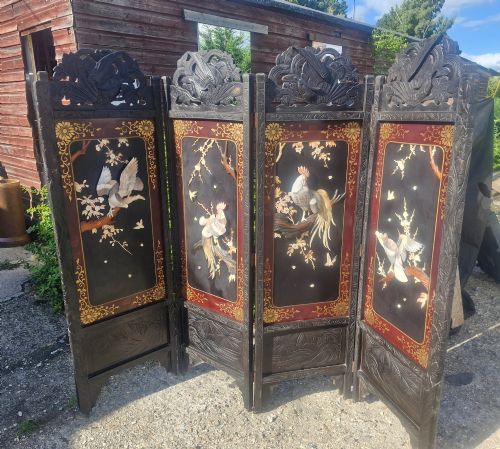






Oriental Lacquer Room Divider
An oriental lacquer room divider brings depth and rich texture to an interior, functioning as a folding screen or a striking panel.
Oriental Lacquer Room Divider
An oriental lacquer room divider is a folding screen designed to separate spaces or decorate a wall, appearing in forms from three-fold dressing screens to grand eight-fold panels. The pieces seen here span the eighteenth century, the nineteenth century, the Regency era, and through the early decades of the twentieth century up to nineteen fifty.
Most examples originate from Chinese or Japanese traditions, incorporating styles such as Chinoiserie, Qing Dynasty, Chinese Chippendale, and Japanese Meiji. Buyers encounter multi-panel folding screens as well as specialised items like fire screens and wall art panels.
How they were made
The construction relies primarily on wood and hardwood foundations coated in layers of lacquer, sometimes enhanced with brass fixtures. Artisans applied gold leaf, paint, and intricate inlays of hardstone and bone to create detailed surface designs.
Techniques range from deep carving into dark lacquer grounds to delicate textile applications and painted decorations on black lacquer or papier mâché bases.
The listings here feature pieces spanning the eighteenth, nineteenth, and twentieth centuries, utilising materials like lacquered wood, brass, hardstone, and gold leaf.
What varies in quality
Quality separates ordinary surface decoration from masterwork execution through the depth of the lacquer layers and the precision of the carving. Superior pieces display finely detailed bone and hardstone inlay work alongside expertly rendered figures and motifs.
The structural integrity of the folding hinges and the richness of the gilding further distinguish the finer examples from simpler decorative panels.
The Oriental Lacquer Room Divider Glossary
- Lacquer
- A durable finish applied to wood surfaces in multiple coats, derived from natural tree sap or synthetic resins. It provides a glossy, protective sheen that resists moisture and wear.
- Coromandel
- A type of Chinese incised lacquer where designs are carved into a dark ground and filled with colours or gold. This technique produces deeply textured panels with rich pictorial scenes.
- Hardstone
- Semi-precious stones such as jade, agate, or soapstone used inlays. Artisans carve these minerals to create raised pictorial elements on screen panels.
- Meiji
- A period in Japanese history spanning from eighteen sixty-eight to nineteen twelve, known for exceptional craftsmanship in metalwork, lacquer, and screen decoration.
Oriental Lacquer Room Divider: Frequently Asked Questions
How do I use a room divider at home?
These folding screens work well to zone large open-plan spaces, create privacy in a dressing area, or simply stand flat against a wall as large-scale art. Positioning them away from direct sunlight helps protect the delicate lacquer and gold leaf finishes.
Ensure the panels are angled correctly when freestanding to maintain stability, especially on multi-fold versions spanning several leaves.
How are different periods told apart?
Eighteenth and nineteenth-century examples often feature traditional Coromandel carving and rich patination on heavy wooden frames. Twentieth-century pieces, including those from the nineteen twenties and thirties, may show Republic Era influences or incorporate distinct decorative hardware.
Examining the materials, such as the use of papier mâché in Victorian pieces or deep carved bone in Meiji items, helps establish the era of manufacture.
What is the difference between a dressing screen and a room divider?
Dressing screens typically feature fewer folds, such as three or four panels, and were historically used in bedrooms or private chambers for changing. Room dividers often comprise six or eight panels to span wider areas of a room.
Both types utilise hinged wooden leaves, though dressing screens are generally more compact in scale.
How should I care for lacquered wood?
Maintaining these pieces requires gentle dusting with a soft, dry cloth and avoiding harsh chemical cleaners or abrasive polishes. Keeping them away from excessive heat sources prevents the wood and lacquer from drying out or cracking.
Stable indoor humidity levels ensure the wooden substrates and intricate inlays remain secure within their frames.