
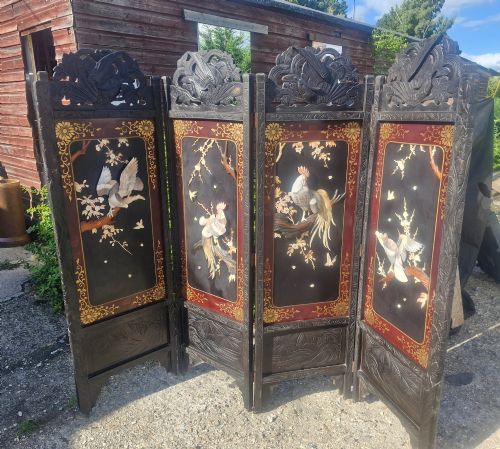


Black Lacquer Decorative Screen
These black lacquer decorative screen pieces offer striking oriental motifs and rich panel work, bringing depth and traditional craftsmanship directly into a room.
Black Lacquer Decorative Screen
Buyers seeking a black lacquer decorative screen encounter folding screens, wall plaques, and wall art spanning from the nineteenth century into the mid-twentieth century. The selection includes multi-panel folding screens and framed panels originating from Japanese, Chinese, and Burmese traditions.
The pieces on this page lean heavily towards Chinoiserie, Japanese Meiji, and Chinese Qing styles, alongside Victorian interpretations and Burmese work. Surviving examples range from intimate three-fold and four-fold screens to large six-fold pieces and sets of framed panels.
Materials and construction
Maker workshops built these screens using wood and hardwood foundations coated in deep layers of dark lacquer, creating a durable and lustrous surface. Artisans then applied intricate pictorial scenes directly onto the dark ground.
Decoration relied heavily on applied relief materials, incorporating carved bone, soapstone, mother-of-pearl, and abalone inlay to build up figures, birds, and foliage. Some works also integrated brass elements, textile panels, or painted papier-mache techniques.
Current listings feature pieces spanning from the mid-nineteenth century through the nineteen-fifties, utilising wood, lacquer, bone, and mother-of-pearl.
Judging quality in black lacquer work
Quality rests in the depth of the carving and the precision of the inlay work, distinguishing flat painted surfaces from elaborate relief decoration. Pieces featuring deep carved bone or carefully fitted mother-of-pearl and abalone demonstrate a higher tier of artisan skill.
The complexity of the composition also dictates distinction, separating simple pictorial panels from large multi-fold screens with detailed figural narratives and botanical scenes. The integration of specialised techniques, such as work recalling Coromandel or Bantam traditions, adds further distinction to a panel.
The Black Lacquer Decorative Screen Glossary
- Lacquer
- A durable resin finish applied to wooden substrates in multiple coats to create a smooth, glossy dark ground. It forms the protective and aesthetic base for decorative panels.
- Chinoiserie
- European artistic styles reflecting Chinese and East Asian motifs, prominent in decorative arts and furnishings. This style reinterprets traditional oriental scenes through a Western decorative lens.
- Meiji
- The period of Japanese history spanning from eighteen sixty-eight to nineteen twelve, known for distinctive craftsmanship and export arts. Pieces from this era often feature meticulous metal, bone, and lacquer work.
- Coromandel
- A type of Chinese incised lacquer work where designs are cut into the lacquer ground and filled with pigments or gold. The style influenced later export pieces found in Western collections.
- Mother of pearl
- The iridescent inner layer of mollusk shells, shaped and inlaid into lacquer surfaces to catch the light. It is frequently paired with abalone to depict plumage and floral foliage.
Black Lacquer Decorative Screen: Frequently Asked Questions
How do I use a folding screen at home?
Folding screens function well as room dividers in open-plan spaces, or placed flat against a wall to serve as large-scale decorative art.
S Smaller three or four-fold versions suit corners or smaller rooms, while larger multi-panel screens anchor a major living space.
Where did these screens originate?
The pieces originate primarily from East Asian and Southeast Asian traditions, including China, Japan, and Burma.
Many nineteenth and early twentieth-century examples were produced specifically for export, blending traditional regional craftsmanship with European interior tastes.
How do I care for black lacquer?
Keep lacquer surfaces away from direct sunlight and excessive heat sources to prevent the finish from drying out or cracking.
Dust gently with a soft, dry cloth and avoid using chemical cleaning sprays or abrasive materials on the delicate inlay.
What is the difference between a screen and a panel?
Screens consist of multiple hinged folds designed to stand upright independently or partially curve around a space.
Panels and plaques are fixed flat units, often framed individually or in sets to hang directly on a wall like a picture.
How are bone and shell secured to lacquer?
Artisans set carved bone, soapstone, mother-of-pearl, and abalone into recesses carved directly into the hardened lacquer ground.
This inlay technique creates a low-relief surface where the decorative elements sit flush with or slightly raised above the dark background.