
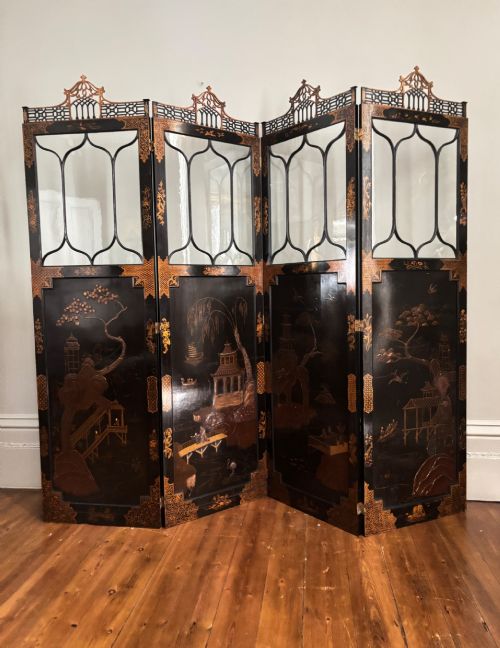
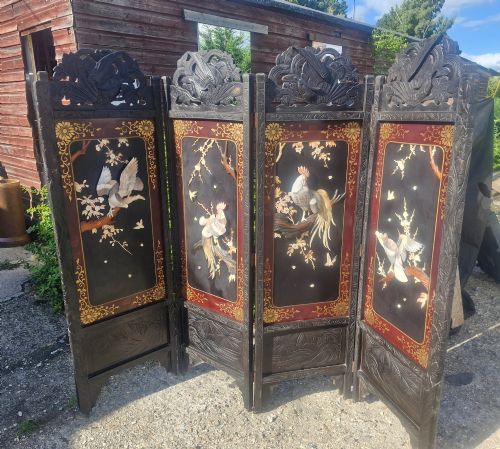
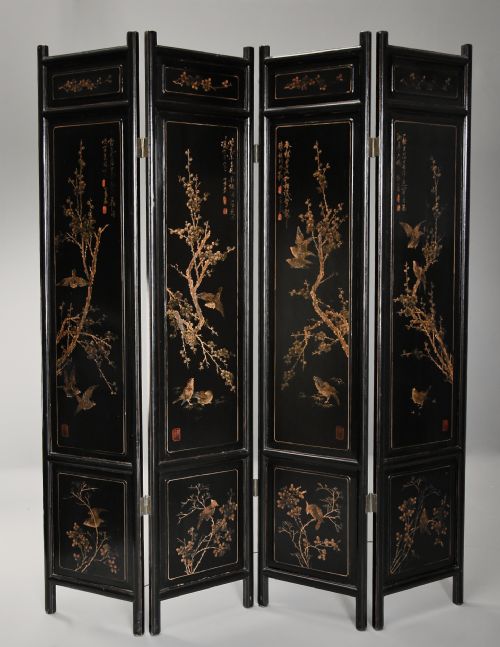


Black Folding Room Divider
These black folding room divider pieces bring architectural structure and hand-finished lacquer depth to open spaces.
Black Folding Room Divider
A black folding room divider operates as a freestanding partition, separating large rooms or creating intimate corners within domestic spaces. These screens rely on hinged panels that fold flat for storage or extend to form varied geometric angles across a floor.
The pieces listed here span the nineteenth century, the Regency era, and twentieth-century periods including the nineteen-tens, nineteen-twenties, and nineteen-thirties. Forms range from three-fold and four-fold partitions to expansive six-panel and eight-fold dressing screens.
Origins stretch across Chinese workshops, Japanese Meiji makers, Burmese studios, and British Arts and Crafts or Chinoiserie interpretations. Buyers encounter lacquered wood frames, ebonised oak, and papier-mâché panels decorated with painted motifs, hardstone, and bone inlay.
How they were made
Construction centres on timber frames built from hardwood, oak, or lacquered wood, joined with hinges to support multiple folding leaves. Panels receive layers of black lacquer, building a smooth surface suited to subsequent painting, gilding, or incising.
Decoration involves diverse techniques including deep carving into coromandel lacquer, surface painting, and the application of inlaid bone, hardstone, and textile elements. Brass hardware frequently secures the folding joints between leaves, while glass appears in specific decorative variants.
Several screens hide miniature bone-carved figures within their black lacquer landscapes, inviting close inspection from anyone walking past.
What varies in quality
The refinement of the surface finish defines the upper tiers of these screens, where deep lacquer build-up and precise hand-carving create rich textural contrast. Simpler decorative screens rely on straightforward painted or printed surfaces without the depth of layered lacquer.
Complexity of construction and materials also separates standard production from exceptional work. Hardwood frames and intricate bone, hardstone, or gold leaf inlays demonstrate greater artisan investment than basic ebonised or softwood alternatives.
The Black Folding Room Divider Glossary
- Coromandel
- A type of Chinese incised lacquer where designs are carved into a dark ground and filled with pigments or gold leaf. This technique produces a low-relief textured surface across multiple folding panels.
- Meiji
- A period in Japanese history spanning the late nineteenth and early twentieth centuries, known for exceptional metalwork, textile, and lacquer production exported internationally. Screens from this era often incorporate detailed bone or ivory inlay.
- Papier-mâché
- A composite material made from paper pulp or layers of paper bound with glue, pressed into moulds, and finished with lacquer. It provides a lightweight yet sturdy base for decorative dressing screens.
- Ebonised
- Wood treated with a chemical stain or black finish to imitate the appearance of ebony. This treatment appears frequently on British Arts and Crafts furniture frames.
Black Folding Room Divider: Frequently Asked Questions
How do I clean a lacquer screen?
Dust the panels regularly with a soft, dry cloth to prevent particulate buildup on the delicate surface. Avoid chemical cleaning agents and excessive moisture, which can damage aged lacquer and inlay.
Keep the divider out of direct sunlight to prevent the black lacquer and painted details from fading over time.
Are these screens heavy to move?
Weight depends entirely on the size, panel count, and timber used in the specific construction. Larger eight-fold coromandel screens require two people to reposition safely.
Smaller three-fold or four-fold dressing screens in papier-mâché or lighter wood are easily managed by a single person.
Can a screen support heavy items?
These folding pieces are designed strictly as decorative room dividers or dressing screens rather than structural supports. They cannot bear the weight of heavy objects hung from their frames.
Position the panels in a zigzag configuration so the divider remains stable under its own weight on a flat floor.
How do I date a black folding screen?
Examine the materials, hinge types, and decorative style to determine the likely period of manufacture. Nineteenth-century pieces often show hand-wrought hardware and dense coromandel carving, while twentieth-century examples display different lacquer formulations and assembly methods.
Cross-reference the stylistic details, such as Chinoiserie motifs or Arts and Crafts ebonised oak frames, with known production eras.