


Oriental Jewellery Cabinet
An oriental jewellery cabinet brings intricate craftsmanship and storied materials into a room, offering compact storage for precious items.
Oriental Jewellery Cabinet
An oriental jewellery cabinet is a small, portable chest designed to organise valuables, featuring multiple internal drawers behind hinged doors or drop-front panels. These pieces span table cabinets, tabletop chests, and collector's boxes originating from various Eastern traditions.
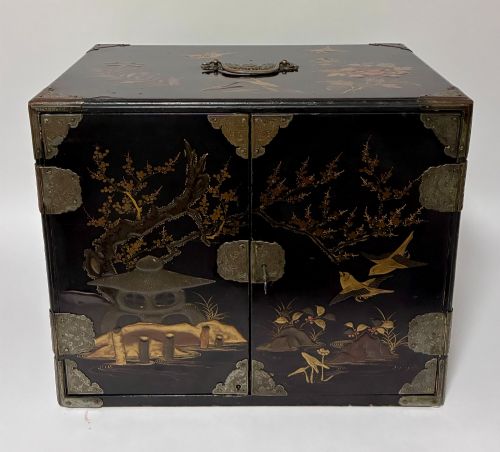
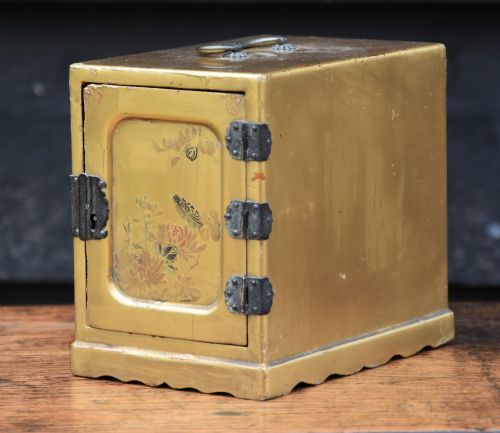
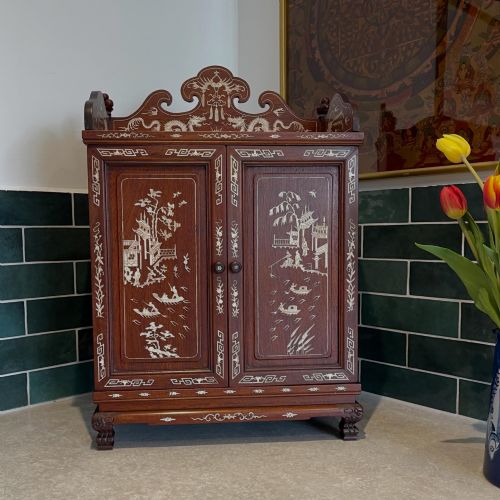
The versions most frequently met on this page belong to the nineteenth and early twentieth centuries, encompassing Japanese Meiji period lacquerwork, Chinese export pieces, and Ottoman chests. Makers constructed these cabinets in rosewood, hardwood, and elm, often applying deep black or gilt lacquer.
Such cabinets served both domestic utility and export markets, resulting in forms that blend traditional regional craftsmanship with the tastes of British Victorian and Edwardian buyers. Their compact proportions allow them to sit easily upon desks, chests of drawers, or side tables.
Materials and construction methods
Cabinet makers built the primary carcass from dense timbers such as rosewood, hardwood, and elm, providing a stable foundation for decorative surface treatments. These wooden frames were joined with traditional techniques to accommodate the seasonal expansion of the timber.
Surfaces frequently display layers of lacquer, sometimes enhanced with gold leaf, gilt decoration, or inlaid mother-of-pearl. Metal elements, including brass hinges, lock plates, and bronze animal decorations, reinforce the corners while adding structural contrast to the dark wood and lacquer.
Several small cabinets feature bronze animal decorations keeping watch over the tiny drawers within.
Distinctions in quality and finish
The refinement of the surface decoration largely separates standard boxes from exceptional examples, particularly in the depth of the lacquer and the precision of the gilding. Hand-painted motifs and intricate inlays of mother-of-pearl require significant skill, yielding sharper details and greater durability.
Hardware execution also marks the division in quality, where heavy cast brass or bronze mounts, secure original locks, and cleanly fitted internal drawers indicate superior workshop standards. The choice of secondary timbers and the tightness of the joinery further reflect the care taken during production.
The Oriental Jewellery Cabinet Glossary
- Kodansu
- A small Japanese tabletop cabinet with multiple drawers, traditionally used for storing documents, seals, or personal valuables. These miniature chests often display fine lacquerwork.
- Lacquer
- A durable resin finish applied in multiple thin coats to wood, creating a smooth, glossy protective surface. It forms the canvas for painted, carved, or gilded ornamentation.
- Meiji Period
- The era in Japanese history lasting from 1868 to 1912, marked by the opening of trade with the West. Cabinets from this time frequently combine traditional techniques with export designs.
- Qing Dynasty
- The final imperial dynasty of China, ruling from 1644 to 1912, noted for elaborate export crafts. Pieces from this period often utilise rich hardwoods and gilded lacquer.
- Specimen Case
- A small cabinet or box fitted with shallow drawers designed to hold botanical, geological, or man-made curiosities. Collectors used them to organise classified samples.
Oriental Jewellery Cabinet: Frequently Asked Questions
How were these cabinets used historically?
Historically, these cabinets sat on desks or dressing tables to hold personal ornaments, documents, small seals, or precious trinkets. Their compartmentalised interiors kept delicate items separated and secure.
Many examples were also produced specifically for the Western export market during the nineteenth and early twentieth centuries.
How do I date a Japanese lacquer cabinet?
Dating relies on stylistic markers, construction methods, and materials associated with specific eras such as the Meiji period or the early twentieth century. Examining the type of lacquer, the execution of the gilding, and the metal hardware provides reliable clues.
Changes in export laws and global trade also influenced the design characteristics of different decades.
How do I care for antique lacquer?
Antique lacquer requires stable indoor humidity away from direct sunlight and heat sources to prevent cracking or fading. Dusting should be done gently with a soft, dry cloth without chemical polishes.
Preserving the original surface maintains both the historical integrity and the visual depth of the finish.