
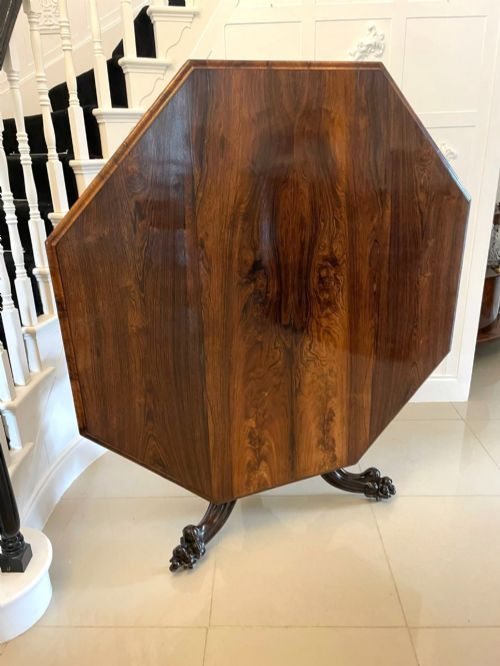
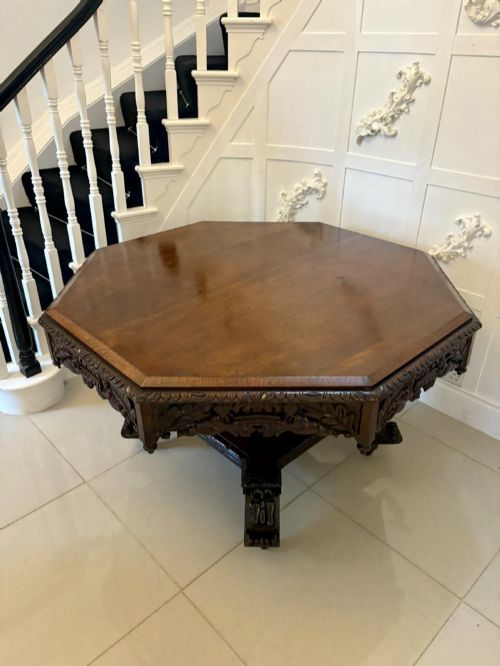


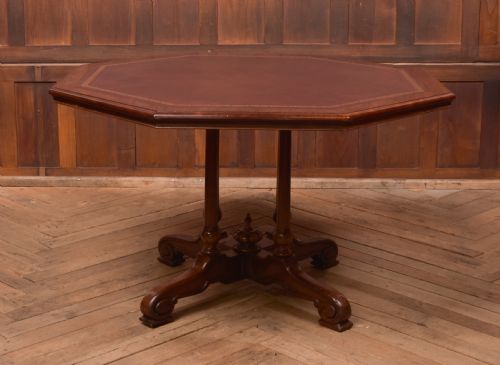

Octagonal Pedestal Dining Table
An octagonal pedestal dining table offers a striking geometric silhouette that anchors a room with distinctive lines.
Octagonal Pedestal Dining Table
An octagonal pedestal dining table brings together a multi-sided top and a central support column, appearing across various Victorian, William IV, Regency, and Art Deco eras. These forms function primarily as centre tables or breakfast tables that double as dining surfaces.
The versions most commonly met on this page span the nineteenth century, showcasing periods from Early Victorian to Gothic Revival alongside later twentieth-century Art Deco interpretations.
How they were made
Cabinet makers constructed these tables using dense timbers such as oak, rosewood, mahogany, and walnut, often applying burr walnut or figured veneers to the top surfaces.
Makers integrated sturdy central pillars to support the weight of the heavy wooden tops, occasionally incorporating glass, metal, or intricate marquetry details.
Design styles represented in the inventory include Victorian, William IV, Regency, Gothic Revival, and Art Deco.
What varies in quality
The distinction between ordinary and exceptional pieces lies in the crispness of the carved detailing on the pillar and the careful selection of figured timber veneers on the top.
Superior examples display balanced proportions where the octagonal top and the substantial pedestal column complement one another without heaviness.
Gillows
The Octagonal Pedestal Dining Table Glossary
- Pedestal table
- A table supported by a single central pillar or column rather than four corner legs. This construction allows for greater legroom around the perimeter.
- Centre table
- A freestanding piece designed to be viewed from all sides, frequently placed in the middle of a principal room. These tables often serve multiple functions including dining.
- Marquetry
- Decorative patterns formed by the insertion of small pieces of wood, veneer, or other materials into a structured surface. This technique creates elaborate pictorial designs on table tops.
- Veneer
- A thin layer of finely figured wood applied over a secondary timber base to provide a decorative exterior. This method displays striking grain patterns like burr walnut.
- Gothic Revival
- An architectural and decorative style drawing inspiration from medieval forms, prevalent during the nineteenth century. Pieces from this movement often feature pointed arches and heavy carved oak.
Octagonal Pedestal Dining Table: Frequently Asked Questions
What is an octagonal pedestal dining table?
An octagonal pedestal dining table is a freestanding furniture piece featuring a multi-sided top supported by a central pillar. These tables appear across nineteenth and twentieth-century styles.
They function as versatile dining or centre surfaces that introduce strong geometric lines to an interior scheme.
How do I identify a Victorian octagonal table?
Victorian examples typically feature dense timbers such as mahogany, oak, or rosewood, paired with substantial central pillars. Carved ornamentation often reflects historicist revivals.
Looking closely at the timber grain and the construction of the pedestal helps confirm the nineteenth-century origins of the piece.
Can I use a centre table for dining?
Many nineteenth-century centre tables and breakfast tables provide ample surface area and sturdy pedestal support for regular dining use. Their central columns make seating around the perimeter straightforward.
Checking the height and clearance beneath the table ensures it accommodates chairs comfortably.
What timbers were used for these tables?
Cabinet makers utilised a range of hardwods including mahogany, oak, walnut, and rosewood. Decorative surfaces frequently incorporated figured veneers or contrasting marquetry.
These materials provided the structural strength needed to support heavy octagonal tops on single central pillars.
How do I care for a veneered table top?
Veneered surfaces require protection from excessive moisture, direct sunlight, and heat to prevent warping or lifting of the delicate wood layers. Regular polishing with suitable wax maintains the finish.
Handling the piece with care preserves the historic timber grain and inlay details for daily use.