






Octagonal Parlour Table
An octagonal parlour table offers a distinctive eight-sided top that brings useful surface area and period character to a reception room.
Octagonal Parlour Table
When you search for an octagonal parlour table, you encounter versatile multi-sided pieces originating primarily from the Victorian and Edwardian eras, spanning the nineteenth and early twentieth centuries. These pieces appear as centre tables, occasional tables, side tables, and library tables designed for formal reception rooms and domestic sitting spaces.
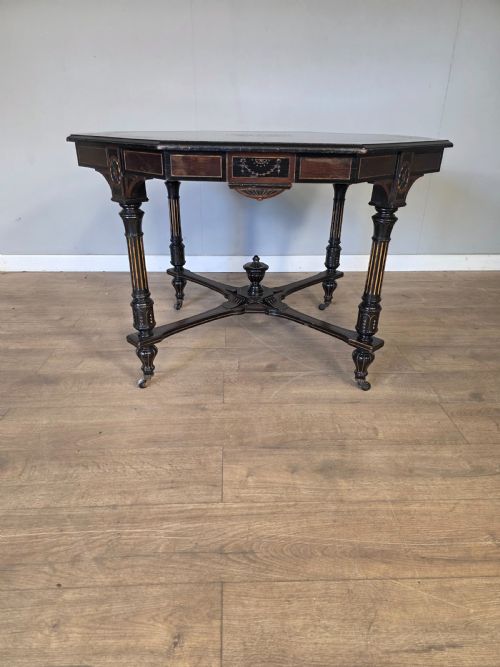
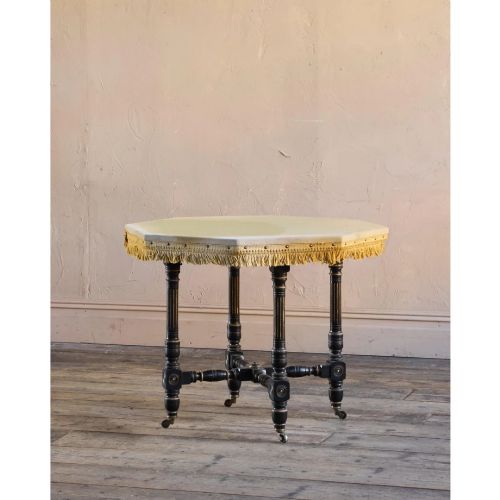
The selections on this page showcase distinct stylistic influences from the Aesthetic Movement alongside classic Victorian and Edwardian interpretations. Makers deployed these eight-sided formats to break up the rigid lines of traditional rectilinear furniture while providing accessible surfaces from multiple angles.
Construction and materials
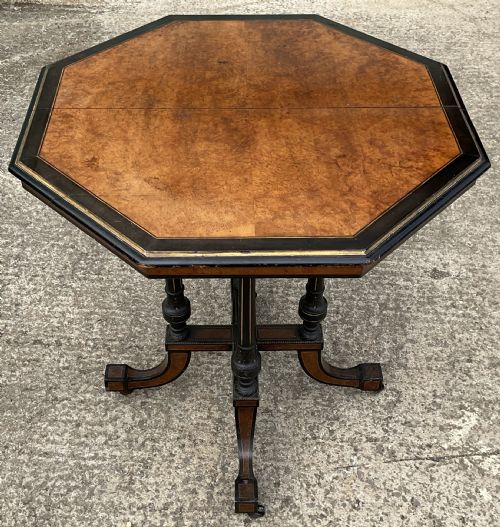
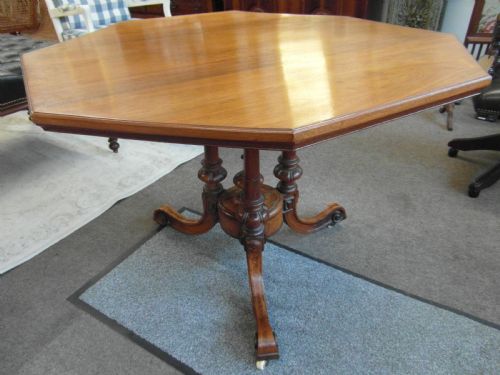
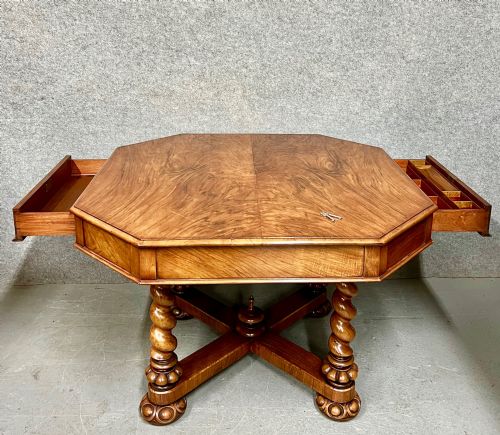
Cabinet makers utilised dense hardwoods such as mahogany, walnut, and rosewood for the primary carcases, occasionally employing ebonised timber for a dramatic dark finish. Selected models incorporate decorative boxwood inlay to accentuate the geometric form of the eight-sided top.
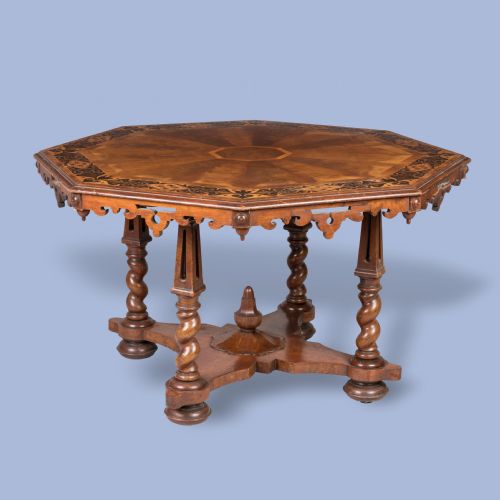
Structural elements frequently feature robust pedestal bases or turned legs finished with brass mounts and castors. These construction choices ensured stability for heavy timber tops while allowing the tables to be repositioned easily within a room.
An ingenious Victorian maker once decided a square room simply demanded eight corners instead of four.
Assessing quality and craftsmanship
Quality reveals itself in the precision of the timber selection and the crispness of any inlaid boxwood detailing. Superior examples demonstrate careful grain matching across the eight-sided top and secure joinery at the pedestal junction.
The sophistication of the turning on the central column and the presence of original brass fittings elevate certain pieces above standard utilitarian production. Cabinet work attributed to known workshops displays a higher degree of finish in concealed structural areas.
A Hindley & Sons·James Winter
The Octagonal Parlour Table Glossary
- Centre table
- A freestanding piece designed to be viewed from all sides rather than pushed against a wall. These typically occupy the middle of a Victorian parlour.
- Ebonised timber
- Wood treated with a chemical stain or pigment to imitate heavy ebony. This finish gained popularity during the Victorian era for its striking contrast with inlaid elements.
- Boxwood inlay
- Narrow strips of pale boxwood set flush into darker wood surfaces to create geometric or floral patterns. This decorative technique highlights the edges of table tops.
- Aesthetic Movement
- A late nineteenth-century design current that prioritised visual beauty over moral narrative. Furniture from this style often employs ebonised finishes and geometric clarity.
- Pedestal base
- A single central column supporting the table top, frequently resting on splayed feet. This design allows maximum legroom around the multi-sided top.
Octagonal Parlour Table: Frequently Asked Questions
Where should an octagonal parlour table go?
These tables function best in the middle of a room or positioned near a window where the eight-sided top can be appreciated from multiple angles. Their compact footprint makes them suitable as central display surfaces or generous side tables.
Ensure there is adequate circulation space around the multi-sided top so the piece can serve its original function as an accessible gathering point.
How do I date an octagonal parlour table?
Dating relies on identifying stylistic markers such as ebonised timber finishes from the late nineteenth century or lighter walnut and maple configurations from the Edwardian period. Examining the underlying construction methods and secondary timbers provides further chronological clues.
Comparative study of Victorian and Edwardian design catalogues helps narrow down the decade of manufacture for unmarked examples.
Were these tables used for dining?
Parlour tables were generally intended for display, holding decorative objects, books, or parlour games rather than heavy daily meals. Their multi-sided tops provided convenient access for people seated around them during social calls.
Using them for lighter domestic tasks preserves the delicate timber surfaces and inlaid details characteristic of the period.
How do I care for rosewood and mahogany?
Regular dusting with a dry, soft cloth prevents particulate accumulation on polished timber surfaces. Avoid placing these tables in direct sunlight or near heat sources to prevent the wood from drying out.
Occasional application of appropriate wax polish maintains the lustre of the grain without building up heavy residues over time.