
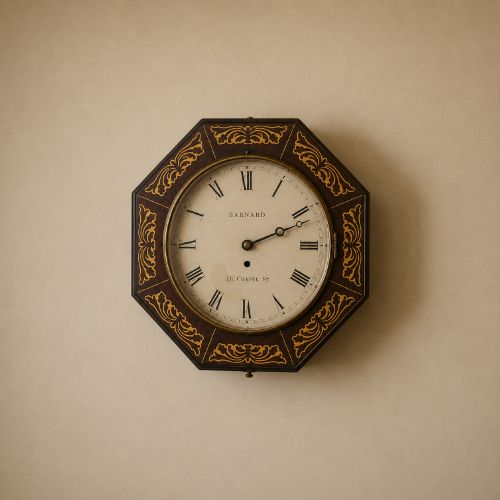


Octagonal Fusee Clock
An octagonal fusee clock brings precision timekeeping and architectural presence to a wall, combining clean geometric timber frames with reliable mechanical movements.
Octagonal Fusee Clock
An octagonal fusee clock is a wall timepiece distinguished by its eight-sided wooden surround and a single-fusee movement designed to equalise the pull of the mainspring. The examples on this page span the Regency and Victorian periods, taking the form of wall clocks and drop-dial variants that hang securely in domestic and public interiors.
Most pieces appear in rich woods such as mahogany and rosewood, frequently enhanced by brass inlay, mother-of-pearl, or tortoiseshell details. Makers based in London and regional towns such as Bridgwater, Frome, Bath, and London signed many of these dials, providing a direct link to nineteenth-century horology.
How they were made
Cabinetmakers constructed the distinctive octagonal surrounds from solid mahogany or rosewood, often applying veneers and intricate brass or mother-of-pearl inlay to catch the light. The cases house heavy brass movements driven by a fusee cone and chain or cord, which regulates the power delivery from the mainspring to ensure steady timekeeping.
Painted iron or brass dials sit behind bevelled glass within a hinged bezel, allowing access for winding and regulation. Selected pieces incorporate twin fusee trains to power a bell-striking mechanism, adding audible depth to the visual craft.
Some clocks bear inscriptions naming early owners, turning timepieces into personal historical records.
What varies in quality
The sophistication of the timber work and secondary materials sets examples apart, ranging from plain mahogany surrounds to richly figured rosewood inlaid with brass or mother-of-pearl. Finer pieces retain crisp moulding profiles on the octagonal frame and well-proportioned drop trunks that balance the dial above.
Movement quality is marked by the precision of the brass cutting, the condition of the fusee chain, and whether the dial bears a recognised regional or London maker signature. Original painted dials with clear lettering and untouched motion work carry distinct distinction over later replacements.
Barnard·Halliday & Rich·Kleyser of London·Webb of Frome·James Bell·J Fisher
The Octagonal Fusee Clock Glossary
- Fusee
- A conical pulley used in mechanical clocks to maintain an even drive force as the mainspring unwinds. This clever device compensates for the dropping tension of the spring.
- Drop-dial
- A wall clock featuring an extended wooden trunk beneath the main circular or octagonal dial. This drop often houses a pendulum or visual window.
- Bezel
- The brass or wooden ring that holds the glass protecting the clock face. It is typically hinged on one side to swing open for winding and hand setting.
- Twin fusee
- A movement incorporating two separate fusee mechanisms, one to drive the timekeeping train and another to power the striking train. Such setups often sound the hours on a bell.
Octagonal Fusee Clock: Frequently Asked Questions
How do I wind an octagonal fusee clock?
Use the appropriate winding key on the dial arbor, turning it gently until resistance indicates the mainspring is fully tensioned.
Take care not to overwind the movement, as this places unnecessary strain on the fusee chain and internal components.
Where should I hang a fusee wall clock?
Select a sturdy interior wall away from direct sunlight, dampness, and heavy vibrations from doors or traffic.
Secure the clock firmly to a wall plug or timber stud using the built-in hanging bracket to ensure the pendulum swings cleanly.
Why does my clock need to be in beat?
An even ticking sound ensures the escapement releases the gear train at regular intervals for accurate timekeeping.
Adjusting the crutch wire or mounting angle slightly helps achieve this balanced rhythm.
How do I tell Regency clocks from Victorian ones?
Regency pieces often display restrained mahogany cases with clean lines and understated brass mounts characteristic of the early nineteenth century.
Victorian models frequently embrace rosewood, more elaborate inlay work, and drop-dial proportions that emerged later in the period.