


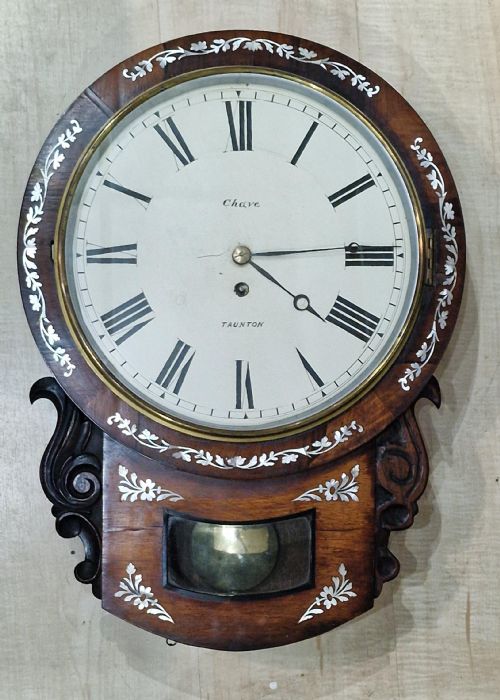


Mother of Pearl Inlay Clock
These mother of pearl inlay clock examples combine dark woods with iridescent shell, offering a striking focal point for a room.
Mother of Pearl Inlay Clock
When you search for a mother of pearl inlay clock, you look for timepieces that marry functional timekeeping with decorative shell work. These pieces span the Victorian and Georgian eras, reaching through the nineteenth century.
The most common formats on this page are drop-dial wall clocks and mantel clocks. They originate from English workshops and French makers, showing distinct regional tastes.
Rosewood and ebonised wood provide the dark grounds that make the iridescent shell catch the light. Drop-dial wall clocks dominate the selection, often housing reliable fusee movements.
Construction and materials
Cabinet makers utilised dense timbers like rosewood, mahogany, and ebonised wood to build robust cases. They hand-cut thin sections of mother of pearl shell to form intricate floral or geometric inlay patterns.
Metal wire inlay frequently accompanies the shell work, particularly on French pieces of the period. Dial surrounds feature brass bezels and glass covers protecting enamelled or silvered faces.
One London wall clock carries the specific inscription of J Fisher Esq, permanently tying the timepiece to its nineteenth-century owner.
Assessing quality and execution
Quality rests in the precision of the cabinet work and the tightness of the shell fitting into the timber. Better examples maintain every piece of mother of pearl without shrinkage cracks or clumsy replacement patches in the wood.
The sophistication of the movement dictates the standing of the clock, moving from standard timepieces to twin fusee or striking mechanisms. Signatures on dials or movements from documented makers elevate the piece further.
Henri Marc Of Paris·Walker And Hall·Savory And Fils A Paris·James Bell Bath
The Mother of Pearl Inlay Clock Glossary
- Fusee
- A conical pulley used in spring-driven clocks to equalise the force of the mainspring as it unwinds. This mechanism helps the clock maintain consistent timekeeping throughout its run.
- Drop-dial
- A clock case featuring a circular dial at the top and an extended trunk below to house the pendulum. This form became a staple of nineteenth-century offices, stations, and homes.
- Ebonised
- Wood treated with a dark finish to imitate expensive ebony. This technique provided a high-contrast background for mother of pearl inlay.
- Boulle
- A style of marquetry using brass and tortoiseshell, sometimes associated with French luxury clocks. Makers adapted these lavish decorative traditions for nineteenth-century wall and mantel pieces.
Mother of Pearl Inlay Clock: Frequently Asked Questions
What is a fusee movement?
A fusee movement uses a conical drum and a cord or chain to regulate the pull of the mainspring. This keeps the driving force steady as the spring winds down.
Clocks with this system generally offer superior timekeeping accuracy compared to simpler spring-driven alternatives.
How do I care for rosewood and shell?
Keep these clocks away from direct sunlight and steady sources of heat to prevent the wood from drying out. Sudden temperature shifts can cause the delicate mother of pearl inlay to lift.
Apply a light wax polish occasionally to nourish the timber and maintain the sheen of the dark case.
Where were drop-dial clocks used?
Drop-dial clocks suited domestic halls, public offices, and business premises during the nineteenth century. Their wall-mounted format kept them out of the way while remaining easy to read.
The extended lower case allowed the pendulum enough swing space while adding visual weight to the design.
How do I distinguish French and English clocks?
English examples often favour practical drop-dial wall formats with fusee movements by provincial makers. French pieces tend towards decorative mantel clocks or elaborate wall designs utilising brass wire alongside the shell.
Signatures on the dial or movement backplate often confirm the origin of the piece.