
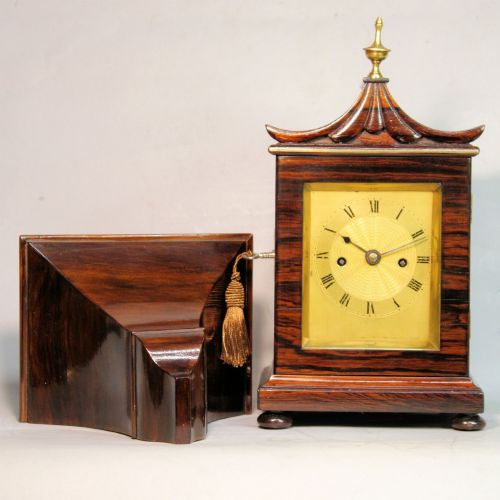


Victorian Rosewood Wall Clock
A victorian rosewood wall clock brings rich timber grain and reliable mechanical timekeeping into a room, spanning drop-dial and octagonal library forms.
Victorian Rosewood Wall Clock
When you search for a victorian rosewood wall clock, you encounter timepieces housed in dark, dense timber cases designed to hang securely in domestic or institutional settings. The selection includes drop-dial wall clocks, octagonal variants, and drum dial formats spanning the nineteenth century.
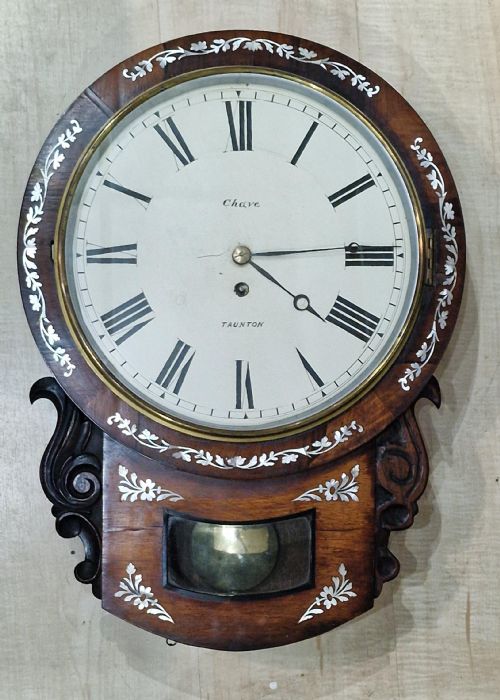
Drop-dial wall clocks dominate the offerings, often featuring inlaid decoration and brass or mother-of-pearl embellishment. You also find library clocks and fusee timepieces originating from English and French workshops during the eighteen-fifties through to the late Victorian era.
Materials and construction
Cases combine solid rosewood and rosewood veneer over secondary timbers, sometimes enhanced with boxwood stringing, brass inlay, or mother-of-pearl details. Dials sit behind protective glass held in brass bezels, while movements rely on iron and brass components.
Movements utilise fusee or double barrel mechanisms to regulate power delivery from the spring to the gear train. Dial surrounds take octagonal or circular shapes, frequently incorporating carved wooden elements or side viewing ears.
Listings feature nineteenth-century rosewood wall clocks utilising brass, glass, mother-of-pearl, iron, and boxwood materials across various regional English makers.
Craftsmanship and distinction
Quality rests in the crispness of the rosewood grain, the precision of the boxwood or brass inlay, and the original condition of the painted dial. Finer examples display careful cabinetmaking in the construction of the drop-dial trunk and side access doors.
The sophistication of the movement separates standard timepieces from superior ones, with single or twin fusee mechanisms representing higher mechanical achievement. Maker signatures inscribed on the dial or movement add historical weight to the piece.
Samuel Chave Taunton·Halliday & Rich Bridgwater·L Morris Islington·Kleyser of London·James Bell Bath
The Victorian Rosewood Wall Clock Glossary
- Fusee
- A conical pulley used in mechanical clocks to maintain an even pull as the mainspring unwinds. This mechanism ensures consistent timekeeping accuracy throughout the running cycle.
- Drop-dial
- A clock case design featuring a circular dial section at the top attached to a lower trunk or box. The lower portion often houses a pendulum and allows room for a longer drop.
- Mother-of-pearl
- An iridescent inner layer of mollusc shell utilised for decorative inlay on clock cases. It provides a contrasting shimmer against dark rosewood surfaces.
- Octagonal
- A geometric eight-sided shape forming the outer boundary of many clock dial surrounds. This style appears frequently across nineteenth-century wall timepieces.
Victorian Rosewood Wall Clock: Frequently Asked Questions
How do fusee movements work?
A fusee movement uses a conical pulley connected to the mainspring by a chain or cord. As the spring loses tension, the chain moves to a wider part of the cone to maintain steady force.
This clever mechanical design ensures the clock maintains consistent timekeeping accuracy from the moment of full wind until it runs down.
Where should I hang a drop dial clock?
Drop dial clocks require a sturdy wall with direct screw fixing into timber studs or solid masonry. Because the pendulum hangs within the lower trunk, stability prevents vibration from interfering with the beat.
Position the clock at eye level where you can easily access the side door for winding and pendulum adjustment.
How do I wind an antique wall clock?
Winding involves inserting a matching key into the winding hole on the dial face and turning it slowly until resistance indicates a full spring. Care must be taken not to overwind the mechanism.
Most fusee and double barrel movements require attention at regular weekly or eight-day intervals to keep the mechanism running continuously.
How can I tell a Victorian clock from a Regency one?
Regency wall clocks generally date from the early nineteenth century and favour restrained architectural lines with classical proportions. Victorian examples from the eighteen-fifties onward often incorporate richer inlay, mother-of-pearl, and bolder carved details.
Examining the movement construction, timber choice, and dial lettering style helps establish the likely production period.