
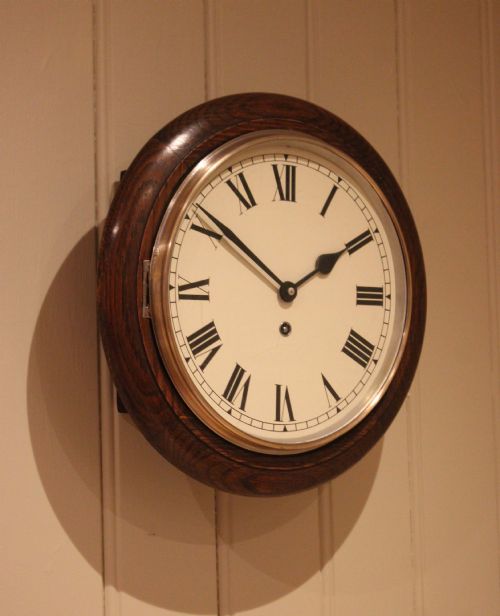


Dark Brown Wall Clock
A dark brown wall clock brings warmth and mechanical precision to a room, ranging from robust dial timepieces to intricately carved Alpine designs.
Dark Brown Wall Clock
When you search for a dark brown wall clock, you encounter timepieces spanning the Georgian, Victorian, and early twentieth-century periods, alongside regional European styles. These items range from simple school clocks to elaborate Black Forest carvings and precision regulators.
The most common examples on this page are timber-cased wall clocks featuring dial faces protected by glass and driven by weights, springs, or fusee movements. Mahogany and oak predominate, offering the deep brown tones typical of traditional domestic interiors.
Objects listed under this description also include wall barometers alongside standard timepieces, reflecting the historic overlap between household measurement instruments. Origins stretch from English workshops to German alpine carvers and Japanese export houses.
Materials and construction methods
Cases are constructed from hardwoods such as mahogany, oak, walnut, and rosewood, often shaped through traditional cabinetmaking techniques to house internal movements securely. Linden wood appears in regional carvings, while brass forms bezels, pendulum bobs, and delicate gear trains.
Dial faces incorporate painted wood, metal, or paper under glass covers, sometimes enhanced with bone inlay or intricate hand-carved motifs. Fusee and spring-driven mechanisms provide the reliable timekeeping required for daily domestic or institutional use.
Several clocks on this page maintain time well enough to have outlived multiple generations of pocket watches and wristwatches.
Distinctions in quality
Quality rests in the crispness of the timber carving and the architectural proportion of the case, where deeper colour and smoother grain elevate certain woods like mahogany and rosewood. Superior examples demonstrate meticulous joinery and well-preserved surface patination built up over decades.
Movement sophistication sets finer pieces apart, particularly fusee mechanisms and precision regulators designed for exact timekeeping rather than basic domestic utility. The integration of quality materials like brass bezels and bone details further marks out the better specimens.
John Wilson·Negretti and Zambra
The Dark Brown Wall Clock Glossary
- Fusee
- A conical pulley used in clock movements to equalize the declining pull of a mainspring as it unwinds. This mechanism ensures steady timekeeping throughout the power reserve.
- Dial clock
- A round-faced timepiece designed for wall mounting, common in schools, offices, and railway stations. These feature clear numerals and simple wooden surrounds.
- Regulator
- A high-precision clock designed for exact time measurement and used as a standard for setting other timepieces. They often feature long pendulum drops and refined dial layouts.
- Aneroid barometer
- An instrument that measures atmospheric pressure without using liquid, relying on a flexible metal box. These are frequently housed in matching wooden cases alongside traditional clocks.
- Drop dial
- A clock case design where the circular dial sits atop an extended wooden box that houses the pendulum. This style gained popularity during the Georgian and Victorian eras.
Dark Brown Wall Clock: Frequently Asked Questions
How do fusee movements work?
A fusee movement uses a conical drum and a cord or chain to maintain even tension from the mainspring as it runs down. This ingenious mechanical device prevents the loss of accuracy as the power diminishes.
Such mechanisms appear in better quality nineteenth-century wall clocks and require careful handling during winding to preserve the delicate brass teeth.
Where should I hang a heavy wooden clock?
Heavy timber clocks require secure fixing directly into wall studs or solid masonry using appropriate screws and rawlplugs. Hanging them from picture rails is generally unsuitable due to the substantial weight of mahogany or oak cases and moving pendulums.
Ensure the wall is flat so the case hangs plumb, which is essential for the escapement to beat evenly and keep correct time.
How do I date a Victorian wall clock?
Dating relies on examining the timber species, the style of the dial surround, and the construction of the movement inside the case. Victorian examples often utilise oak or mahogany with distinct regional design traits like drop dials or school clock configurations.
Maker signatures on the dial face or movement plates provide further clues for narrowing down the decade of production.