
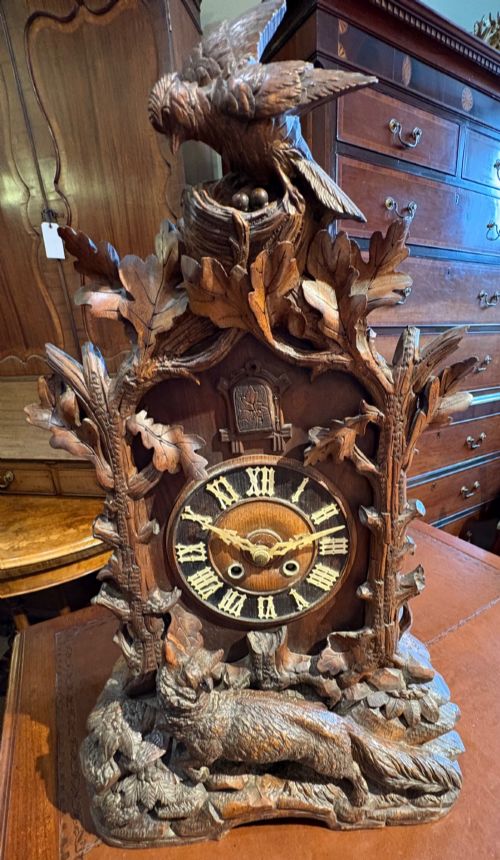
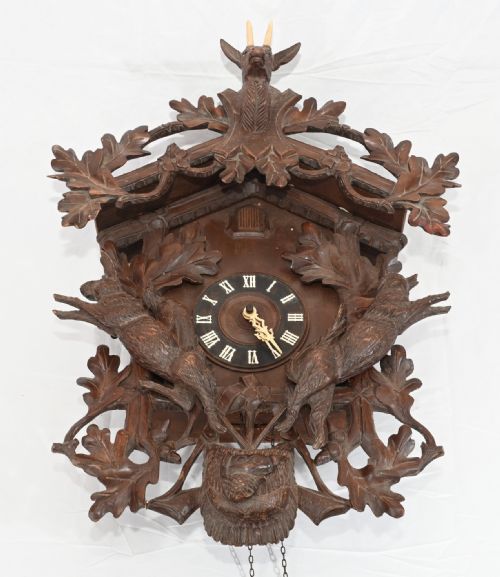


Hand Carved Wooden Clock
These hand carved wooden clock pieces bring Black Forest and Arts and Crafts character into a room through elaborate naturalistic detail.
Hand Carved Wooden Clock
A hand carved wooden clock brings sculptural presence to a room, drawing on the traditions of the Black Forest and the Arts and Crafts movement. Buyers looking at this page encounter mantel clocks and wall clocks shaped from walnut, linden wood, and oak.
Most examples date from the nineteenth century, including pieces from eighteen-fifty and eighteen-ninety alongside later Victorian and nineteen-twenty items. These timepieces range from traditional cuckoo clocks to large architectural mantel pieces in French Rococo and Baroque Revival styles.
How they were made
Carvers shaped these clocks from warm woods like walnut, linden wood, and oak, often cutting deep relief foliage and animal motifs directly into the timber. Craftsmen combined these carved wooden cases with brass movements, metal components, and glass faces.
Some dials incorporate delicate bone details to mark the hours against the dark wood background. The construction unites cabinetry with sculptural carving, creating robust wall clocks and substantial mantel pieces.
Listings span the nineteenth century, Victorian era, and nineteen-twenty, featuring walnut, linden wood, brass, and bone.
What varies in quality
Quality rests in the depth and ambition of the carving, moving from simple geometric borders to intricate naturalistic scenes with deep undercut foliage and figures. The crispness of the chisel work dictates how well the grain and texture catch the light across the case.
The integration of the movement into the wooden housing also separates standard production from finer workshop output. Better examples maintain harmonious proportions between the architectural case and the ornamental details.
Bergen & Co
The Hand Carved Wooden Clock Glossary
- Black Forest
- A regional style originating from Germany and Switzerland known for naturalistic wood carving. It frequently depicts foliage, birds, and forest animals.
- Linden wood
- A pale timber with a fine grain favoured by carvers for its even texture. It allows for intricate detail without splitting along the grain.
- Mantel clock
- A portable clock designed to sit on the shelf above a fireplace. These pieces rely on flat bases for stability.
- Rococo style
- An ornamental design approach characterised by asymmetry, scrollwork, and curved organic forms. It appears on several nineteenth-century clock cases.
Hand Carved Wooden Clock: Frequently Asked Questions
What styles do these clocks come in?
These clocks appear primarily in Black Forest designs, alongside French Rococo, Baroque Revival, and Arts and Crafts styles. They reflect nineteenth-century and early twentieth-century workshop traditions.
Carvings often feature natural motifs such as leaves, branches, and animals integrated into the wooden housing.
How were these wooden clocks used?
Owners placed them on mantelpieces or hung them on walls to serve as both timekeepers and decorative focal points in domestic rooms. Their sculptural wooden cases functioned as prominent interior ornaments.
Many incorporate mechanical movements designed for daily or weekly winding.
Which woods are most common?
Walnut, linden wood, and oak form the primary materials for these carved cases. These timbers provided the structural stability and softness required for detailed hand chiselling.
Makers selected them for their grain patterns and warm tones.
How do I identify the period?
Dating relies on stylistic markers such as nineteenth-century Black Forest carving techniques or later Arts and Crafts structural lines. Materials like brass dials, bone markers, and glass bezels also offer clues to the era of production.
Makers sometimes inscribed signatures or details on the wooden case or movement.