


Octagonal Dining Table
An octagonal dining table brings distinct geometric form to a room, offering social seating without the corners of a traditional oblong piece.
Octagonal Dining Table
The octagonal dining table appears across the nineteenth century and into the 1930s, often serving dual roles as a centre table or a breakfast table. These pieces emerge in styles ranging from early Victorian and William IV to Regency, Victorian, and Art Deco, reflecting shifting domestic habits over the decades. Walnut, mahogany, and oak dominate the large dining and centre forms, while smaller occasional pieces utilise these same timbers.
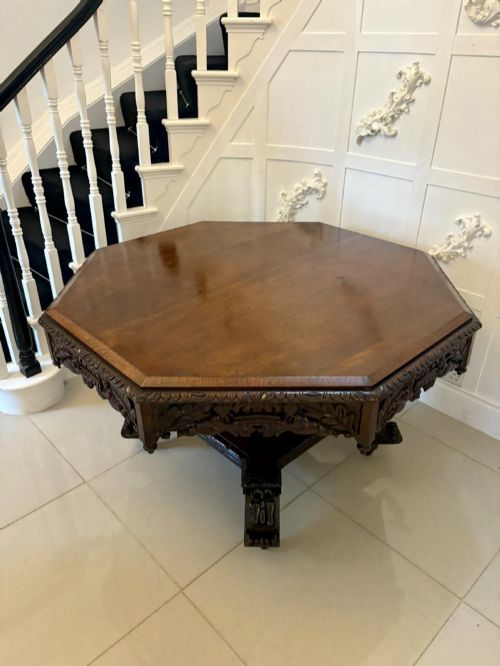
On this page, walnut and mahogany versions from the Victorian period predominate, frequently featuring substantial pillars and carved bases. Buyers also encounter heavier oak examples from the mid-nineteenth century, along with lighter Art Deco interpretations from the 1930s. The multi-sided format allows generous surface area while maintaining a compact visual footprint in the room.
Materials and Construction
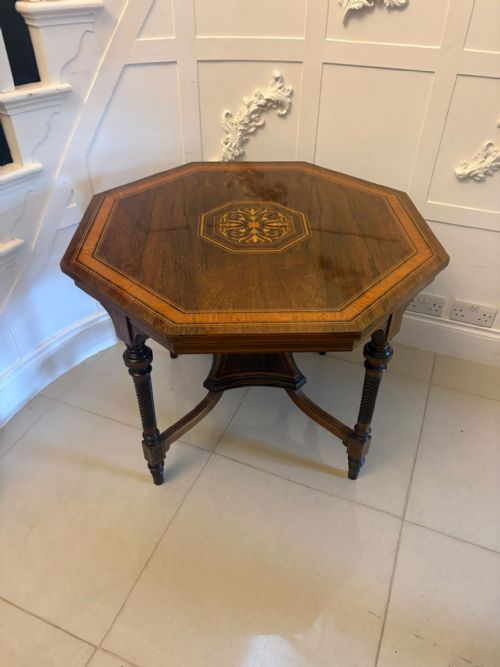
Makers built these tables primarily in solid mahogany, walnut, and oak, often applying figured veneers to the top surfaces to create visual depth. Marquetry inlay appears on select rosewood and walnut examples, introducing contrasting botanical or geometric motifs across the octagonal plane.
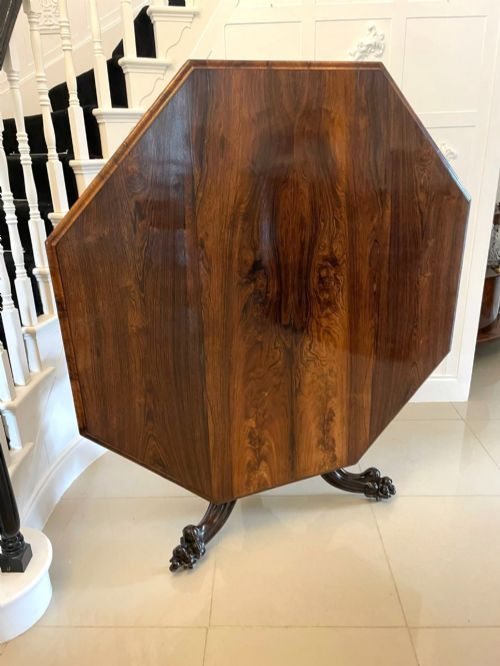
Support structures typically rely on a central turned or carved pillar resting on a platform base with castors, or four heavy legs. Tilt-top mechanisms occur on certain nineteenth-century examples, allowing the table surface to fold vertically when not in use.
Listings feature mahogany, walnut, and oak predominantly, spanning from the early nineteenth century through the 1930s.
Judging Quality
Quality separates in the selection of timber veneers and the crispness of the carved detail on the pillar and base. Superior tables exhibit continuous grain matching across the multi-sided top and deeply undercut carving on the frieze and legs.
The integrity of the central column and the weight of the base dictate structural stability, particularly on tilt-top variants. Finer workshops employed robust internal framing that prevents warping across the wide eight-sided span.
Gillows·Lamb Of Manchester·James Dixon & Sons·Elkinton & Co
The Octagonal Dining Table Glossary
- Centre table
- A freestanding piece designed to be viewed from all sides rather than pushed against a wall. These often share dimensions suitable for both display and dining.
- Tilt-top
- A mechanism allowing the table top to pivot to a vertical position for storage. This construction was common on nineteenth-century pillar tables.
- Marquetry
- Decorative inlay work using various coloured woods to form intricate patterns across the surface. It appears on finer walnut and rosewood tops.
- Frieze
- The horizontal band beneath the table top, which sometimes carries carving or moulding. On better pieces, this area displays detailed mythological or floral motifs.
Octagonal Dining Table: Frequently Asked Questions
How many people can sit at an octagonal dining table?
The eight-sided shape naturally distributes diners around the perimeter, often seating four to six people comfortably depending on the diameter.
The lack of sharp corners improves legroom and allows conversation to flow more evenly across the centre.
Can I use an octagonal centre table for everyday meals?
Many nineteenth-century examples functioned interchangeably as centre tables and dining surfaces, handling daily domestic use with ease.
Protecting the polished timber top with appropriate table pads preserves the French polished or waxed finish during dinner service.
How do I distinguish an early Victorian table from a later one?
Early Victorian and William IV pieces tend to feature heavy figured mahogany or rosewood with robust architectural pedestals.
Later Victorian examples frequently incorporate carved oak or walnut with more elaborate fretwork and applied mouldings around the frieze.
What is a tilt-top octagonal table?
A tilt-top table includes a hinged mechanism beneath the surface that allows the entire top to lock vertically against the pedestal.
This design enabled nineteenth-century households to clear floor space quickly when the table was not required for dining.