
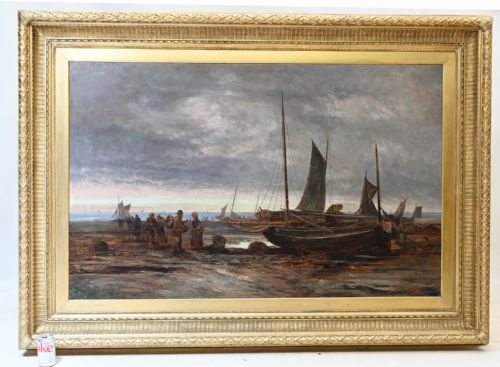


Norfolk Landscape Painting
A norfolk landscape painting captures the flat horizons, wide skies and winding waterways of the county through the eyes of local and visiting artists.
Norfolk Landscape Painting
A norfolk landscape painting typically depicts recognisable rural scenes, coastal villages, marshlands and river broads across the county. These works capture specific locations such as Cromer, Brancaster Staithe, Burnham Market and the Yare valley. Buyers look for these pieces to bring the distinct atmospheric light and topography of East Anglia into an interior.
The most common examples on this page are watercolours on paper and oil paintings on canvas or board. They range from small topographical studies to large framed maritime and rural compositions. The selection spans the nineteenth century through to post-war modernist interpretations.
Regional movements heavily influence these works, notably the Norwich School and subsequent generations of British impressionists. Painters recorded changing agricultural practices, vernacular architecture and traditional river craft before industrial shifts altered the terrain. Each piece offers a visual record of the county as it appeared to past observers.
Materials and Techniques
Artists worked primarily with watercolour pigment on paper or oil paint on canvas and board, framed beneath glass or within giltwood surrounds. Watercolour permitted rapid outdoor sketching to capture ephemeral effects of weather and tide, while oil paint allowed for richer textures and heavier impasto on larger surfaces.
Support materials varied according to the date and scale of the work, utilising card, wood panels and woven textiles prepared with traditional grounds. Pigments were applied with brushes and occasionally palette knives to render the characteristic flat horizons, water reflections and towering cumulus clouds of the region.
Several watercolours preserve the exact spot where artists stood to watch timber being loaded onto boats at remote marshland staithes.
Distinctions in Quality
Quality rests upon the artist's command of light, atmosphere and spatial depth within the flat terrain. Superior works capture the specific quality of East Anglian air and the movement of water without relying on formulaic compositions.
Execution and handling of the medium separate accomplished regional artists from amateur topographers. Stronger paintings demonstrate confident brushwork, a coherent palette and a sensitivity to scale that brings presence to modest rural subjects.
Sir Thomas Newenham Dean·Edward Seago·Frederick William Hattersley·John Edward Bale·Leslie Rackham·Charles Harmony Harrison·H E Tidmarsh·Stephen John Batchelder·George De Paris·John Joseph Cotman·Henry Bright·Joseph West·John Thirtle·Thomas Lound·William Burns·J Syer·J G Zobel·Mary Ellen Lee·John Reginald Goodman·Norman Ellis
The Norfolk Landscape Painting Glossary
- Norwich School
- A regional art movement of painters working in the nineteenth century inspired by the Norfolk landscape. It represents the first provincial art movement in Britain.
- Staithe
- A landing stage or small port along a river or broad. These locations frequently appear as focal points in local maritime and rural paintings.
- Windpump
- A traditional drainage mill used to pump water from the low-lying marshes. They form a characteristic architectural feature in regional landscape art.
- Giltwood
- Carved wood treated with a thin layer of gold leaf or metallic powder. Many nineteenth-century oil paintings retain their original frames finished in this material.
Norfolk Landscape Painting: Frequently Asked Questions
What subjects do these paintings show?
These works depict local landmarks, coastal scenes, marshlands, rivers and windmills across the county. Common subjects include the broads, coastal towns and agricultural valleys.
Artists focused on recording the specific topography and changing light conditions of the region. Many pieces document specific locations such as Cromer, Brancaster and the river Yare.
How should I frame and display a watercolour?
Watercolours require framing behind glass with acid-free mount board to protect the paper and pigments from atmospheric moisture and handling damage. Conservation-grade materials ensure the long-term stability of the work.
Display these paintings away from direct sunlight to prevent fading of the delicate water-soluble pigments. Stable indoor humidity helps preserve both the paper support and the antique frame.
How can I tell the period of a landscape?
Dating relies on stylistic clues, clothing in figures, architectural details and the specific materials used for the canvas or paper support. Nineteenth-century works often feature tighter brushwork and traditional varnishes.
Signatures, inscriptions on the reverse and framing styles offer further chronological indicators. Comparative study with documented works by known regional artists helps narrow down the date of creation.
Did these artists paint outdoors?
Many painters produced initial watercolours and sketches on location to capture direct observations of light and weather. These field studies often formed the basis for larger studio canvases.
Artists utilised portable sketching materials to record transient effects on the marshes and rivers. This practice allowed them to document the working life of staithes and mills with direct accuracy.