
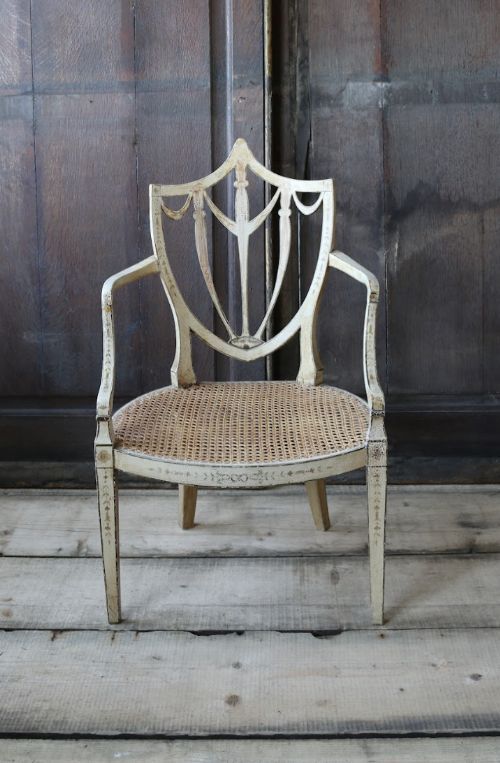


Neoclassical Painted Arm Chair
A neoclassical painted arm chair brings classical restraint and painted elegance into a room.
Neoclassical Painted Arm Chair
A neoclassical painted arm chair draws upon classical architectural motifs like fluted legs and shield backs, executed with a painted surface finish. These seats span periods from the eighteenth century through to the late nineteenth century, encompassing English and continental interpretations.
The versions most commonly met on this page include George III and Sheraton designs alongside French Louis XVI and Gustavian styles. They feature timber frames finished in paint, often combined with cane seating or upholstered pads.
Makers such as Gillows produced notable examples, while other pieces reflect regional British and continental workshops. Their forms range from open-arm elbow chairs to formal shield-back and fauteuil silhouettes.
How they were made
Makers shaped these frames primarily from beech and other hardwoods, constructing sturdy joinery to support upright backs and arm supports. Surfaces were then prepared and painted, sometimes incorporating parcel gilt details over the timber.
Upholstery and textiles were applied to seats and backs using traditional stuffing methods, while other variants utilised woven cane panels. Floral painted decorations and music motifs were applied by hand to embellish the painted wood structures.
The inventory spans the eighteenth and nineteenth centuries, including Georgian and Louis XVI styles.
What varies in quality
The refinement of the carved and painted decoration dictates much of the distinction between pieces, with crisp detailing on shields and fluting showing superior handwork. Original paint surfaces hold greater interest for collectors than later overpainting.
Structural integrity in the joints and the crispness of the timber turnery separate standard regional pieces from distinguished workshop productions. The retention of period textile coverings or appropriate historical upholstery methods also elevates an individual chair.
Gillows
The Neoclassical Painted Arm Chair Glossary
- Fauteuil
- An open-arm chair with upholstered back and seat, typically associated with French eighteenth-century design. These armchairs have exposed wooden frames rather than fully padded arms.
- Parcel gilt
- A decorative technique where small areas of gold leaf are applied over a painted or polished wooden surface. It highlights specific carved details on neoclassical frames.
- Gustavian
- The Swedish interpretation of French neoclassical style, characterised by lighter painted finishes and restrained classical carving. These chairs often display muted tones and simplified proportions.
Neoclassical Painted Arm Chair: Frequently Asked Questions
How do I identify a neoclassical painted arm chair?
Look for straight tapered legs, architectural motifs such as fluting, and painted wooden frames rather than dark polished mahogany. The overall silhouette tends to be rectilinear and balanced, drawing directly on classical antiquity.
Check for shield backs or open arms with upholstered pads, which are typical structural hallmarks of this group across both British and continental workshops.
Are these chairs comfortable for daily use?
Most of these chairs were designed for formal sitting rather than deep lounging, featuring upright backs and supportive armrests. Their comfort depends largely on the firmness and depth of the period-appropriate upholstery.
Many examples use cane seating or padded squabs that provide a firm seat suitable for occasional use at a desk or in a drawing room.
How should I care for original paint finishes?
Protect painted wooden surfaces from direct sunlight and excessive humidity to prevent flaking or fading of the decorative layer. Dust gently with a dry, soft cloth rather than using liquid polishes or chemical cleaners.
Treat the antique timber and paint with care, avoiding abrasive materials that can strip away original surface patination.
What is the difference between French and English styles here?
French pieces, such as Louis XVI fauteuils, often feature more rounded carved frames and integrated upholstery with decorative gilt highlights. English equivalents by makers like Sheraton lean towards geometric precision and shield-back geometries.
Gustavian pieces offer a distinct Scandinavian take, combining French neoclassical elegance with simpler, lighter painted palettes.