
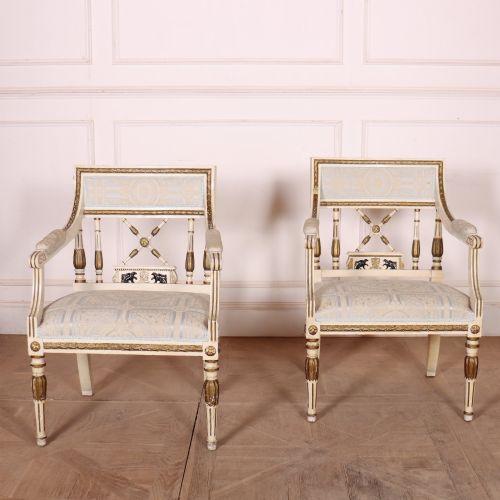
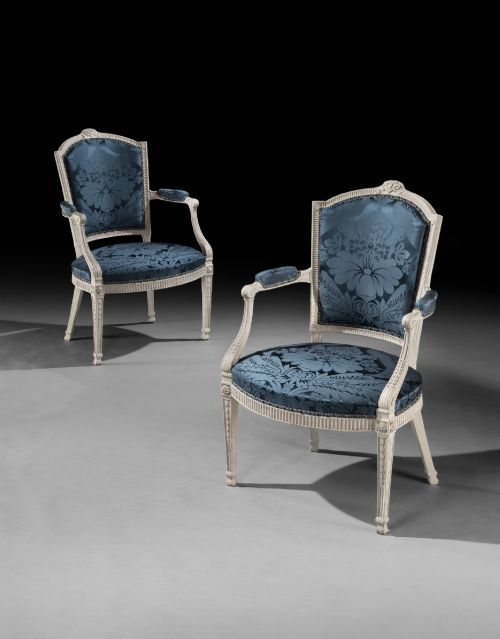
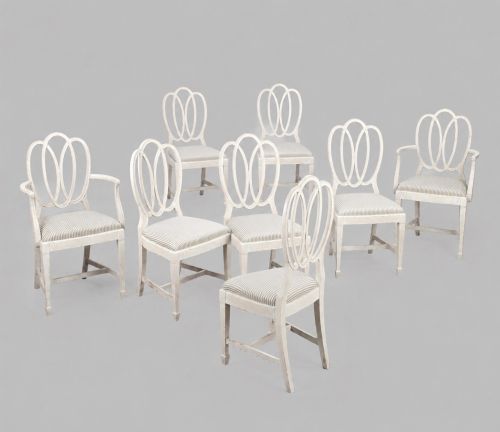
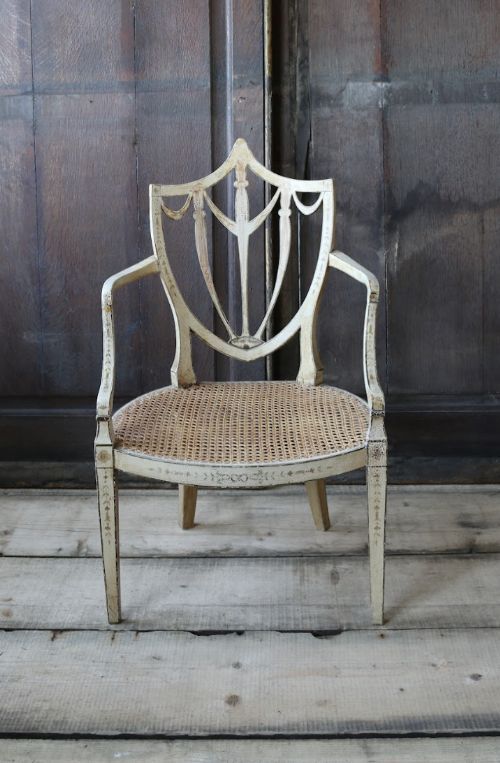


Painted Neoclassical Carver
A painted neoclassical carver is an armchair of architectural line and hand-painted finish that brings refined symmetry and colour to a formal interior.
Painted Neoclassical Carver
A painted neoclassical carver represents a fusion of classical restraint and decorative painted surfaces, typically appearing as an armchair or elbow chair designed with an open frame. These seating forms draw upon eighteenth-century George III, Sheraton, and Hepplewhite idioms alongside later Swedish Empire, French Directoire, and Gustavian revivals spanning the nineteenth and early twentieth centuries.
The silhouettes on this page range from late eighteenth-century shield-back and upholstered armchairs to later pairs and sets created in revival decades up to nineteen thirty. Origins encompass English workshops like Gillows as well as continental Scandinavian and French traditions, often featuring parcel gilt highlights or polychrome floral decoration upon painted wood.
Buyers encountering these armchairs will notice distinct structural variations, from open armchairs with cane seats to fully upholstered dining chairs and elbow chairs with music motifs. The overarching character remains grounded in neoclassical symmetry, straight or tapered legs, and decorative paint schemes rather than heavy carved mahogany.
Materials and construction methods
Construction relies primarily on painted timber, wood, and giltwood, forming the structural frame of each armchair before the application of decorative paint or parcel gilt layers. Artisans shaped these components using traditional joinery to support upright backs, open arms, and straight or tapered legs.
Surface ornamentation is achieved through direct application of paint, polychrome decoration, and textile or fabric upholstery, occasionally incorporating cane panels for lightness. The integration of paint and parcel gilt accents reflects both eighteenth-century practices and later revival techniques.
One cheerful elbow chair arrives complete with integrated music painted right onto the wood.
Distinctions in craftsmanship and finish
Quality in a painted neoclassical carver rests upon the crispness of the original form and the preservation of its painted or parcel gilt surface. Fine examples exhibit harmonious proportions, delicate floral or architectural painted decoration, and integrated structural joinery that withstands centuries of use.
Lesser or later revival pieces often display heavier framing, simplified paint application, or surfaces that have undergone multiple overpaintings. The distinction between an eighteenth-century original and a later twentieth-century revival lies in the handling of the wood, the depth of the polychrome work, and the integrity of the underlying frame.
Gillows
The Painted Neoclassical Carver Glossary
- Carver
- An armchair, usually designed with open arms to sit at the head of a dining table or function as a parlour chair. These pieces match or complement smaller side chairs in a set.
- Neoclassical
- A style spanning the mid-eighteenth through early nineteenth centuries that revived classical Greek and Roman motifs such as urns, swags, fluting, and strict geometric symmetry.
- Parcel Gilt
- A decorative technique where specific raised details, carvings, or mouldings are partially gilded with gold leaf while the rest of the surface is painted or left plain.
- Gustavian
- The Swedish interpretation of Louis XVI and neoclassical styles, characterised by pale painted finishes, restrained carving, and functional elegance.
- Polychrome
- Decorated or executed in several colours, frequently applied to eighteenth-century chair frames in floral or pastoral motifs.
Painted Neoclassical Carver: Frequently Asked Questions
What is a painted neoclassical carver?
A painted neoclassical carver is an armchair featuring symmetrical lines, classical motifs, and a painted or parcel gilt wooden frame. These chairs date from the eighteenth century through to twentieth-century revivals.
They serve as statement seating in dining rooms and drawing rooms, combining architectural restraint with decorative surface finishes like polychrome florals.
How do I date a painted armchair?
Dating relies on examining the timber construction, joinery techniques, and the wear beneath the painted surface. Eighteenth-century pieces often show specific hand-tool marks and period upholstery methods.
Later nineteenth and twentieth-century revivals, such as Swedish Empire or Gustavian style pieces, utilise similar decorative schemes but carry structural traits typical of their actual production era.
Where should I place these armchairs?
These armchairs suit formal dining spaces as host chairs or accent placement in sitting rooms and hallways. Their open frames and painted finishes prevent them from feeling visually heavy in a room.
Pairing them with neutral walls allows the polychrome decoration and parcel gilt highlights to stand out without overwhelming the surrounding interior.
What is the difference between Gustavian and Sheraton styles?
Sheraton style originates in late eighteenth-century England, featuring refined neoclassical geometry, satinwood or painted finishes, and delicate proportions. Gustavian style reflects Swedish adaptations of French neoclassical design, known for pale monochrome or muted painted surfaces.
Both styles emphasise light, elegant frames and classical motifs, though their regional cabinet-making traditions create subtle variations in silhouette.